 By
By 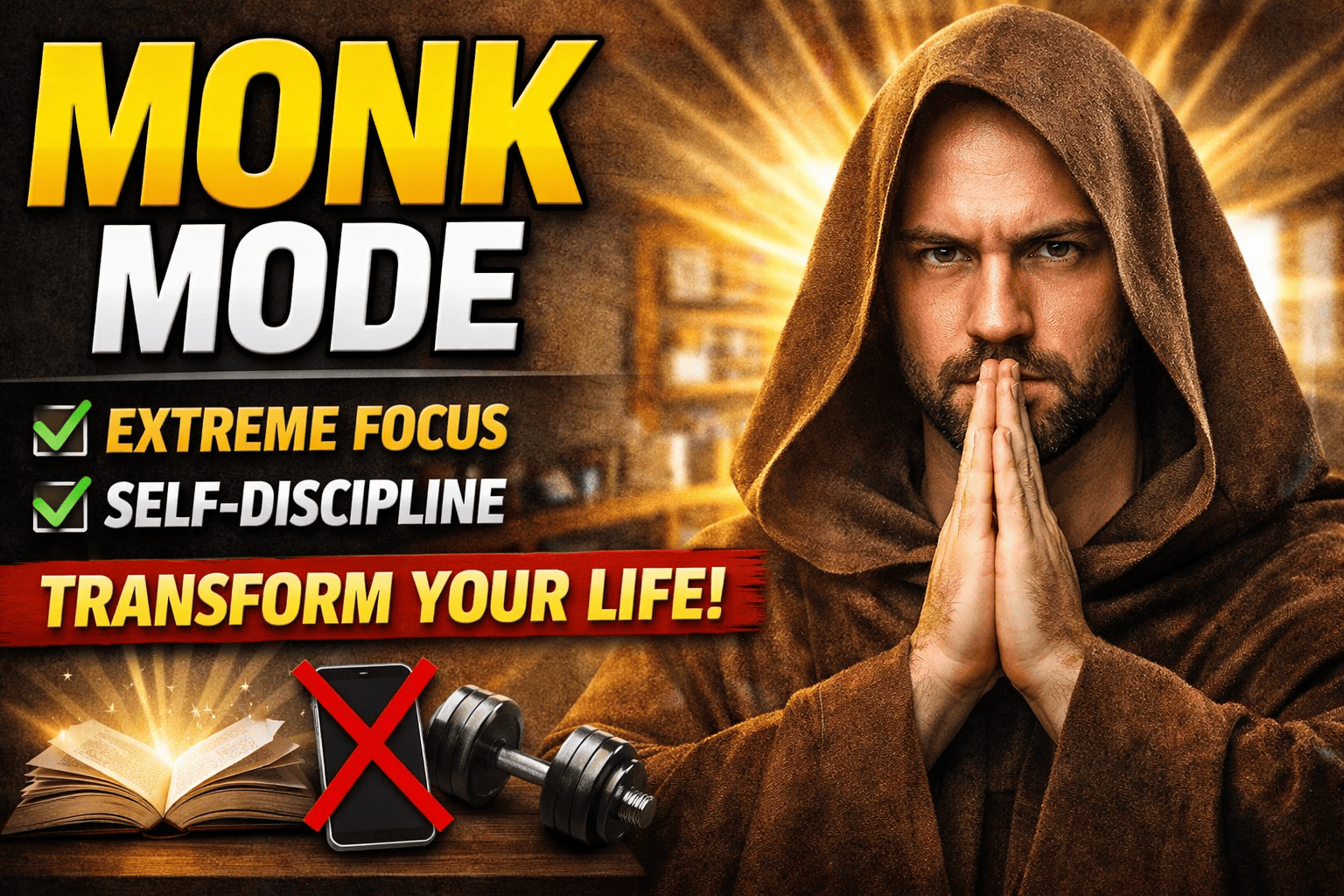
We are living in an attention economy. Every notification, every buzz in your pocket, and every algorithmic social media feed is meticulously engineered by some of the smartest minds on the planet to do one thing: steal your focus. We are constantly connected, perpetually available, and chronically distracted.
As a result, our ability to engage in deep, meaningful work has plummeted. We multitask our way through the day, mistaking motion for progress, and end up feeling exhausted yet unaccomplished. If you feel like your goals are constantly slipping through your fingers because you simply cannot maintain the discipline required to achieve them, you are not alone.
The antidote to this modern crisis of distraction is a concept that has surged in popularity among high-achievers, entrepreneurs, and creatives. It is a period of radical focus, discipline, and intentional isolation.
It is called Monk Mode.
In this comprehensive guide, we will dive deep into exactly what Monk Mode is, the science behind why it is so effective, and a step-by-step framework on how to get into Monk Mode and completely transform your life.
What is Monk Mode?
At its core, Monk Mode is a period of extreme, unapologetic focus dedicated to achieving a specific goal. It involves temporarily withdrawing from the distractions of everyday life—socializing, social media, entertainment, and sometimes even dating—to dedicate all your mental, physical, and emotional resources to a singular pursuit.
The term borrows from the lifestyle of traditional monks, who retreat from secular society to dedicate themselves entirely to spiritual growth. However, modern Monk Mode is not about taking a lifelong vow of silence or moving to a monastery in the mountains. Instead, it is a strategic, temporary “season” of your life designed to foster hyper-productivity and rapid personal or professional growth.
Think of it as a software update for your brain. You are shutting down all unnecessary background applications to allocate 100% of your processing power to the primary task at hand.
The Difference Between Monk Mode and Standard Productivity
Standard productivity hacks teach you how to organize your to-do list, manage your inbox, or use a Pomodoro timer while still living your normal life.
Monk Mode is a paradigm shift. It is not about managing distractions; it is about completely eliminating them from your environment. It is a holistic lifestyle change that dictates how you eat, sleep, work, and interact with the world for a set period.
The Core Pillars of Monk Mode
To truly understand how to get into Monk Mode, you must first understand the three fundamental pillars that uphold the practice:
1. Radical Elimination (The “Monk” Aspect)
You cannot achieve extraordinary focus in an environment filled with ordinary distractions. The first pillar is ruthless elimination. This means cutting out the “junk food” of modern life: endless scrolling, binge-watching television, excessive video gaming, and frivolous social outings. It requires saying “no” to almost everything so you can say “yes” to your one big goal.
2. Singular Focus (The “Work” Aspect)
In Monk Mode, multitasking is a sin. This pillar is heavily inspired by author Cal Newport’s concept of “Deep Work”—the ability to focus without distraction on a cognitively demanding task. You channel the time and energy reclaimed from distractions directly into your primary objective, whether that is building a business, studying for a crucial exam, getting into peak physical shape, or writing a book.
3. Disciplined Routines (The “Foundation” Aspect)
Motivation is fleeting; discipline is permanent. Monk Mode relies heavily on strict, non-negotiable daily routines. By automating when you wake up, when you work, when you exercise, and when you sleep, you remove decision fatigue. Your day becomes a highly optimized system.
Why You Need Monk Mode: The Science and Benefits
Committing to a period of intense restriction might sound daunting, even punishing. So, why do so many successful people swear by it? The benefits of Monk Mode extend far beyond simple time management; it actively alters your brain chemistry and psychological baseline.
Resetting Your Dopamine Baseline
Every time you check your phone, eat junk food, or watch a short-form video, your brain releases a spike of dopamine—a neurotransmitter associated with pleasure and reward. Over time, constant overstimulation causes your dopamine baseline to drop. You require more extreme stimuli to feel normal, making everyday tasks like reading or working feel painfully boring.
Monk Mode acts as a dopamine detox. By starving your brain of cheap, instant gratification, your dopamine receptors upregulate. Suddenly, the “boring” work required to achieve your goals becomes stimulating and rewarding again.
Reaching Flow State Easier
“Flow” is a psychological state where you are so immersed in an activity that you lose a sense of time and self. It is the ultimate state of human performance. However, research shows it takes an average of 23 minutes to regain deep focus after an interruption. In a normal environment, you are interrupted constantly, meaning you rarely enter flow. Monk Mode creates an impenetrable bubble around your work, allowing you to access and maintain flow states for hours at a time.
Accelerated Skill Acquisition
Because you are dedicating massive blocks of uninterrupted time to a specific pursuit, the speed at which you learn and progress is exponential. What might take a normal person a year to achieve can often be accomplished in a 90-day Monk Mode sprint simply due to the sheer volume of deep practice.
Mental Clarity and Reduced Anxiety
The constant influx of information from the news and social media keeps our nervous systems in a state of low-grade fight-or-flight. Stepping away from the digital noise during Monk Mode leads to a profound sense of mental clarity. Anxiety drops, brain fog lifts, and you gain a deeper understanding of who you are and what you truly want out of life.

How to Get Into Monk Mode: A Step-by-Step Guide
Monk Mode is not something you casually decide to do on a Tuesday afternoon. It requires intentional planning and strict parameters. If you do not set clear rules, you will inevitably fall back into old habits. Here is the definitive, step-by-step guide on how to get into Monk Mode.
Step 1: Define Your “Why” (The Ultimate Goal)
Before you isolate yourself, you must know exactly what you are fighting for. If your goal is vague (“I want to be more productive” or “I want to make money”), you will quit when it gets hard.
Your goal must be highly specific, measurable, and deeply meaningful to you.
- Weak Goal: I want to get fit.
- Monk Mode Goal: I will follow a strict macro-diet and train six days a week to drop 15 pounds of body fat and run a 10k in under 50 minutes.
- Weak Goal: I want to start a side hustle.
- Monk Mode Goal: I will spend four hours every single day building my freelance copywriting portfolio and pitching 10 clients daily until I secure $3,000 in monthly recurring revenue.
Write this goal down. Put it on your bathroom mirror, set it as your phone wallpaper, and look at it every morning. This is your North Star.
Step 2: Set the Duration (The Timeframe)
Monk Mode is a sprint, not a marathon. Human beings cannot sustain intense isolation and output indefinitely without burning out. You need a clear start and end date.
Common Monk Mode durations include:
- 21 Days: Great for beginners to build discipline and kickstart momentum.
- 30 Days: A solid block to complete a medium-sized project or establish profound new habits.
- 90 Days (The Gold Standard): Three months is the sweet spot. It is long enough to completely change your life, build a business, or transform your physique, but short enough to see the light at the end of the tunnel.
- 6 Months: Reserved for veterans dealing with massive, life-altering projects.
Choose a duration that challenges you but is ultimately realistic for your current life circumstances.
Step 3: Establish Your Protocol (The Rules)
This is the most crucial step in learning how to get into Monk Mode. You must define your non-negotiables—the daily habits you must perform, and the vices you must avoid.
A successful Monk Mode protocol usually consists of two categories: The Eliminations and The Additions.
The Eliminations (What you will NOT do): You must tailor this to your specific weaknesses, but standard eliminations include:
- No alcohol or recreational drugs.
- No social media scrolling (Instagram, TikTok, X, etc.). Use website blockers if necessary.
- No video games.
- No binge-watching Netflix, YouTube, or television.
- No junk food or excessive sugar.
- No unnecessary social outings (parties, casual hangouts).
The Additions (What you WILL do): These are the daily non-negotiables that keep you grounded, healthy, and moving toward your goal.
- Deep Work: A minimum of 2 to 4 hours of uninterrupted, focused work on your primary goal.
- Physical Exercise: At least 30 to 45 minutes of movement daily (weightlifting, running, yoga). A healthy body fuels a focused mind.
- Meditation/Mindfulness: 10 to 20 minutes a day to train your attention span and manage stress.
- Strict Sleep Schedule: Going to bed and waking up at the exact same time every day to optimize circadian rhythms.
- Clean Diet: Eating whole, unprocessed foods to prevent energy crashes and brain fog.
Step 4: Redesign Your Environment
Willpower is a finite resource. If you have to constantly fight the urge to check your phone or eat a cookie, you will eventually lose. You must design your environment so that failing is difficult and succeeding is easy.
- Digital Environment: Delete distracting apps off your phone. Log out of accounts on your computer. Install website blockers like Freedom or Cold Turkey. Put your phone in another room while you are doing your deep work.
- Physical Environment: Clear your workspace of clutter. Throw away the junk food in your pantry. Set out your gym clothes the night before.
Step 5: Inform Your Inner Circle
Going off the grid without warning will cause the people who care about you to worry, and it can damage relationships.
Have a transparent conversation with your family, close friends, or partner. Explain what you are doing, why it is important to you, and how long it will last. Say something like: “For the next 60 days, I am going into intense focus mode to build my business. I won’t be coming out to the bars on weekends, and I might be slow to reply to texts. I appreciate your support and promise to catch up properly when this sprint is over.”
Most people will respect your dedication. Those who try to drag you down are revealing themselves as distractions you need to distance yourself from anyway.
Common Monk Mode Templates (Find Your Fit)
If you are unsure where to start, you can adopt one of these common Monk Mode archetypes tailored to specific life goals:
The Entrepreneur’s Sprint
Goal: Launch a business, scale revenue, or finish a major product.
- Focus: 4+ hours of deep work dedicated solely to business building.
- Elimination: All social media, all social events, alcohol.
- Addition: Daily exercise to manage stress, reading 10 pages of a business/mindset book daily.
The Student’s Grind
Goal: Ace final exams, pass the bar, or finish a thesis.
- Focus: 6+ hours of structured study using the Pomodoro technique.
- Elimination: Video games, parties, streaming services.
- Addition: Strict 8 hours of sleep for memory consolidation, high-protein/brain-food diet, walking outdoors for 30 minutes to clear the mind.
The Wellness Reset
Goal: Overcome a period of depression, break bad habits, or achieve peak physical health.
- Focus: 2 hours of physical training, meal prep, and personal development.
- Elimination: Junk food, sugar, alcohol, toxic social circles, negative news consumption.
- Addition: Daily journaling, daily meditation, strict macronutrient tracking, getting morning sunlight.
Navigating the Challenges of Monk Mode
Knowing how to get into Monk Mode is only half the battle; staying in it is where the real test begins. You will face significant psychological resistance. Here is how to handle the inevitable hurdles.
Dealing with FOMO (Fear Of Missing Out)
Around week two, the novelty will wear off, and FOMO will hit hard. You will see friends posting about vacations or parties, and you will feel isolated. The Fix: Remind yourself of the pain of staying exactly where you are. The parties will still be there in 90 days. But the time you have right now to change your life will not. Reframe FOMO into JOMO—the Joy Of Missing Out, knowing you are building a superior future.
Managing Burnout
Because Monk Mode is intense, the risk of burnout is real. If you try to work 12 hours a day while starving yourself of all dopamine, your brain will rebel. The Fix: Do not confuse Monk Mode with toxic hustle culture. Sleep is mandatory. Exercise is mandatory. True downtime (like going for a walk in nature without a podcast, or reading fiction) is vital to let your subconscious mind process information.
What to Do When You Slip Up
You are human. You might accidentally eat a donut, cave in and scroll Instagram for an hour, or skip a workout. The Fix: Do not let a flat tire ruin the whole car. The biggest mistake people make is adopting an “all or nothing” mentality. If you break a rule, forgive yourself immediately, analyze why it happened (was your phone too close to your desk?), and seamlessly restart the protocol the very next minute. Do not wait for Monday to start again.
Tools and Tech to Support Your Journey
While Monk Mode is about disconnecting, strategic technology can actually enforce your boundaries.
- Website and App Blockers: * Freedom: Blocks internet access, specific websites, or apps across all your devices simultaneously.
- Cold Turkey: An aggressive blocker for desktop that is nearly impossible to bypass once a timer is set.
- Opal: Excellent for mobile devices to lock down distracting apps during specific hours.
- Focus Timers: * Forest: A gamified Pomodoro timer. You plant a virtual tree, and if you leave the app to check your phone, the tree dies.
- Habit Trackers: * Use a physical wall calendar and a red marker. Cross off every day you successfully stick to your protocol (the “Don’t Break the Chain” method popularized by Jerry Seinfeld).
- Apps like Habitica or Strides can digitize this process.
Life After Monk Mode: Transitioning Back
The day your Monk Mode protocol ends, you will likely feel a massive sense of accomplishment. However, the period immediately following is a danger zone. Many people experience a “rebound effect,” where they binge on junk food, social media, and laziness as a reward. This destroys the new baseline you just worked so hard to establish.
The Re-entry Phase
Do not end Monk Mode abruptly. Gradually reintroduce elements back into your life over a period of a week or two.
- Evaluate: What habits from Monk Mode made you feel incredible? (e.g., waking up early, daily meditation). Keep those permanently.
- Moderate: Slowly reintroduce social activities, but maintain boundaries. You might decide you only want to use social media for 30 minutes a day going forward, rather than cutting it out completely.
- Celebrate Responsibly: Reward yourself for finishing the sprint, but do so in a way that aligns with your new identity—buy yourself a nice dinner, take a weekend trip, or purchase gear related to your newly acquired skills.
Frequently Asked Questions (FAQs) About Monk Mode
Is Monk Mode healthy?
Yes, when done correctly. Cutting out excessive screen time, junk food, and alcohol while prioritizing sleep, exercise, and deep work is incredibly beneficial for both physical and mental health. However, if taken to an extreme (e.g., completely isolating yourself to the point of severe loneliness, or neglecting sleep to work 16 hours a day), it can be detrimental. Balance and basic self-care are essential.
Can I do Monk Mode if I have a 9-to-5 job or kids?
Absolutely. Monk Mode is highly customizable. If you have a family or a full-time job, you cannot vanish into a cave. Instead, your Monk Mode might look like waking up two hours before your family to write your book, cutting out all television in the evenings, and strictly meal-prepping on Sundays. It is about maximizing your available free time and eliminating your specific time-wasters.
How long should Monk Mode last?
There is no universal rule, but 21 to 90 days is the standard recommendation. Less than 21 days is usually not enough time to break old habits and see profound results. More than 90 days can lead to social isolation and burnout. You can do multiple Monk Mode sprints throughout a year, with “maintenance phases” in between.
Is Monk Mode the same as a dopamine detox?
They are closely related, but not exactly the same. A dopamine detox focuses primarily on starving the brain of cheap stimulation to reset neurotransmitter baselines. Monk Mode includes a dopamine detox, but it goes a step further by actively redirecting that reclaimed energy into highly structured routines and a specific, ambitious goal.
Conclusion
In a world where everyone is distracted, the ability to focus is a superpower. Learning what Monk Mode is and how to get into Monk Mode is about taking back control of your attention, your time, and ultimately, your life’s trajectory.
It will not be easy. You will face boredom, frustration, and the temptation to quit. But on the other side of that discomfort lies immense pride, monumental progress toward your goals, and a version of yourself you previously only dreamed of becoming.
Stop letting your potential slip away in three-second video increments. Define your goal, set your rules, eliminate the noise, and get to work. Your future self is waiting.
Related articles :
- How to Become More Intelligent Than 99% of People: A Complete Guide to Cognitive Mastery
- How to Speak Like the Richest 1%: Master the Language of High-Net-Worth Individuals
- How to Grow Any Business Faster: 10 Proven Strategies for Scalable Success
- 7 Principles for Teenagers to Become Millionaires
- Beginner’s Guide to Dropshipping in 2026