 By
By 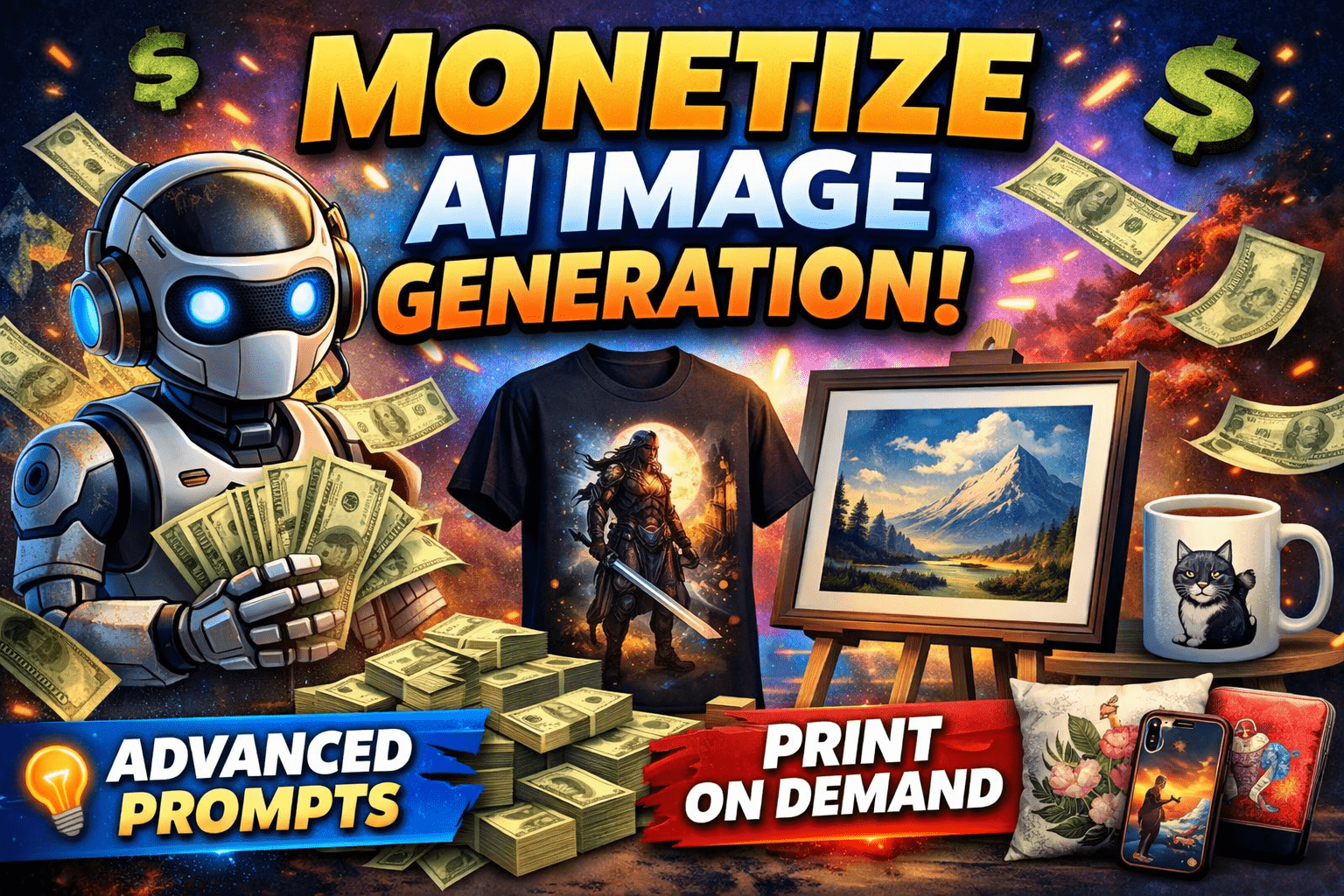
The digital landscape is undergoing a visual revolution. Artificial Intelligence is no longer just processing data or writing text; it is generating breathtaking, hyper-realistic, and highly stylized imagery in seconds. For entrepreneurs, creators, and digital hustlers looking to make money online, AI image generation represents an unprecedented opportunity to build scalable income streams without needing a traditional background in fine art or graphic design.
However, the barrier to entry has lowered, which means the market is becoming saturated with low-effort generation. To truly stand out and build a profitable business, you need a strategy. You must move beyond simply typing basic requests into an engine and hoping for a masterpiece. Success in this space requires mastering the tools, understanding the nuances of commercial rights, identifying hungry niches, and applying solid digital marketing and SEO principles to get your products in front of buyers.
This comprehensive guide will walk you through exactly how to monetize AI image generation. We will cover the entire pipeline, from mastering advanced prompt engineering to launching a fully-fledged Print-on-Demand (POD) empire, and exploring alternative monetization avenues like digital products and freelance services.
Understanding the AI Image Generation Ecosystem
Before you can monetize, you must master the machinery. The current ecosystem is dominated by a few powerhouse models, each with distinct advantages, learning curves, and commercial use policies.
The Big Three: Midjourney, DALL-E 3, and Stable Diffusion
To build a sustainable business, you need reliable tools. Here is a breakdown of the primary engines you will use to generate monetizable assets.
1. Midjourney Currently operating through Discord (and gradually rolling out a web interface), Midjourney is widely considered the gold standard for artistic, highly aesthetic, and cinematic imagery. It excels at rendering lighting, textures, and stylized art.
- Best For: Print-on-demand designs, concept art, fantasy illustrations, and highly stylized digital products.
- Monetization Note: You must have a paid Midjourney subscription to own the commercial rights to the images you generate. Free tier images cannot be legally monetized.
2. DALL-E 3 (via ChatGPT Plus or API) OpenAI’s DALL-E 3 is unmatched in its semantic understanding. It follows complex, multi-layered instructions exceptionally well and can accurately render legible text within images—a massive advantage over competitors.
- Best For: Logos, typography-heavy designs, comic book panels, and specific editorial illustrations.
- Monetization Note: OpenAI allows users full commercial rights to the images generated with DALL-E 3, making it highly versatile for business applications.
3. Stable Diffusion Unlike Midjourney or DALL-E, Stable Diffusion is an open-source model. It can be run locally on your own hardware (if you have a powerful GPU) or through various cloud-based interfaces. It offers the highest level of control through tools like ControlNet, allowing you to dictate exact poses, compositions, and lighting.
- Best For: Consistent character design, highly specific custom client work, and users who want zero recurring subscription fees (if running locally).
- Monetization Note: The base model is open-source and free for commercial use, but you must check the specific licensing of any custom “checkpoints” or “LoRAs” (fine-tuned models) you download from communities like Civitai.
Navigating Copyright and Legalities
The legal landscape of AI art is still evolving. Currently, the US Copyright Office states that purely AI-generated images cannot be copyrighted because they lack “human authorship.” However, you can still commercialize them.
To protect your business:
- Always ensure you have commercial rights via your tool’s terms of service.
- Avoid generating images of trademarked characters (e.g., Mickey Mouse) or specific, living celebrities. Selling recognizable IP will result in platform bans and potential legal action.
- Transform your AI art. Add your own typography, composite multiple images, or use AI as a base layer for your own digital painting. The more human effort you add, the stronger your claim to the final product.
Mastering the Art of Advanced Prompt Engineering
To monetize AI, you must first master the input. A prompt is not just a description; it is a string of code that directs the AI’s neural network. Advanced prompt engineering is the foundation of high-quality, monetizable output.
The Anatomy of an Advanced Prompt
Amateur prompters type: “A cute cat in space.”
Professional prompters use a structured formula to guarantee consistent, high-fidelity results. A strong prompt typically includes:
- Subject: The core focus (e.g., A Maine Coon cat astronaut).
- Action/Setting: What is happening and where (e.g., floating inside a futuristic space station illuminated by neon blue lights).
- Medium/Style: The artistic approach (e.g., 3D render, oil painting, vector illustration, hyper-realistic photography).
- Lighting: The mood of the light (e.g., cinematic lighting, volumetric rays, rim lighting, golden hour).
- Camera/Technical Details: Lens types and rendering engines (e.g., shot on 35mm lens, f/1.8, Unreal Engine 5 render, 8k resolution, highly detailed).
Example of an Advanced Prompt:
A majestic Maine Coon cat wearing a high-tech astronaut suit, floating inside a futuristic space station. Illuminated by neon blue and magenta ambient lights. Cinematic lighting, volumetric rays shining through a porthole. Hyper-realistic photography, shot on 35mm lens, f/1.8, 8k resolution, hyper-detailed, photorealistic –ar 16:9
Selling Prompts as a Service
If you become highly skilled at crafting prompts that yield specific, consistent results (like seamless patterns, minimalist logos, or specific photography styles), you can monetize the text itself.
Platforms like PromptBase and PromptSea allow you to sell your prompt formulas. Buyers purchase your prompt to save time and achieve professional results without the trial and error.
- Optimization Tip: To succeed on these marketplaces, your listings must be optimized. Use clear titles, provide a gallery of at least 5-10 variations generated by your prompt, and use relevant keywords (e.g., “Midjourney V6 Seamless Floral Pattern Prompt”) so buyers can easily search for your specific style.
Building a Profitable Print-on-Demand (POD) Empire
Print-on-Demand is arguably the most scalable way to monetize AI image generation. POD platforms handle the inventory, printing, and shipping; you provide the design and the marketing. When a customer buys a t-shirt from your store, the POD provider prints and ships it, and you keep the profit margin.
Step 1: Choosing a High-Demand Niche
Selling “general art” is a fast track to zero sales. The secret to POD is niche marketing. You need to create designs for specific, passionate communities who love to express their identity through merchandise.
Profitable niches include:
- Professions: Nurses, software engineers, teachers.
- Hobbies: Book lovers, tabletop RPG players (D&D), indoor plant enthusiasts, coffee snobs.
- Pets: Specific dog breeds (e.g., “Corgi Mom”), exotic pets.
- Aesthetics/Vibes: Synthwave/Retrowave, Dark Academia, Cottagecore, Cyberpunk.
Use AI to generate designs specifically tailored to these niches. For example, use Midjourney to generate a high-quality “Cyberpunk Tarot Card” design for the tabletop gaming niche.
Step 2: Selecting the Right POD Platforms
You have two primary routes in the POD ecosystem: Marketplaces and Standalone Storefronts.
Route A: POD Marketplaces (Redbubble, Teepublic, Merch by Amazon)
- Pros: These platforms already have millions of monthly visitors. You don’t need to drive your own traffic.
- Cons: Lower profit margins and massive competition.
- Strategy: Success here relies heavily on SEO. Your title, tags, and description must precisely match what users are typing into the platform’s search bar.
Route B: Standalone Storefronts (Shopify or Etsy + Printify/Printful)
- Pros: Much higher profit margins and complete control over your brand and customer data. Etsy provides a built-in audience, while Shopify allows for extreme customization.
- Cons: You must drive your own traffic (via social media, paid ads, or organic SEO).
- Strategy: Connect a fulfillment partner like Printify or Printful directly to your Etsy or Shopify store. When an order comes in, it is automatically routed to the printing facility.
Step 3: Preparing AI Art for Print
AI generators do not output files that are ready for immediate printing. If you try to print a standard Midjourney image on a large canvas, it will look pixelated and blurry.
The Post-Processing Workflow:
- Upscaling: Use AI upscaling software (like Topaz Gigapixel AI, Magnific AI, or free alternatives like Upscayl) to increase the resolution of your image by 400% to 600% without losing detail. Print files typically need to be at least 300 DPI (Dots Per Inch).
- Background Removal: If you are designing for t-shirts or mugs, you usually don’t want a square background. Use tools like Photoroom, Canva, or Photoshop to strip out the background, leaving only your main subject with a transparent background (saved as a PNG).
- Vectorization (Optional): For logos, typography, or flat graphics, converting your image to a vector format (.SVG) using tools like Vectorizer.ai ensures infinite scalability without quality loss.
Step 4: Mastering E-commerce SEO and Listing Optimization
If you are selling on Etsy or Shopify, your background in web development and SEO will give you a massive edge. AI art businesses live and die by search visibility.
- Keyword Optimization: Use tools like eRank or Marmalead to find long-tail keywords. Don’t target “Dog Shirt.” Target “Vintage Golden Retriever Botanical T-Shirt.”
- Title Construction: Front-load your title with the most important keywords.
- Meta Descriptions and Slugs: If using Shopify, ensure your product URL slugs are clean, concise, and keyword-rich (e.g.,
/products/vintage-golden-retriever-shirt). Write compelling meta descriptions that not only include keywords but also include a call-to-action to increase click-through rates from Google search results. - Mockups: Never use the default, rigid mockups provided by POD partners. Purchase high-quality, lifestyle mockups from platforms like Placeit or Etsy. Buyers need to visualize the product in a real-world setting.
Creating and Selling Digital Products
If you prefer 100% profit margins and zero physical fulfillment, digital products are the answer. Once created, a digital file can be sold infinitely.
Selling Clipart and Design Elements
Crafters, graphic designers, and scrapbookers are constantly looking for assets. Use Midjourney with a white background prompt (e.g., on a pure white background --v 6.0) to generate packs of themed elements.
Top Selling Clipart Categories:
- Watercolor floral arrangements and wedding borders.
- Seasonal icons (Halloween, Christmas, Autumn leaves).
- Vintage botanical illustrations.
- Fantasy RPG item assets (potions, swords, spellbooks).
Remove the background, bundle 20-50 related images together, and sell them as “Clipart Bundles” on platforms like Etsy, Creative Fabrica, or Design Bundles.
Digital Planners, Journals, and KDP Printables
The digital planning and printable market is booming. You can use AI to generate stunning covers and internal decorative elements for:
- Digital Planners (for use in apps like GoodNotes or iPad).
- Printable Wall Art (provide high-resolution, upscaled JPEG files in various aspect ratios for customers to print at home or at local print shops).
- Amazon KDP (Kindle Direct Publishing): Create “low-content” books. Generate beautiful, intricate patterns for adult coloring books, or aesthetic covers for blank notebooks and journals. You upload the PDF interior and the AI-generated cover, and Amazon prints and ships the book whenever a customer orders.
Stock Photography Alternative
Stock photo sites (like Adobe Stock and Freepik) now explicitly accept AI-generated content, provided you label it correctly according to their guidelines.
This is a volume game. By consistently generating high-quality, commercially viable “stock” images—such as corporate team handshakes, modern living room interiors, or diverse flat-lays—you can build a portfolio that generates passive royalty income over time. Pay close attention to current trends; if a specific aesthetic or topic is trending in the news or design world, generate AI stock imagery to meet that search demand.
Offering Freelance AI Art Services
Monetizing through POD and digital products takes time to build momentum. If you want active, immediate income, offering your skills as a freelance service is the fastest route. Many businesses and individuals know AI exists but lack the time, patience, or skill to learn advanced prompting.
Platforms and Gig Structures
Set up profiles on freelance marketplaces like Fiverr and Upwork. Position yourself not just as an “AI Artist,” but as a solution to specific business problems.
Profitable Freelance Gigs:
- Character Design for Authors: Self-published authors often need concept art for their characters, but cannot afford traditional $500 commissions. You can offer high-quality AI character sheets and portraits for a fraction of the cost.
- Custom Blog and Article Assets: Offer a service to webmasters to generate custom, SEO-optimized featured images for their articles, ensuring they no longer have to rely on the same repetitive Unsplash stock photos.
- E-commerce Product Backgrounds: Use AI (like Photoshop’s Generative Fill or specialized tools like Flair.ai) to take a client’s basic product photo and place it into stunning, lifestyle backgrounds (e.g., placing a bottle of perfume on a mossy rock next to a waterfall).
- YouTube Thumbnails: Generate highly clickable, vibrant background assets for YouTube creators.
When communicating with clients, be fully transparent that you are utilizing AI tools. Focus the value proposition on your ability to curate, edit, and deliver exactly what they need rapidly.
Marketing and Scaling Your AI Art Business
Generating the art is only 20% of the work; marketing is the remaining 80%. Building an audience is what separates a hobby from a sustainable income online.
Leveraging Visual Social Media
AI art is inherently visual, making it perfect for platforms like Instagram, Pinterest, and TikTok.
- Pinterest: This is the most critical platform for digital products and POD. Create rich pins that link directly to your Etsy or Shopify store. Pinterest acts as a visual search engine, and high-quality, aesthetic pins can drive traffic for years.
- Instagram & TikTok: Document your process. Show a time-lapse of generating an image, upscaling it, and applying it to a t-shirt mockup. “Behind-the-scenes” content builds trust and engages viewers much more effectively than simply posting a flat image.
Building an Email List
Do not rely entirely on third-party platforms. If Etsy changes its algorithm, your traffic could vanish overnight. Start collecting emails early. Offer a free digital download (like a mini-pack of your AI-generated phone wallpapers or a short guide on your favorite prompts) in exchange for email addresses. Use this list to announce new product launches, holiday sales, or exclusive POD designs, driving direct, owned traffic to your storefront.
Conclusion
Monetizing AI image generation is a dynamic and highly accessible frontier for making money online. It merges the creative potential of cutting-edge technology with proven digital business models. Whether you choose to sell prompt formulas, build a niche Print-on-Demand storefront, distribute digital asset bundles, or offer specialized freelance services, the key to success lies in execution.
Treat your AI generation not as a toy, but as a production engine. Focus on high-quality outputs, rigorous upscaling, smart niche selection, and robust SEO practices. By combining the raw power of AI with strategic marketing and business fundamentals, you can build a scalable, profitable enterprise in the visual digital economy.
Related articles :
- 7 Obscure Freelance Niches: Earn Substantial Income
- Is Fiverr a smart choice for freelancers?
- Top Ways to Make Money from AI in 2026
- 30 AI Side Hustles You Can Start With $0 (Make Money Online in 2026)
- 24 AI marketing tools to expend your business