 By
By 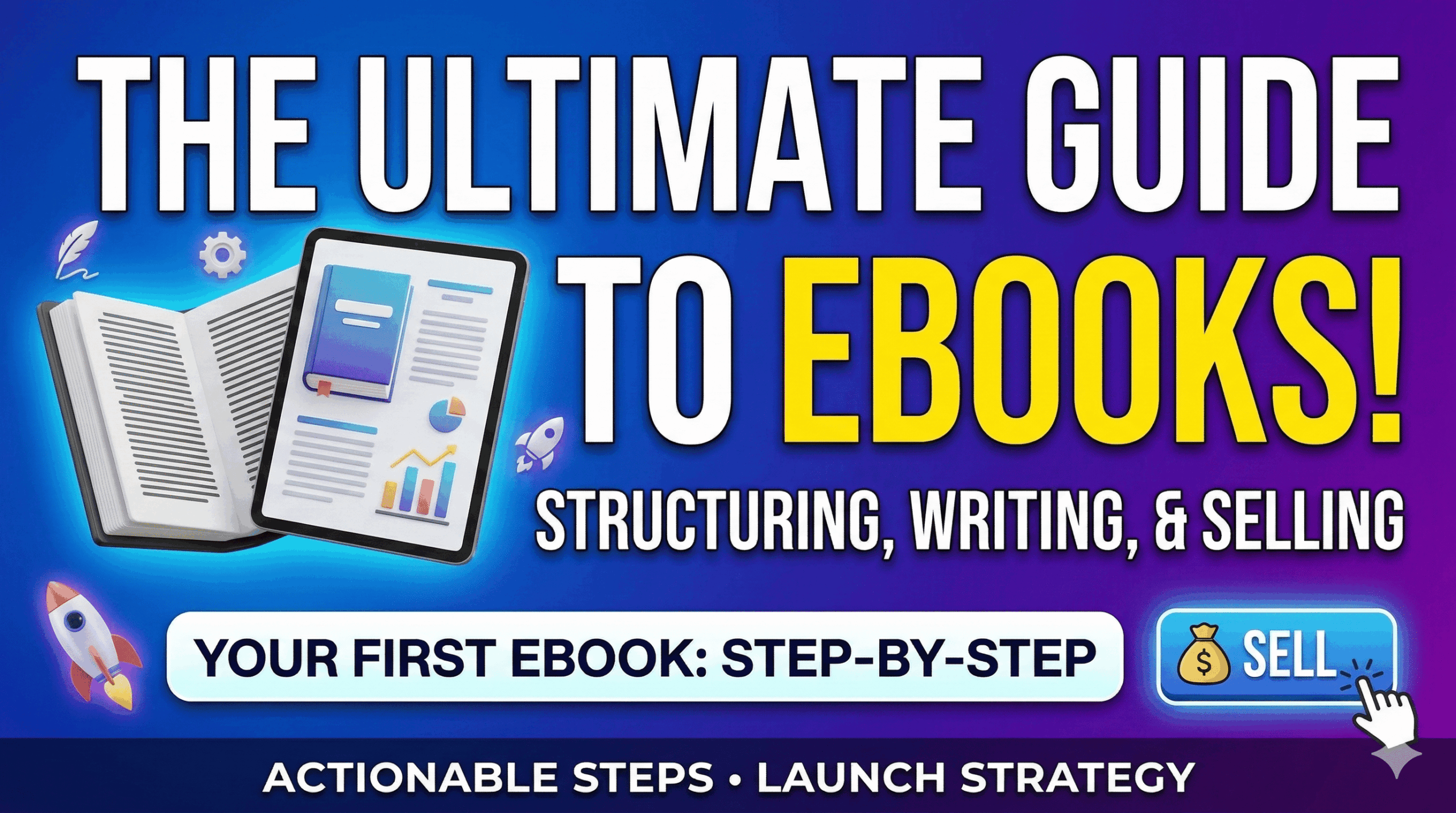
The creator economy has evolved, and in 2026, owning your audience and creating digital assets is more critical than ever. Whether you are a seasoned industry expert, a passionate hobbyist, or an entrepreneur looking to build an email list, writing an eBook remains one of the most accessible and profitable ways to package your knowledge.
However, the days of throwing a hastily written Word document online and expecting a flood of sales are long gone. Today’s readers demand quality, actionable insights, and a seamless reading experience. If you want to stand out in a crowded market, you need a proven strategy.
This comprehensive guide will walk you through the exact steps to structure, write, and sell your first eBook in 2026. From validating your initial idea to mastering launch day marketing, here is everything you need to know to turn your knowledge into a profitable digital product.
Phase 1: Planning and Validating Your eBook Idea
The biggest mistake first-time authors make is writing a book nobody actually wants to read. Before you type a single word, you must ensure there is a hungry market for your topic.
Finding Your Profitable Niche
Your eBook should solve a specific problem for a specific group of people. Broad topics like “How to Lose Weight” or “Personal Finance” are highly saturated and incredibly difficult to rank for. Instead, niche down.
In 2026, successful eBooks target micro-niches. Instead of “Personal Finance,” try “Personal Finance Strategies for Freelance Graphic Designers in Their 20s.” Instead of “How to Lose Weight,” write “A 30-Day Plant-Based Meal Prep Guide for Busy Single Parents.”
To find your niche, ask yourself:
- What unique skills or experiences do I have?
- What questions do people constantly ask me?
- What gaps exist in the current market that I can fill?
Validating Your eBook Idea Before Writing
Validation is the process of proving that people will actually pay for your idea. Do not skip this step.
- Audience Polling: If you have an existing audience on platforms like X (formerly Twitter), LinkedIn, or an email list, run a simple poll asking which of three eBook topics they would be most interested in reading.
- Search Intent Research: Use SEO tools like Ahrefs, Semrush, or AnswerThePublic to see what people are actively searching for. High search volume combined with low competition is the sweet spot.
- The Pre-Sale Strategy: The ultimate form of validation is a pre-sale. Create a high-quality landing page outlining the eBook’s proposed contents and offer it at an early-bird discount. If you don’t hit a specific sales goal (e.g., 20 pre-orders), refund the buyers and pivot your idea. If you do, you now have paid validation and a deadline to start writing.
Phase 2: Structuring Your First eBook
A well-structured eBook keeps readers engaged from the first page to the last. Structure transforms a brain dump of information into a logical, actionable journey.
Creating a Bulletproof Outline
Think of your outline as the architectural blueprint of your eBook. Without it, your writing will wander, and you will inevitably face writer’s block.
Start by identifying the Point A (where your reader is now, struggling with a problem) and Point B (where they want to be, having solved the problem). Every chapter should be a stepping stone that moves them closer to Point B.
A classic non-fiction eBook outline looks like this:
- Introduction: Hook the reader, share your story, and explain exactly what they will achieve by the end of the book.
- The Core Problem: Validate their struggles and explain why previous methods haven’t worked.
- The Solution/Framework: Introduce your unique method or framework.
- Actionable Steps (The Body Chapters): Break your framework down into 5 to 10 manageable steps.
- Troubleshooting: Address common roadblocks they might face while implementing your advice.
- Conclusion: Summarize the main points and provide a final dose of motivation.
- Call to Action (CTA): What should they do next? Join your newsletter? Buy your course? Hire you for consulting?
The Anatomy of a High-Converting Chapter
Each individual chapter needs its own internal structure to maintain momentum. Use the Hook-Story-Lesson-Action framework:
- Hook: Open the chapter with a surprising statistic, a bold claim, or a compelling question.
- Story: Share a brief personal anecdote or a case study related to the chapter’s topic to build empathy and context.
- Lesson: Deliver the core educational content. Use bullet points, bold text, and subheadings to make it skimmable.
- Action: End every chapter with an “Action Step.” What is the one thing the reader needs to do right now before moving to the next chapter?
Phase 3: Writing Your eBook (Without Burning Out)
With a solid outline in hand, the writing phase becomes much less intimidating. It is no longer about staring at a blank page; it is about filling in the blanks.
Setting a Writing Schedule
Consistency is more important than intensity. You do not need to take a month off work to write your first eBook. You just need a dedicated schedule.
Time-block 60 to 90 minutes of uninterrupted writing time each day. Use the Pomodoro technique (25 minutes of focused writing, followed by a 5-minute break) to maintain high energy levels. If you commit to writing just 500 words a day, you will have a 15,000-word draft finished in exactly one month.
Leveraging AI Tools for Writing Assistance in 2026
AI writing assistants have advanced significantly, but they should be used as collaborators, not replacements for your unique voice. Readers can spot fully AI-generated, soulless text from a mile away.
Here is how to use AI ethically and effectively:
- Brainstorming: Ask AI to generate 10 alternative titles or suggest sub-topics you might have missed in your outline.
- Overcoming the Blank Page: If you are stuck on a section, dictate your messy thoughts into an AI tool and ask it to “organize these thoughts into a coherent paragraph.”
- Research Assistance: Use AI to quickly summarize long articles or find specific statistics (always verify the facts independently).
The “Write First, Edit Later” Rule
The quickest way to derail your progress is to edit while you write. Let your first draft be messy. Ignore typos, grammatical errors, and clunky phrasing. Your only goal during the drafting phase is to get the ideas out of your head and onto the screen. You will fix the prose later.
Phase 4: Editing and Refining Your Draft
Editing is where the magic happens. A rough draft is raw material; editing turns it into a professional product.
Self-Editing Techniques
Step away from your manuscript for at least a week after finishing the first draft. You need fresh eyes to spot inconsistencies.
When you return, do three distinct passes:
- The Developmental Edit: Read for flow and structure. Does the progression of chapters make sense? Are there any missing steps? Is the tone consistent?
- The Line Edit: Focus on paragraph structure and word choice. Trim the fluff. If a sentence doesn’t add value, delete it.
- The “Read Aloud” Edit: Read your entire eBook out loud. This is the ultimate test for catching awkward phrasing and repetitive words. If you stumble over a sentence while speaking, your reader will stumble over it while reading.
Hiring Professional Editors and Proofreaders
If budget allows, hiring a professional is a worthwhile investment. At the very least, invest in advanced grammar software like ProWritingAid or Grammarly Premium.
If you are self-publishing a high-ticket eBook (pricing it above $30), a professional copyeditor is non-negotiable. Typos destroy credibility, and credibility is what allows you to command premium prices.
Phase 5: Formatting and Design
Readers judge eBooks by their covers and their interior formatting. A poor visual experience will lead to negative reviews and high refund rates.
Designing a Click-Worthy eBook Cover
Your cover is your number one marketing asset. It must look professional at a thumbnail size, as most people will view it on mobile devices.
- DIY Design: Tools like Canva offer excellent eBook cover templates. Keep the design minimalist. Use high-contrast colors, a bold, legible font for the title, and a simple central image or graphic.
- Professional Design: If design isn’t your strong suit, hire a cover designer on platforms like Fiverr or Upwork. A professional cover can drastically increase your click-through rate.
Formatting for Different Devices
In 2026, you cannot just export a Word document as a PDF and call it a day—unless it is a highly visual workbook. People read on Kindles, iPads, and smartphones. Your text needs to be “reflowable” to adapt to different screen sizes.
- PDF: Best for workbooks, highly illustrated guides, or direct sales from your own website.
- EPUB: The universal standard format for eBooks, required by almost all major publishing platforms (including Apple Books, Kobo, and Google Play).
- Formatting Tools: Software like Vellum (for Mac) or Atticus (for PC/Mac) are industry standards in 2026. They allow you to turn a Word document into a beautifully formatted, professional EPUB and PDF file with just a few clicks.
Phase 6: Pricing and Publishing Your eBook
Choosing where to sell your eBook and how much to charge will define your revenue model.
Choosing the Right Publishing Platform
You generally have two routes: massive marketplaces or direct sales.
1. Amazon KDP (Kindle Direct Publishing)
- Pros: Amazon has the largest built-in audience of readers in the world. You can tap into organic search traffic.
- Cons: You do not get the customer’s email address. Royalties are capped at 70% (and only for books priced between $2.99 and $9.99).
- Best for: Authors looking for broad reach and those writing fiction or low-ticket non-fiction.
2. Direct Sales Platforms (Gumroad, Stan Store, Lemon Squeezy)
- Pros: You keep 90%+ of the profits. You own the customer data and email addresses, allowing you to upsell future products. You have total freedom over pricing.
- Cons: You have to drive 100% of the traffic yourself.
- Best for: Creators with an existing audience, niche experts, and those selling high-ticket, highly actionable guides.
eBook Pricing Strategies for 2026
Pricing is largely dependent on the platform and the promised transformation.
- The Lead Magnet ($0 – $0.99): Used primarily to build an email list.
- The Amazon Standard ($2.99 – $9.99): The sweet spot for maximizing the 70% KDP royalty rate.
- The Authority Guide ($19 – $49+): Sold directly to your audience via Gumroad or Stan Store. If your eBook helps someone make money, save time, or learn a high-income skill, price it based on the value of the result, not the page count.
- Tiered Pricing: A highly effective direct-sale strategy. Offer “Tier 1” (Just the eBook for $29), “Tier 2” (The eBook + Audio version + Worksheets for $49), and “Tier 3” (The eBook + Worksheets + A 30-minute consultation call with you for $149).
Phase 7: Selling and Marketing Your eBook
Publishing your eBook is only the halfway mark. Selling it requires a proactive, multi-channel marketing approach.
Building a Launch Strategy
Don’t just silently publish your book and post a single link. Treat your eBook launch like an event.
- 2 Weeks Out: Start teasing the book cover, sharing behind-the-scenes snippets of the writing process, and opening up pre-orders.
- Launch Week: Send a structured email sequence to your list. Offer a limited-time launch discount or an exclusive bonus (like a free template or checklist) for early buyers.
- Post-Launch: Gather early reviews and use them as social proof in your ongoing marketing.
Utilizing Social Media and Short-Form Video
In 2026, short-form video content on platforms like TikTok, YouTube Shorts, and Instagram Reels is the most powerful organic marketing tool available.
Do not just make videos saying “Buy my book.” Instead, give away the core concepts of your book for free.
- Create a 60-second video explaining “Step 1” of your framework. At the end, tell viewers they can find the remaining steps in your new eBook.
- Read an excerpt from your most impactful chapter.
- Answer frequently asked questions related to your niche and point to your eBook as the ultimate resource.
Leveraging Email Marketing and Automation
Your email list is your most valuable asset. Set up an automated “welcome sequence” for anyone who joins your list. Over the course of 3 to 5 emails, introduce yourself, provide massive free value, and smoothly transition into pitching your eBook as the logical next step for those who want to dive deeper.
Conclusion
Writing and selling your first eBook in 2026 is a highly rewarding endeavor that requires a blend of focused writing, strategic structuring, and modern marketing. By validating your idea early, utilizing the right tools to write and format efficiently, and choosing a publishing platform that aligns with your goals, you can create a digital asset that generates income and establishes your authority for years to come.
The market is waiting for your unique perspective. Stop overthinking the process, open a blank document, and start building your outline today.
Frequently Asked Questions (FAQs) About Writing eBooks
How many pages should my first eBook be? Quality trumps quantity. An eBook should be exactly as long as it needs to be to solve the reader’s problem, and not a word longer. Most highly actionable non-fiction eBooks range from 10,000 to 25,000 words (roughly 40 to 100 pages).
How long does it take to write an eBook? If you outline thoroughly and commit to writing 500 to 1,000 words a day, you can comfortably draft an eBook in 30 to 60 days. Editing, formatting, and launch prep will typically add another 30 days to the timeline.
Can I use AI to write my entire eBook? While technically possible, it is highly discouraged. AI lacks personal experience, emotional resonance, and unique human perspective. Readers buy books to connect with an author’s unique voice. Use AI to outline, brainstorm, and edit, but write the core content yourself.
Do I need an ISBN for my eBook? If you are publishing solely on Amazon KDP or selling directly through platforms like Gumroad, you do not strictly need an ISBN (Amazon assigns its own ASIN). However, if you plan to distribute widely to libraries and multiple retailers via aggregators like Draft2Digital, purchasing an ISBN is recommended.
Related articles :
- Top Digital Products to Sell in 2026: The Complete Guide
- Top 11 trendy products to sell on the internet in 2026
- Top Ways to Make Money from AI in 2026
- Your Comprehensive Guide to Making Money from Digital Products
- 7 Principles for Teenagers to Become Millionaires