
 By
By 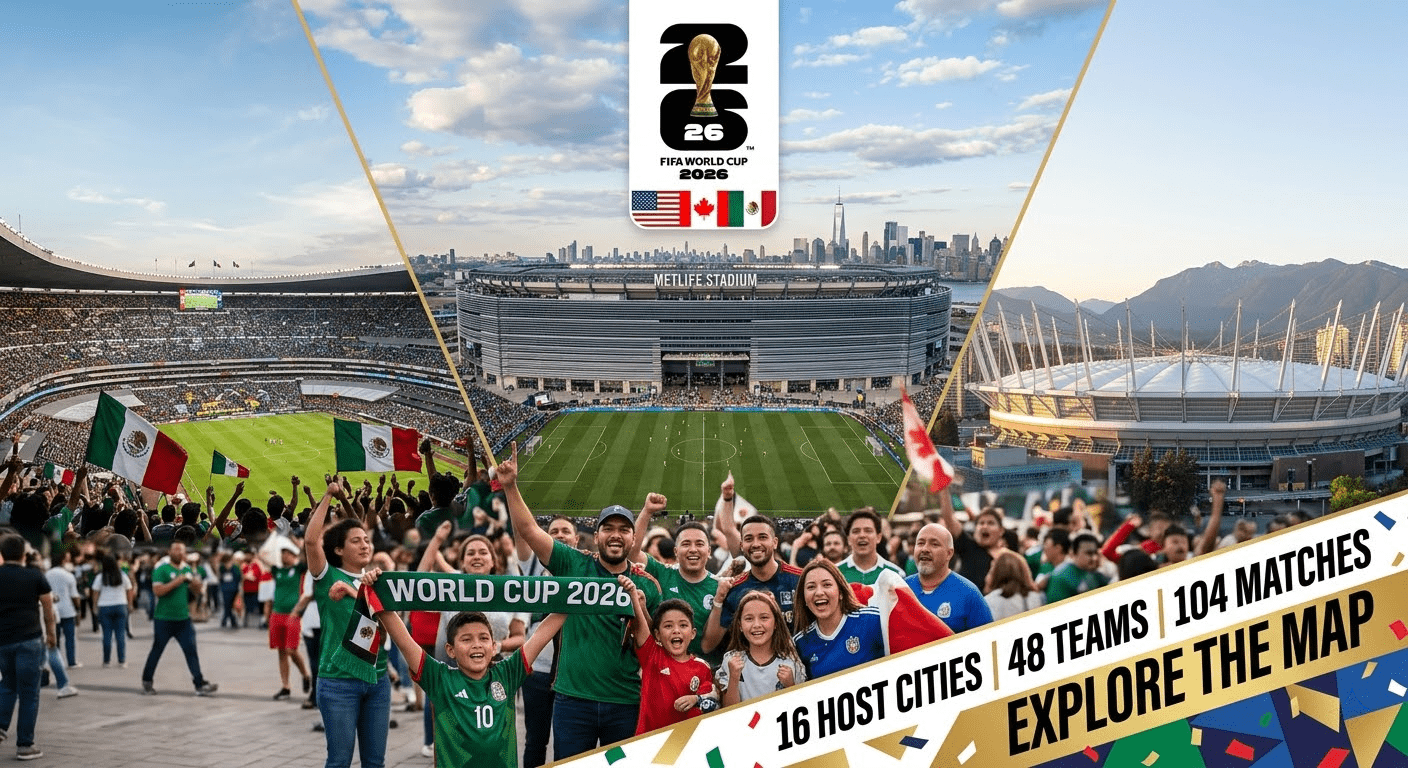
The beautiful game is about to get even bigger. For the first time in history, the FIFA World Cup will be hosted by three different nations: the United States, Canada, and Mexico. The 2026 FIFA World Cup is breaking all the rules and setting new records. With the tournament expanding to include 48 teams (up from the traditional 32), the excitement is off the charts.
But the biggest talking point isn’t just the teams; it’s the locations. The matches will be played across 16 incredible host cities. Whether you are planning to travel to the games or just watching from home, knowing about these host cities is essential.
Why the 2026 World Cup is Historic
This tournament is completely unprecedented. The sheer scale of the 2026 World Cup is hard to wrap your head around.
- Three Host Nations: USA, Canada, and Mexico are joining forces.
- 48 Teams: More teams mean more matches. We are looking at a massive 104 matches packed into the tournament schedule, starting on June 11 and ending on July 19, 2026.
- 16 Host Cities: Spanning from the Pacific coast of Vancouver all the way to the bustling streets of New York/New Jersey, the cultural diversity is amazing.
If you are an entrepreneur or content strategist living in one of these host cities, the influx of tourists is a massive opportunity. Making sure your business is visible online is crucial. You might want to brush up on your digital marketing with our comprehensive SEO pillar content strategy to capture that local search traffic.
Now, let’s dive into the ultimate breakdown of all 16 host cities for the FIFA World Cup 2026.
Host Cities in Canada
Canada is hosting the World Cup for the very first time, and they are bringing two of their most vibrant cities to the global stage.
Toronto (BMO Field)
Toronto is a true melting pot of cultures, making it a perfect World Cup city.
- The Stadium: BMO Field (often referred to as Toronto Stadium for the tournament) is a purpose-built soccer stadium. It’s currently home to Toronto FC.
- Capacity: Around 45,000.
- What to Expect: Toronto is going to host 6 matches, including Canada’s opening game against Bosnia-Herzegovina. The stadium is located right by Lake Ontario, offering a great breeze and a fantastic atmosphere.
- Things to Do: When you aren’t watching football, check out the CN Tower, grab some food at the St. Lawrence Market, or explore the historic Distillery District.
Vancouver (BC Place)
Vancouver offers stunning scenery where the mountains meet the ocean.
- The Stadium: BC Place. This venue is iconic for its cable-supported retractable roof.
- Capacity: 54,000.
- What to Expect: BC Place will host 7 matches. It is widely considered one of the most beautiful stadiums in the tournament. It already has World Cup history, having hosted the unforgettable 2015 FIFA Women’s World Cup Final.
- Things to Do: Rent a bike and ride around Stanley Park, visit Granville Island for amazing local food, or take the Skyride up Grouse Mountain for a breathtaking view of the city.
Host Cities in Mexico
Mexico has a rich, passionate football history. They previously hosted the World Cup in 1970 and 1986. Now, they are bringing the magic back to three phenomenal cities.
Mexico City (Estadio Azteca)
If there is a holy grail of football stadiums, this is it.
- The Stadium: Estadio Azteca.
- Capacity: 83,000.
- What to Expect: This is the big one. Estadio Azteca will host 5 matches, including the grand opening match of the tournament on June 11, where Mexico will face South Africa. It will be the first stadium ever to host matches in three different World Cups.
- Things to Do: Explore the historic Zócalo, visit the Frida Kahlo Museum, and eat as many authentic street tacos as you possibly can. The food scene here is legendary.
Guadalajara (Estadio Akron)
Known as the birthplace of mariachi and tequila, Guadalajara brings the ultimate Mexican cultural experience.
- The Stadium: Estadio Akron.
- Capacity: 48,000.
- What to Expect: Hosting 4 matches, Estadio Akron is famous for its unique volcano-inspired design. It seamlessly blends into the surrounding landscape.
- Things to Do: Take a day trip to the town of Tequila, explore the beautiful historic center, and catch a Lucha Libre match for a fun night out.
Monterrey (Estadio BBVA)
Monterrey is a modern, bustling industrial hub surrounded by dramatic mountains.
- The Stadium: Estadio BBVA.
- Capacity: 53,500.
- What to Expect: Nicknamed “The Steel Giant,” this stadium offers jaw-dropping views of the Cerro de la Silla mountain right from your seat. It will host 4 matches.
- Things to Do: Stroll along the Paseo Santa Lucía (a beautiful artificial river), visit the Macroplaza, and try cabrito (roast kid goat), a local culinary specialty.
Speaking of modern wonders and the digital age, if the massive scale of the World Cup inspires you to build a global business from your laptop, check out our Shopify high-ticket dropshipping guide to get started on your e-commerce journey.
Host Cities in the United States
The U.S. is doing the heavy lifting for this tournament, providing 11 world-class stadiums. The stadiums in the States are massive, highly modern, and built to handle huge crowds.
New York / New Jersey (MetLife Stadium)
The city that never sleeps gets the biggest match of them all.
- The Stadium: MetLife Stadium (in East Rutherford, New Jersey).
- Capacity: 82,500.
- What to Expect: This stadium is hosting 8 matches, culminating in the FIFA World Cup Final on July 19. The atmosphere is going to be electric.
- Things to Do: You have the entire Big Apple at your fingertips. See a Broadway show, walk through Central Park, visit Times Square, and grab a classic New York slice of pizza.
Dallas (AT&T Stadium)
Everything is bigger in Texas, and this stadium proves it.
- The Stadium: AT&T Stadium (located in Arlington).
- Capacity: 94,000.
- What to Expect: This is the largest venue in the entire tournament. Because of its massive size, Dallas is hosting a tournament-high 9 matches, including a semi-final.
- Things to Do: Check out the Fort Worth Stockyards for a true cowboy experience, visit the Sixth Floor Museum, and indulge in some authentic Texas BBQ.
Los Angeles (SoFi Stadium)
Welcome to Hollywood. L.A. is bringing pure glitz and glamour to the games.
- The Stadium: SoFi Stadium (in Inglewood).
- Capacity: 70,000.
- What to Expect: This is one of the most technologically advanced and expensive stadiums ever built. It will host 8 matches, bringing massive crowds to the West Coast.
- Things to Do: Hike to the Hollywood Sign, walk the Santa Monica Pier, relax in Malibu, and enjoy the diverse food truck scene.
Atlanta (Mercedes-Benz Stadium)
Atlanta has quickly become one of the biggest soccer cities in the United States.
- The Stadium: Mercedes-Benz Stadium.
- Capacity: 75,000.
- What to Expect: Known for its incredible halo video board and retractable roof, this stadium will host 8 matches, including one of the crucial semi-finals.
- Things to Do: Visit the Georgia Aquarium, check out the World of Coca-Cola, and explore the Martin Luther King Jr. National Historical Park.
Miami (Hard Rock Stadium)
Sun, beaches, and a heavy Latin American influence make Miami the perfect host.
- The Stadium: Hard Rock Stadium (in Miami Gardens).
- Capacity: 65,000.
- What to Expect: Miami will host 7 matches, including the third-place playoff. Expect a massive party atmosphere.
- Things to Do: Spend a day on South Beach, admire the Art Deco architecture, and eat incredible Cuban food in Little Havana.
Houston (NRG Stadium)
Houston is one of the most diverse cities in the country, guaranteeing a warm welcome for fans from all over the world.
- The Stadium: NRG Stadium.
- Capacity: 72,000.
- What to Expect: Hosting 7 matches, NRG Stadium is famous for its retractable roof and intense air conditioning—which will be very much needed in the Texas summer heat!
- Things to Do: Visit the Space Center Houston (NASA), explore the Museum District, and try out the city’s famous Tex-Mex cuisine.
Boston (Gillette Stadium)
Boston brings a deep love of sports and a ton of American history.
- The Stadium: Gillette Stadium (located in Foxborough).
- Capacity: 65,000.
- What to Expect: Gillette will host 7 matches. It’s a bit outside the city, but the passion of New England sports fans is unmatched.
- Things to Do: Walk the Freedom Trail, visit Fenway Park, and definitely grab a bowl of New England clam chowder.
Philadelphia (Lincoln Financial Field)
The birthplace of the United States is ready for the world.
- The Stadium: Lincoln Financial Field.
- Capacity: 69,000.
- What to Expect: Philly is hosting 6 matches. The city is famous for its hardcore, passionate sports fans, so the energy here will be intense.
- Things to Do: Run up the “Rocky Steps” at the Philadelphia Museum of Art, see the Liberty Bell, and eat a traditional Philly Cheesesteak.
Seattle (Lumen Field)
Seattle has one of the best soccer cultures in the United States, hands down.
- The Stadium: Lumen Field.
- Capacity: 69,000.
- What to Expect: Hosting 6 matches. Lumen Field is notoriously loud. The acoustics are designed to trap crowd noise, making it an intimidating place for visiting teams and an incredible place for neutral fans.
- Things to Do: Grab a coffee at the original Starbucks in Pike Place Market, go up the Space Needle, and enjoy the lush, green Pacific Northwest scenery.
San Francisco Bay Area (Levi’s Stadium)
The tech capital of the world is bringing its innovation to the World Cup.
- The Stadium: Levi’s Stadium (located in Santa Clara).
- Capacity: 71,000.
- What to Expect: Hosting 6 matches. This stadium is incredibly eco-friendly and features a green roof and solar panels.
- Things to Do: Walk across the Golden Gate Bridge, visit Alcatraz Island, and explore the incredibly diverse food scenes in San Francisco and nearby San Jose.
Want to document your epic travels to all these stadiums and turn it into a profitable side hustle? Learn how you can do it without ever showing your face on camera with our guide to creating faceless YouTube channels with AI.
Kansas City (Arrowhead Stadium)
Right in the heart of America, Kansas City is bringing the noise.
- The Stadium: Arrowhead Stadium.
- Capacity: 73,000.
- What to Expect: Hosting 6 matches. Arrowhead actually holds the Guinness World Record for the loudest outdoor sports stadium in the world. Bring your earplugs!
- Things to Do: Eat world-class Kansas City barbecue, listen to live jazz in the 18th & Vine District, and visit the National WWI Museum.
How to Plan Your Trip to the Host Cities
If you are planning to attend the 2026 World Cup, you need to start planning right now. With 48 teams and millions of fans traveling, hotels and flights will book up incredibly fast.
- Figure Out Your Base Camp: Because the distances between cities are huge (e.g., Vancouver to Miami is a massive flight), it’s best to pick a “hub” or region. Stick to the East Coast, West Coast, or Central region unless you have a massive travel budget.
- Understand the Climate: June and July in North America can be tricky. Miami and Houston will be incredibly hot and humid. Mexico City is at a very high altitude. Seattle and Vancouver will be mild and comfortable. Pack accordingly!
- Transport and Logistics: The USA heavily relies on domestic flights for long distances. Do not plan to drive from New York to Los Angeles between match days—it takes almost a week! Book your domestic flights early.
- Tickets: Keep an eye on the official FIFA website. Tickets are sold in phases, usually starting with a random selection draw. Be patient, but be persistent.
Conclusion
The FIFA World Cup 2026 is going to be the biggest sporting event in human history. With 16 host cities spread across the USA, Mexico, and Canada, the tournament is showcasing the best stadiums, cultures, and atmospheres North America has to offer. Whether you are eating tacos outside Estadio Azteca, screaming with the crowd at Lumen Field, or watching the Final under the bright lights of New York/New Jersey, this World Cup will be an unforgettable experience. Start saving, start planning, and get ready for a month of pure football magic.
FAQs
1. Which city will host the 2026 World Cup Final? The 2026 World Cup Final will be held at MetLife Stadium in East Rutherford, New Jersey (New York/New Jersey host city) on July 19, 2026.
2. Where is the opening match of the 2026 World Cup being played? The opening match of the tournament will take place at the historic Estadio Azteca in Mexico City on June 11, 2026, featuring Mexico against South Africa.
3. How many matches will be played in total during the 2026 World Cup? Because the tournament has expanded to 48 teams, there will be a total of 104 matches played over the course of the event.
4. Which host city has the largest stadium? Dallas has the largest stadium. AT&T Stadium in Arlington, Texas, has a capacity of around 94,000 spectators.
5. How are the matches divided between the three host countries? While the exact knockout tree determines the final spread, the majority of the matches (including all matches from the quarterfinals onward) will be played in the United States. Canada and Mexico host a significant portion of the group stages and early knockout rounds.
6. Do I need a visa to travel between the US, Canada, and Mexico for the World Cup? Yes, depending on your nationality, you will likely need to comply with the separate visa and entry requirements for each of the three sovereign nations. There is no unified “World Cup Visa.”
7. Who are the mascots for the 2026 World Cup? The mascots are Maple the Moose (Canada), Zayu the Jaguar (Mexico), and Clutch the Bald Eagle (United States).
8. Is this the first time three countries have hosted the World Cup? Yes. While Japan and South Korea co-hosted the tournament in 2002, 2026 marks the first time three nations have united to host the FIFA World Cup.
Related Articles
- SEO Pillar Content Strategy: Ranking Faster
- Shopify High-Ticket Dropshipping Guide 2026
- How to Create Faceless YouTube Channels with AI
- Maximizing ROI with Google Veo Video Generation
- Monk Mode: The Deep Work Protocol for Digital Entrepreneurs