 By
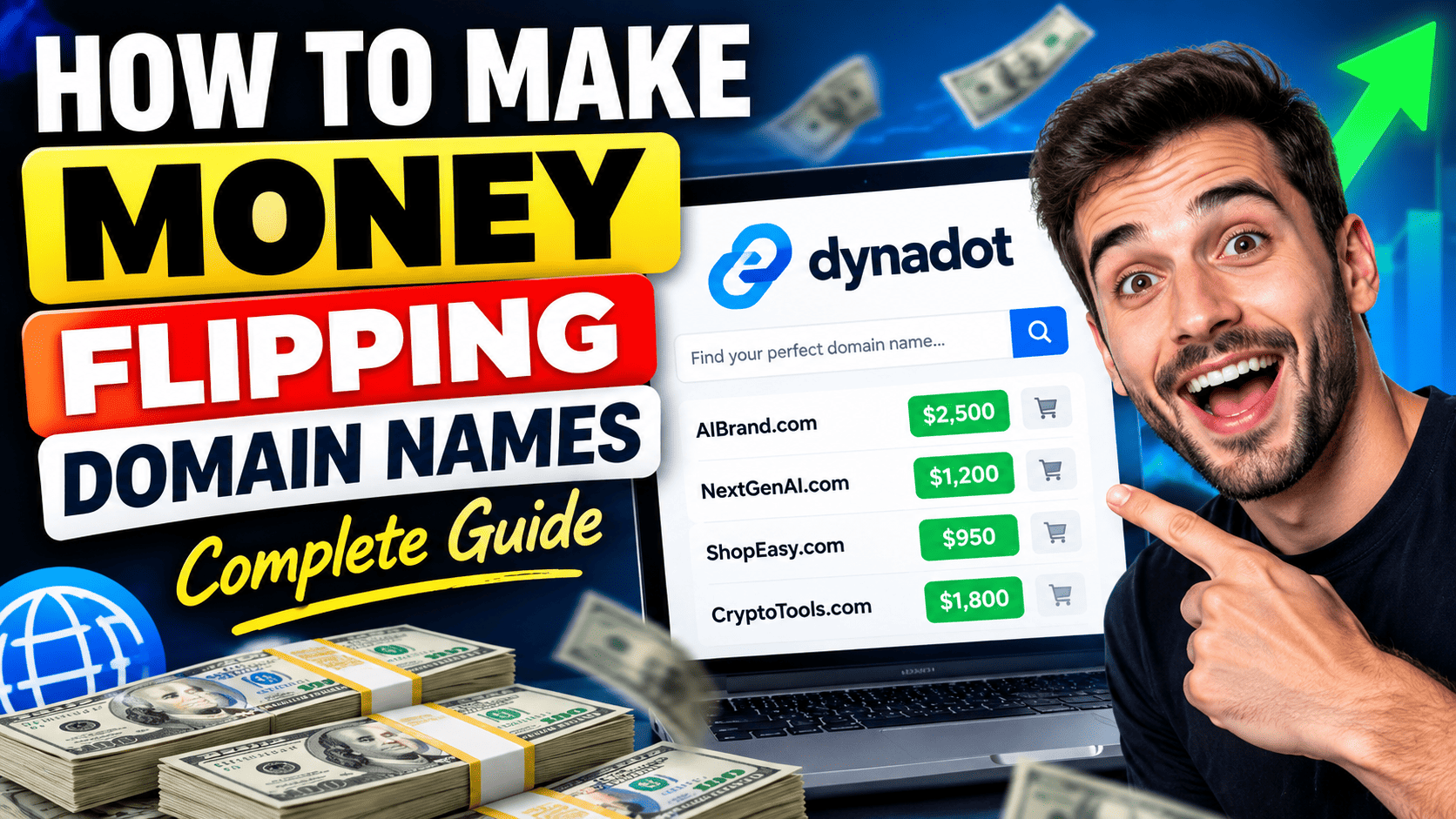
What if you could buy a digital asset for $10 and eventually sell it for $500, $1,000, or even more?
That’s the idea behind domain flipping, an online business model that involves buying domain names and reselling them to interested buyers.
Unlike traditional businesses, you don’t need to manufacture products, manage inventory, or handle shipping. You’re investing in digital names that entrepreneurs, startups, and established companies may want for their websites or brands.
But there’s something most domain-flipping tutorials won’t tell you: buying a domain is easy. Finding someone willing to pay more for it is the difficult part.
In this guide, I’ll explain how domain investing works, how to identify potentially valuable domains, and how to use platforms like Dynadot to build your first domain portfolio.
Whether you’re starting with $50 or $500, the goal is to help you make informed decisions rather than gamble on random domain names.
1. What Is Domaining, and How Does It Work?
Domaining is the practice of acquiring, managing, and potentially reselling internet domain names for profit.
Think of domain names as digital real estate.
A physical property might become more desirable because of its location. A domain name can become valuable because of its branding potential, commercial relevance, memorability, or scarcity.
For example, imagine registering a short, memorable domain for $12.
Several months later, an entrepreneur launches a business that would benefit from that exact name. If the entrepreneur values the domain at $500 and agrees to buy it, you’ve created an opportunity for profit.
Of course, this is only an illustration. Many registered domains never receive a serious offer.
There are three common approaches to domaining:
- Hand registration: Registering previously unregistered domain names at standard registration prices.
- Expired domain investing: Acquiring names that previous owners have allowed to expire.
- Domain flipping: Buying existing domains at prices you believe are below their potential resale value.
Beginners often start with hand registrations because the initial costs are relatively low.
However, inexpensive does not automatically mean undervalued.
2. Why Do Businesses Pay Premium Prices for Domain Names?
A domain name is often one of the first things customers notice about an online business.
Consider two hypothetical brands:
- BestAffordableOnlineFitnessEquipment2026.com
- FitNova.com
The second is shorter, easier to remember, and potentially more suitable for building a recognizable brand.
Businesses may pay premium prices for domains because they offer several advantages.
Stronger branding
A memorable domain makes it easier for customers to recognize and recall a business.
Marketing convenience
Shorter names are generally easier to communicate in advertisements, podcasts, social media posts, and word-of-mouth recommendations.
Commercial relevance
A domain that closely matches a product category or service can attract buyers operating in that industry.
Limited availability
Only one registrant can hold a particular domain name at a time. If a company wants a specific name that’s already registered, it may need to negotiate with its current owner.
However, owning a keyword-rich domain doesn’t guarantee higher Google rankings. Domain value depends on much more than the presence of keywords.
3. How to Find Domain Names Worth Buying
The biggest mistake beginners make is registering dozens of names simply because they’re available.
Availability doesn’t prove demand.
Before purchasing any domain, evaluate it using these five criteria.
A. Keep names short and memorable
Short domains are often easier to remember, spell, and communicate.
Look for names that are:
- Easy to pronounce
- Easy to spell
- Relatively short
- Free from unnecessary numbers and hyphens
- Suitable for a recognizable business
A strong two-word combination can be more marketable than a confusing five-letter abbreviation.
B. Look for commercial applications
Ask yourself: What business could realistically use this domain?
Potential industries include artificial intelligence, cybersecurity, software, finance, e-commerce, and professional services.
For example, a domain related to AI-powered customer support could appeal to businesses developing automation tools.
But industry popularity alone doesn’t make a particular name valuable.
C. Understand domain extensions
The extension after the dot is called a top-level domain, or TLD.
Common examples include:
.com— Widely recognized for commercial websites..ai— Popular among artificial intelligence companies..io— Frequently used by technology businesses..shop— Relevant to e-commerce brands..si— Slovenia’s country-code extension, which can also support creative domain branding.
I’ve personally explored investing in .si domains because alternative extensions can offer interesting naming opportunities.
However, demand and liquidity vary considerably between extensions. A creative .si domain should not automatically be valued like the equivalent .com.
D. Research comparable sales
Before buying a domain, investigate whether similar names have sold previously.
Resources such as NameBio can help you research reported historical sales.
Look for similarities in domain length, extension, commercial meaning, and naming structure.
Remember that historical sales are not guaranteed future prices.
E. Check trademarks and domain history
Before investing, search for existing trademarks and businesses using the same or a confusingly similar name.
Avoid registering domains that exploit established brands.
You should also inspect a domain’s historical use, potential spam history, and backlink profile.
A domain that looks attractive could have a problematic past.
4. Why I Recommend Exploring Dynadot for Domain Investing
One platform worth exploring is Dynadot, a domain registrar that also provides tools for buying, managing, and selling domain names.
Explore Dynadot and start researching domain opportunities
For beginners, having domain registration and aftermarket tools within one platform can simplify the process.
Dynadot provides several useful options.
Domain search and registration
You can search for available names, compare extensions, and register domains.
Always review both the first-year registration price and the renewal price.
Domain marketplace
Dynadot’s user marketplace allows eligible sellers to list domains at fixed prices or accept offers.
This gives buyers the option to purchase immediately or negotiate.
Domain auctions
Dynadot also supports user auctions, where interested buyers can compete through bids.
According to Dynadot’s documentation, user auctions run for seven days, and eligible sellers can set a starting price.
An auction can create competition, but only if interested bidders participate.
For Sale landing pages
Dynadot lets you display a dedicated sales page when someone visits your domain.
Instead of showing an empty website, visitors can immediately see that the domain is available for purchase.
This is particularly useful for reaching buyers who discover your domain directly.
Domain management
As your portfolio grows, centralized DNS management, renewal controls, and bulk domain tools can save time.
These features don’t guarantee sales, but they make managing your investments more convenient.
5. Step-by-Step: How to Start Flipping Domains With Dynadot
Here’s a practical process for getting started.
Step 1: Create your account
Visit Dynadot and create an account.
Explore its domain search tools and marketplace before purchasing anything.
Step 2: Choose a specific niche
Rather than buying random domains, focus on an industry you understand.
For example, if you’re familiar with Shopify and e-commerce, research names that could appeal to online retailers, software developers, or digital agencies.
Your industry knowledge can help you identify more realistic potential buyers.
Step 3: Research ten potential domains
Build a shortlist and investigate each name.
Check availability, trademarks, renewal costs, comparable sales, and commercial applications.
Ask whether you could identify several plausible businesses that might want the name.
Step 4: Buy one or two promising domains
Don’t spend your entire budget immediately.
Start with a small portfolio so you can learn how pricing, listings, and buyer negotiations work.
Step 5: List your domains for sale
Within Dynadot, navigate to your domain management area and select the appropriate selling option.
Depending on eligibility, you can use marketplace listings or user auctions.
Set a realistic price based on your research rather than an automated valuation alone.
Step 6: Promote your listings
Don’t assume buyers will automatically discover your domains.
Consider sharing relevant listings through your professional network, domain-investing communities, or social media.
You can also use targeted, respectful outreach to businesses that might genuinely benefit from a domain.
Avoid spam, misleading claims, and pressure tactics.
Step 7: Negotiate and complete the sale
When a serious buyer appears, evaluate the offer against your costs, comparable sales, and likelihood of finding another buyer.
Sometimes accepting a reasonable offer is better than holding a domain indefinitely.
6. How Much Money Can You Actually Make From Domain Flipping?
Let’s look at a hypothetical transaction.
Suppose you buy a domain for $15 and eventually sell it for $500 through a Dynadot user marketplace listing.
Dynadot currently documents a 10% commission for its direct user marketplace sales.
| Item | Amount |
|---|---|
| Domain purchase | $15 |
| Selling price | $500 |
| Marketplace commission (10%) | $50 |
| Proceeds after commission | $450 |
| Profit before other expenses and taxes | $435 |
That’s a substantial return on a single successful transaction.
But it doesn’t tell the whole story.
Imagine buying 20 domains for $15 each.
Your initial investment would be $300. If only one domain sold for $200, the $20 marketplace commission would leave you with $180 in proceeds.
You would still be $120 below your initial portfolio spending, before renewals and other expenses.
The real measure of success is portfolio profitability, not the percentage return on your best sale.
7. The Hidden Costs of Domain Investing
Domain flipping has relatively low startup requirements, but it isn’t free.
The most important ongoing expense is domain renewal.
If you own 100 domains and each costs $15 annually to renew, you’re spending $1,500 every year just to maintain the portfolio.
Other possible expenses include marketplace commissions, domain transfers, research tools, marketing, and applicable taxes.
There’s also the opportunity cost of money tied up in domains that may never sell.
This is why I recommend tracking every purchase in a spreadsheet.
Record the acquisition price, renewal date, estimated resale range, listing platform, offers received, and actual sale proceeds.
A disciplined investor knows when to renew a domain and when to let it go.
8. Five Domain Flipping Mistakes Beginners Should Avoid
Buying names without identifiable buyers
A clever domain isn’t necessarily a commercially valuable domain.
Research who might realistically purchase it before spending money.
Trusting automated appraisals too much
Automated tools can provide useful reference points, but their estimates are not guaranteed selling prices.
Actual buyers determine what a domain is worth in a transaction.
Overpaying at auctions
Competitive bidding can make an ordinary domain seem more desirable than it is.
Set a maximum purchase price before participating.
Ignoring renewal costs
A portfolio of unsold domains can become expensive to maintain.
Evaluate every renewal based on realistic demand.
Expecting immediate income
Domain sales can take months or years, and some domains never sell.
Domaining is speculative investing, not a reliable way to earn guaranteed monthly income.
9. My Recommended $100 Beginner Domain Investing Strategy
If I were starting with a $100 budget, I wouldn’t buy ten random domains.
I’d use the money strategically.
| Budget allocation | Amount |
|---|---|
| Two carefully researched domains | $30 |
| Reserve for renewals or opportunities | $50 |
| Additional research or transaction expenses | $20 |
| Total | $100 |
This example assumes suitable domains can be acquired for approximately $15 each.
I would focus on learning how to evaluate domains, creating professional sales listings, and understanding how buyers respond.
The first objective wouldn’t be making $10,000.
It would be completing one profitable transaction while developing a repeatable research process.
Once you understand what sells, you can consider expanding your portfolio gradually.
10. Can Domain Flipping Become a Full-Time Business?
Potentially, yes. But it requires capital, market knowledge, patience, and consistent sales.
A professional domain investor must understand branding, negotiation, portfolio management, acquisition costs, and market demand.
Some investors focus on inexpensive domains with modest resale prices.
Others acquire premium domains and wait for buyers willing to pay significantly more.
Neither approach guarantees profitability.
For most beginners, I recommend treating domaining as an experimental side business rather than immediately relying on it for living expenses.
The knowledge you gain about naming, branding, and online business can also be useful beyond domain investing.
Frequently Asked Questions
Is domain flipping legal?
Generally, buying and reselling domain names is legal. However, trademark infringement, cybersquatting, and bad-faith registrations can lead to disputes and legal consequences.
How much money do I need to start domaining?
You can begin experimenting with a relatively small budget, potentially under $100. Actual costs depend on the domains and extensions you choose.
How long does it take to sell a domain?
There is no fixed timeline. A domain might sell quickly, take years to find a buyer, or never sell.
Is Dynadot suitable for beginners?
Dynadot provides domain registration, marketplace listings, user auctions, and domain management tools that beginners can explore. Always review the relevant fees and eligibility requirements.
Can I sell a domain registered elsewhere on Dynadot?
Yes. Dynadot supports eligible marketplace listings for domains registered with other registrars after ownership verification. However, its user auctions have different eligibility requirements.
Is domain flipping passive income?
Not entirely. Researching domains, managing renewals, promoting listings, and negotiating with buyers all require effort. Sales are unpredictable.
Final Thoughts: Start Small, Research Carefully, and Think Like an Investor
Domain flipping can be an interesting way to participate in the digital economy.
You don’t need a warehouse, employees, or an established online store to begin.
But you do need patience, discipline, and the ability to distinguish genuinely marketable names from domains that simply sound interesting.
My biggest advice is simple:
Don’t buy a domain because you like it. Buy it because you have evidence that someone else might value it more.
If you’re ready to explore the domain aftermarket, Dynadot is one platform worth considering for researching, registering, and listing domain names.
Explore domain investing opportunities on Dynadot
Start with one carefully researched domain, understand the risks, and build your knowledge before increasing your investment.
Disclaimer: Domain investing involves financial risk. The examples in this article are hypothetical and do not represent guaranteed earnings or investment advice.