
 By
By 
In the world of e-commerce and modern retail, order fulfillment automation isn’t just a competitive advantage — it’s essential. As businesses grow, manual shipping tasks become bottlenecks: manually entering addresses, selecting shipping services, printing labels, updating customer records, and responding to inquiries all consume valuable time. Automation streamlines these processes, accelerates delivery, reduces human error, and improves customer satisfaction.
Introduction
This article explores the full automation of order fulfillment — from when a customer places an order to when they receive it — and highlights Shippo as one of the best tools to automate the shipping component of fulfillment.
1. What Is Order Fulfillment Automation?
Order fulfillment automation refers to using software and systems to handle tasks that were traditionally manual in the fulfillment process, including:
- Receiving and routing orders to the fulfillment system
- Inventory synchronization
- Picking and packing guidance
- Shipping label generation
- Carrier selection
- Tracking and notifications
- Returns processing
Automating fulfillment means reducing reliance on humans to perform repetitive tasks, freeing your team to focus on strategy, customer service, and scaling your operation.
2. Why Automate Order Fulfillment?
Before diving into how to automate, it’s worth reviewing why automation matters so much:
Speed and Efficiency
Automated systems handle high volumes of orders more quickly than humans. Tasks like shipping label creation and carrier selection that once took minutes can be done in seconds.
Reduced Errors
Manual entry of addresses, package dimensions, and carrier details inevitably leads to errors. Automation ensures consistency and precision, reducing costly mis-shipments and returns.
Scalability
Automation enables businesses to handle large spikes — e.g., holiday sales or flash promotions — without needing to hire and train temporary staff.
Improved Customer Experience
Faster, error-free order fulfillment translates to happier customers. Automatic tracking notifications, delivery estimates, and returns portals help build trust and repeat business.
Cost Savings
Software automation reduces labor costs and helps you choose cost-effective shipping options automatically based on rules and conditions.
3. Core Components of an Automated Order Fulfillment System
To automate order fulfillment comprehensively, a business typically deploys a layered system made up of interconnected tools. These include:
a. Order Management System (OMS)
An OMS centralizes orders from different sales channels (e.g., Shopify, Amazon, Etsy) into a unified dashboard. It then routes them to the appropriate fulfillment system. Automated OMS platforms can trigger fulfillment logic the moment an order arrives.
b. Warehouse Management System (WMS)
A WMS manages inventory, picking, packing, and staging. Sophisticated systems guide warehouse staff or robotics in the most efficient path to fulfill orders. Automated picking systems, for instance, can increase throughput while reducing errors dramatically.
c. Shipping Automation Tools
This is where Shippo excels. Shipping automation tools take the order data and automatically generate electronic shipping labels, select carriers, process tracking, and send updates back to customers and your sales channels.
d. Integrations and Middlewares
Automation often relies on integration platforms (like Zapier, Integromat, MESA) that connect your order and shipping systems, triggering workflows like label generation or inventory updates whenever a new order arrives.
4. Overview of Fulfillment Workflow Automation
To understand automation in context, here’s a typical automated fulfillment flow:
- Order Received
A sale is made on a sales channel (e.g., Shopify). - Data Synchronization
Order details are automatically pushed to the OMS/WMS. - Inventory Check
The system verifies stock and reserves items for picking. - Automated Picking Instructions
A WMS directs warehouse workers or robots to pick the right items. - Packing Decisions via Rules
Automation rules determine packaging type based on weight, dimensions, shipping method, or other criteria. - Shipping Label Generation
Tools like Shippo automatically generate the correct shipping label based on pre-set rules. - Carrier Selection
Business logic automatically selects a carrier and rate (e.g., cheapest or fastest option). - Tracking & Notifications
Tracking numbers are automatically sent to customers and recorded in your OMS. - Returns Handling
Systems can preconfigure return labels and portals, streamlining returns for customers.
Shippo plays a pivotal role in steps 6, 7, and 8 — the heart of shipping automation.
5. Shippo: The Best App for Shipping Automation
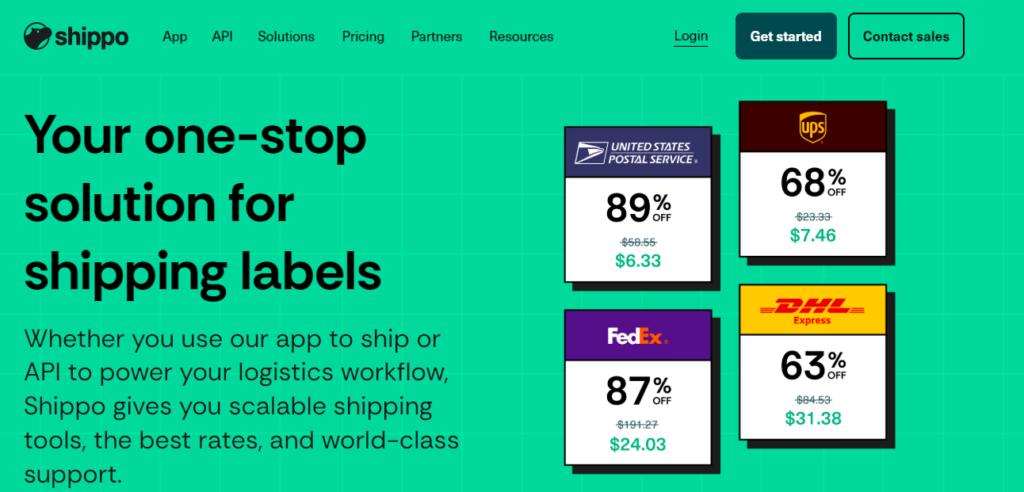
If shipping is part of your fulfillment process, Shippo should be on your radar. It’s a multi-carrier shipping platform that streamlines shipping for e-commerce businesses of all sizes by centralizing carrier management, automation rules, labels, tracking, and returns in one place.
Here’s why Shippo stands out:
a. Centralized Shipping Across Multiple Carriers
Shippo connects with dozens of carriers globally — including USPS, UPS, FedEx, DHL, and regional carriers — through a single platform. This eliminates the need to log into multiple carrier accounts.
b. Automation Rules
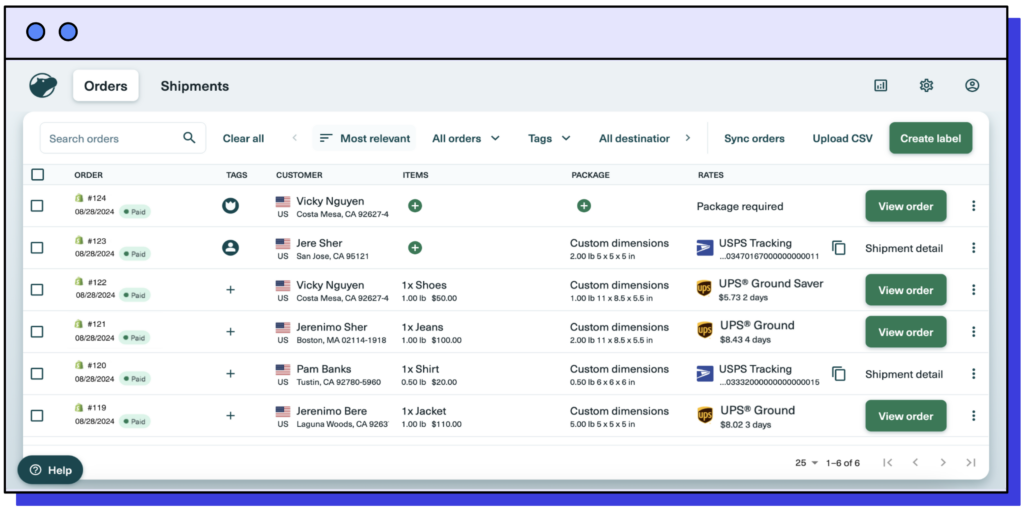
One of Shippo’s strongest features is its Automation Rules engine. With it, you can configure “if/then” rules so that once an order hits Shippo, predefined actions are applied automatically: e.g.,
- If the weight is under 2 lb, use a specific package size
- If the destination is international, apply a global shipping service
- Automatically apply tags based on order characteristics
These rules run automatically and remove the need for manual carrier selection and packaging decisions — saving time and reducing errors.
c. Batch Processing
Shippo supports batch label generation — meaning you can process hundreds of labels at once with minimal clicks. This accelerates fulfillment massively during peak periods or large promotions.
d. Multi-Platform Integration
Shippo integrates cleanly with major e-commerce platforms such as Shopify, WooCommerce, Etsy, Amazon, and marketplaces via custom workflows — which means orders from all your channels funnel automatically into Shippo.
e. Tracking and Notifications
Once Shippo generates shipping labels, it also syncs tracking numbers back to your sales channels and can trigger notifications to customers. This closes the loop and enhances the post-purchase customer experience.
f. Returns Management
Shippo supports automated returns workflows, enabling customers to initiate returns, print labels, and track the process — which reduces support handling time and improves service quality.
6. Real Cases of Automated Rules in Shippo
Here are common automation strategies you can implement with Shippo:
Package Template Automation
Automatically assign packaging based on order weight, item names, or SKU types. This saves repetitive decision-making during fulfillment.
Carrier and Service Selection
Set rules to automatically select the cheapest or most suitable service level (e.g., standard vs. express) based on destination or delivery promises.
Tagging and Prioritization
Automatically tag orders as “International,” “Rush,” “Wholesale,” etc., to streamline sorting and batching in your fulfillment center.
Automated Notifications
Trigger notifications to customers or internal teams once a shipment label is created or when a package hits a specific status.
7. Integrating Shippo with Workflow Platforms
While Shippo has powerful native automation, integrating it with tools like Zapier, MESA, or bespoke integration platforms can unlock even deeper automation:
- Trigger actions when new orders are placed
- Generate shipping labels automatically
- Update inventory levels across systems
- Send custom notifications based on shipment statuses
For example, MESA workflows can connect Shopify orders to Shippo, automatically generating labels and updating status without touching multiple systems.
Integration platforms also allow connecting Shippo to CRM systems, accounting software, helpdesk tools, and dashboards — creating a fully connected fulfillment ecosystem.
8. End-to-End Fulfillment Automation Strategies
Order fulfillment automation isn’t only about shipping; it touches many parts of your business. Here’s how automation fits into broader fulfillment strategy:
Inventory Synchronization
Ensure real-time inventory updates across channels so sales and stock levels are always aligned.
Automated Picking & Packing
Invest in WMS tools that automate picking paths, suggest packing configurations, or even use robotics to accelerate processing.
3PL & Outsourcing Integration
Automate order routing to third-party fulfillment centers (3PLs). When a sale occurs, the order automatically routes to your 3PL, triggers packing, and ships without manual intervention.
Automated Returns & Exchanges
Set up systems that automatically generate return labels and communicate status updates with customers.
Real-Time Dashboards & Alerts
Connect tracking data to real-time fulfillment dashboards so operations teams are alerted to exceptions like delayed shipments.
9. Best Practices for Fulfillment Automation Success
To get the most out of automation:
Map Your Processes First
Understand every step from order receipt to delivery. Knowing your workflow helps you identify where automation has the greatest impact.
Start With Small Rules
Begin by automating simple, rule-based tasks like label creation and carrier selection, then expand into more complex workflows over time.
Monitor Automation Outcomes
Regularly review automation performance — e.g., error rates, shipping costs, delivery times — to fine-tune rules and workflows.
Ensure Data Accuracy
Automated systems rely on clean, structured data. Invest time to standardize SKUs, packaging specs, and weight/dimension accuracy.
Train Teams on Automation Logic
Double your power—spend $25 and Shippo gives you $25 credit free
Ensure your team understands how automation rules work so they can adjust rules when business needs change.
10. Conclusion: The Future of Fulfillment Is Automated
Order fulfillment automation is no longer optional for companies that want to grow efficiently. Manual processes slow scale, increase errors, and add operational costs. By implementing automated workflows — from order reception to carrier selection and fulfillment — businesses can enhance accuracy, speed, and service quality.
Shippo stands out as a powerful tool in this space, offering flexible automation rules, multi-carrier support, batch processing, and seamless integration with platforms across the e-commerce ecosystem. For businesses that want a smart shipping automation layer within their fulfillment stack, Shippo is one of the best solutions available today.
By combining Shippo with your OMS, WMS, and automation platforms, you can build a truly autonomous order fulfillment engine that delivers speed, efficiency, and customer satisfaction — helping your business scale without constraints.
Double your power—spend $25 and Shippo gives you $25 credit free
Related articles :
- What’s Shopify POS ?
- Leveraging Partnerships: A Deep Dive into Impact.com for Affiliate Marketing Success