 By
By 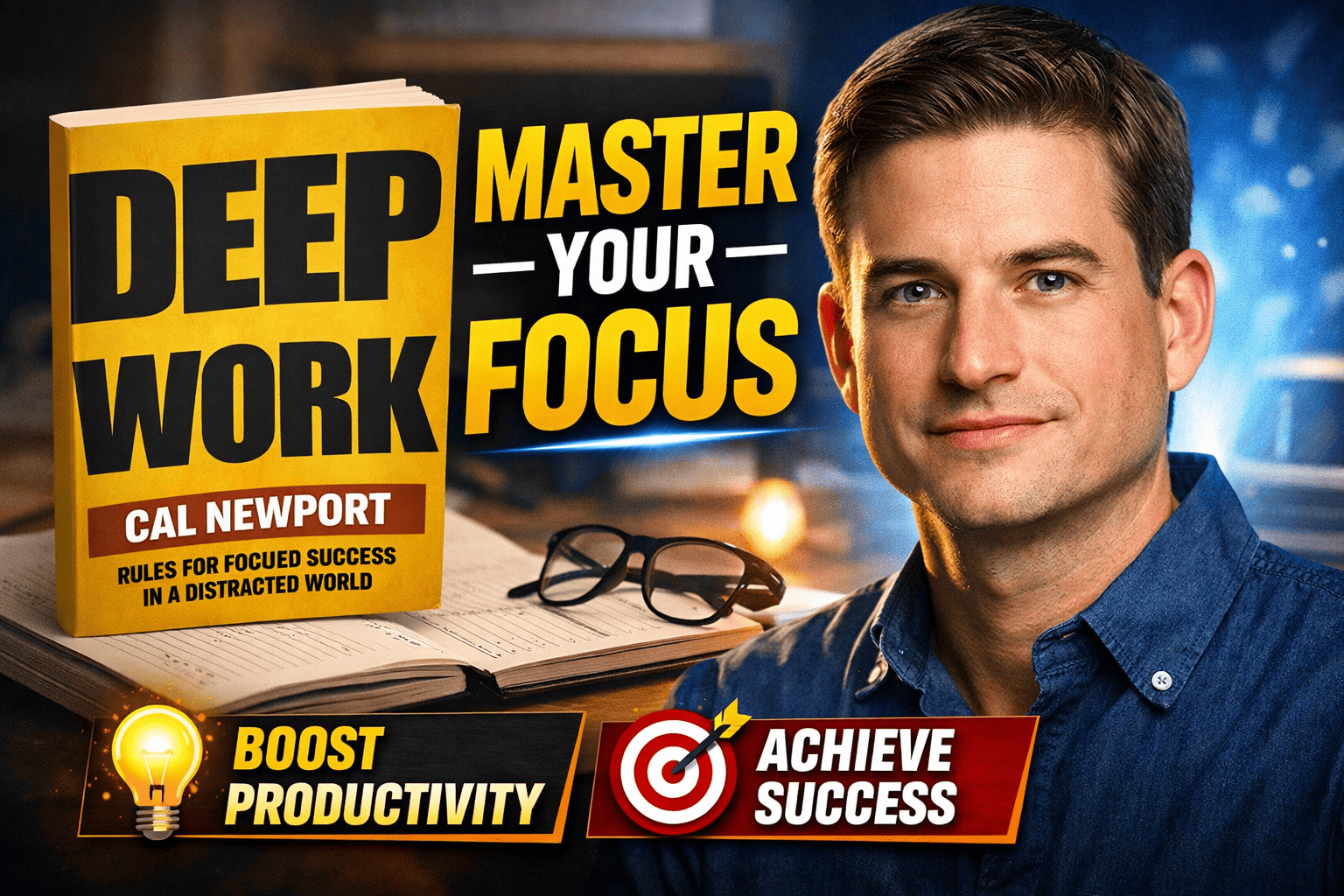
In today’s hyper-connected, always-on digital landscape, the ability to concentrate has become both increasingly rare and immensely valuable. We spend our days reacting to a relentless barrage of notifications, emails, and instant messages, mistaking this frantic busyness for actual productivity. If you feel like you are working harder than ever but failing to make meaningful progress on your most important goals, you are not alone.
The solution to this modern crisis of attention is a concept popularized by Georgetown University computer science professor Cal Newport. In his transformative book, Deep Work: Rules for Focused Success in a Distracted World, Newport argues that the key to elite-level output and true professional fulfillment lies in our ability to master our focus.
This comprehensive guide will break down the core principles of “Deep Work” by Cal Newport, exploring the psychology behind intense concentration and providing you with a step-by-step action plan to achieve complete focus mastery.
What is Deep Work? The Core Philosophy
To understand how to revolutionize your productivity, you first need to understand the fundamental difference between the two types of work that consume your day. Cal Newport divides our professional efforts into two distinct categories:
- Deep Work: Professional activities performed in a state of distraction-free concentration that push your cognitive capabilities to their limit. These efforts create new value, improve your skills, and are incredibly hard for others to replicate.
- Shallow Work: Non-cognitively demanding, logistical-style tasks, often performed while distracted. These efforts tend not to create much new value in the world and are easy to replicate or automate. Examples include answering routine emails, attending status-update meetings, and constantly checking Slack.
The modern workplace is uniquely designed to foster shallow work. The open-office layout, the expectation of immediate email replies, and the constant ping of smartphones naturally pull us away from deep thinking. However, Newport introduces The Deep Work Hypothesis, which states: The ability to perform deep work is becoming increasingly rare at exactly the same time it is becoming increasingly valuable in our economy.
Why Focus Mastery is the Currency of the Future
We are shifting into an information economy where standard, repetitive knowledge work is rapidly being outsourced or automated by artificial intelligence. According to Newport, three specific groups of people will thrive in this new landscape:
- The High-Skilled Workers: Those who can work creatively and effectively with complex, intelligent machines.
- The Superstars: The absolute best in their respective fields who can produce elite-level work.
- The Owners: Those with access to capital to invest in the new technologies driving the economy.
If you are not an owner of capital, your best path to success is to become a high-skilled worker or a superstar. Both of these paths require the ability to master hard things quickly and produce high-quality work at an elite speed. This brings us to Newport’s New Law of Productivity:
High-Quality Work Produced = (Time Spent) x (Intensity of Focus)
By maximizing your intensity of focus, you can drastically reduce the time needed to produce superior results. Deep work physically rewires your brain. When you focus intensely on a specific skill, you stimulate the production of myelin—a layer of tissue that forms around your nerves—which allows brain circuits to fire faster and more cleanly. To achieve true focus mastery, you have to train your brain to operate in this state.
The 4 Philosophies of Deep Work
One of the greatest strengths of Newport’s framework is that it is not rigid. He recognizes that a freelance writer has a very different schedule than a corporate executive. To integrate deep work into your life, you must first choose a scheduling philosophy that aligns with your professional demands.
1. The Monastic Philosophy
This approach involves maximizing deep efforts by completely eliminating or drastically minimizing shallow obligations. Practitioners of the monastic philosophy essentially enter a state of “monk mode,” isolating themselves for long periods to achieve singular focus.
- Who it’s for: Novelists, academics, researchers, and creators who are judged almost entirely on highly complex, singular outputs.
- Example: Science fiction writer Neal Stephenson, who famously refuses to use email or attend interviews while writing a book, ensuring his attention is entirely preserved for his craft.
2. The Bimodal Philosophy
The bimodal approach recognizes that while extreme isolation is powerful, it is not practical for everyone year-round. This philosophy involves dividing your time, dedicating some clearly defined stretches to deep pursuits and leaving the rest open to everything else.
- Who it’s for: Professionals who need periods of intense focus but also have unavoidable collaborative or administrative duties.
- Example: A designer or entrepreneur who spends Monday through Wednesday entirely isolated to work on a major product launch, but leaves Thursday and Friday open for meetings, client calls, and emails. It can also be applied on a seasonal scale, such as an academic who teaches in the fall and retreats to write in the spring.
3. The Rhythmic Philosophy
This is the most accessible philosophy for the standard knowledge worker. It involves generating a daily rhythm, scheduling deep work sessions at the exact same time every single day. By making deep work a rigid habit, you remove the friction of having to decide when to do it.
- Who it’s for: Corporate employees, managers, and anyone with a standard 9-to-5 schedule who wants to build a compounding habit of focus.
- Example: Waking up at 5:30 AM to write an eBook or code for 90 minutes before the rest of the house wakes up and the standard workday begins. The goal is to not break the chain of daily progress.
4. The Journalistic Philosophy
The journalistic approach is the most advanced and difficult to master. It involves fitting deep work into your schedule whenever a window of time naturally opens up. You must be able to instantly switch your mind from a shallow state to a deep state at a moment’s notice.
- Who it’s for: Highly experienced deep workers, executives, or journalists who have incredibly unpredictable schedules but possess intense mental discipline.
- Example: Having an unexpected 45-minute delay before a flight and immediately using that exact window to outline a complex strategy document without hesitation or procrastination.
How to Cultivate Focus Mastery: The 4 Rules of Deep Work
Choosing a schedule is just the beginning. To actually execute, Cal Newport outlines four fundamental rules to train your brain, alter your environment, and elevate your productivity.
Rule #1: Work Deeply
You cannot simply intend to work deeply; your environment is engineered to distract you. You must build routines and rituals that minimize the friction of transitioning into a state of focus.
- Define Your Environment: Choose a specific location strictly for deep work. This could be a quiet conference room, a specific desk, or a library. When you are in this space, your brain should automatically recognize that it is time to focus.
- Establish Rules: Set hard parameters. Will your phone be in another room? Will your internet browser be disconnected? How long will the session last?
- Execute a “Grand Gesture”: Sometimes, to signal to your brain the importance of the task, you need to make a radical change. Booking a hotel room for a weekend solely to finish a project, or investing in expensive noise-canceling headphones, leverages psychological commitment to ensure you follow through.
Rule #2: Embrace Boredom
Our brains have been rewired by smartphones to expect a continuous stream of novel, dopamine-inducing stimuli. If you reach for your phone the second you encounter a moment of boredom—like waiting in line at the grocery store—your brain loses its ability to tolerate the lack of stimulation required for deep work.
- Don’t take breaks from distraction; take breaks from focus: Instead of trying to stay focused and occasionally allowing yourself a distraction break, schedule the exact times you are allowed to use the internet or check your phone. Outside of those specific blocks, you must endure the boredom.
- Practice Mental Endurance: Treat your attention span like a muscle. If you can only focus for 15 minutes right now, aim for 20 minutes tomorrow.
Rule #3: Quit Social Media
Newport challenges the “Any-Benefit Approach” to digital tools, where people justify using a platform simply because it offers some small benefit or fear of missing out. Instead, he advocates for the Craftsman Approach to Tool Selection.
- Evaluate Your Tools: Identify your highest-level professional and personal goals. Then, ruthlessly evaluate your digital tools (Twitter, Instagram, TikTok, LinkedIn). Only adopt a tool if its positive impacts on your core goals substantially outweigh its negative impacts.
- The 30-Day Experiment: Newport suggests quitting social media for 30 days without announcing your departure. After the month, ask yourself two questions: Would my life have been notably better if I had been able to use these services? and Did anyone care that I wasn’t using them? For most professionals, the answer to both is a resounding “no.”
Rule #4: Drain the Shallows
You cannot eliminate shallow work entirely—emails must be answered, and certain meetings must be attended. However, you must aggressively contain it so it does not infect your deep work time.
- Budget Your Shallow Work: Determine what percentage of your time should logically be spent on shallow tasks (usually around 30-50% for standard employees). Discuss this budget with your boss or team to align expectations.
- Become Hard to Reach: Force senders to do more work when they email you. Use process-centric emails. Instead of replying, “Let’s meet next week,” reply with, “I am available Tuesday at 10 AM or Wednesday at 2 PM. If either works, please send a calendar invite with a Zoom link. If not, please suggest three alternative times.” This eliminates the endless back-and-forth ping-pong of shallow scheduling.
Actionable Strategies to Implement Deep Work Today
Knowing the theory is one thing; putting it into practice requires deliberate systems. Here is an action guide to jumpstart your journey toward focus mastery.
1. Schedule Every Minute with Time Blocking
Many people estimate their time poorly and let their day happen to them. Instead of working from a reactionary to-do list, use time blocking.
- The Strategy: At the start of your day, divide your working hours into blocks and assign a specific task to every single minute. Group your shallow tasks together into a “shallow work batch” (e.g., answering all emails between 1:00 PM and 2:00 PM) to prevent them from fragmenting your day.
- Flexibility is Key: Your schedule will inevitably be disrupted. That is entirely fine. The goal of time blocking is not rigid adherence to a perfect plan, but rather maintaining intentionality. When a disruption occurs, simply take five minutes to draw a line through the rest of the day and create a new, revised time-block schedule for the remaining hours.
2. Establish a Strict Shutdown Ritual
To work deeply the next day, your brain requires absolute rest the night before. However, the Zeigarnik Effect—a psychological phenomenon where incomplete tasks dominate our attention—often causes work anxiety to bleed into our evenings.
- The Strategy: Create a strict shutdown ritual to close out your workday. Review your inbox one last time, look at your task list, and create a rough plan for the following day.
- The Execution: Ensure that every incomplete task has a trusted plan for its completion. Once the plan is in place, say a specific phrase to yourself, such as “Shutdown complete.” After this point, no checking emails, no responding to work Slack messages on your phone, and no “quick fixes.” According to Attention Restoration Theory (ART), your cognitive capacity for directed attention is finite and requires unstructured downtime—like walking, reading, or relaxing—to replenish for the next day’s deep work.
3. Practice Productive Meditation
This is a technique designed to sharpen your concentration while you are physically occupied but mentally free.
- The Strategy: Take a period in which you are engaged in a physical, low-cognitive task—such as walking, commuting, or doing the dishes—and focus your attention entirely on a single, well-defined professional problem.
- The Execution: As you walk, outline an article in your head, or work through the logic of a complex business decision. Just like mindfulness meditation, when your mind wanders to unrelated thoughts (or when you feel the urge to pull out your phone), simply acknowledge the distraction and gently bring your attention back to the core problem. This aggressively trains your brain to sustain focus without relying on external inputs.
The Road to Focus Mastery: Overcoming Common Obstacles
Transitioning to a deep work lifestyle is not easy. You are fighting against societal norms, office culture, and your own brain’s chemistry. Here is how to navigate the inevitable hurdles:
Dealing with Internal Resistance
Your brain is wired to conserve energy, and deep work requires immense cognitive calories. The Principle of Least Resistance dictates that, without clear direction, we will naturally gravitate toward the easiest task in the moment (like checking email).
- The Fix: Lower the barrier to entry. Start your deep work blocks with a highly specific, easily actionable micro-task. Don’t write “Finish Project” on your calendar; write “Draft the first two paragraphs of the introduction.” Once you break the seal of inertia, momentum will carry you deeper into the work.
Managing External Interruptions
It is difficult to focus when coworkers constantly interrupt you or when your company culture demands instant availability.
- The Fix: Communication and visibility. If you are using the rhythmic philosophy, block out your deep work time visibly on your company’s shared calendar. Set your chat status to “Deep Work Mode – Will reply at 11:30 AM.” Train your colleagues that you are not ignoring them, but rather batching your availability. Over time, people will respect your boundaries when they see the high-quality output those boundaries allow you to produce.
Conclusion
Deep work by Cal Newport is more than just a productivity hack; it is a fundamental shift in how we approach our professional lives. By recognizing that constant connectivity is an obstacle rather than an asset, we can begin to reclaim our attention.
Whether you choose to enter temporary monk mode or build a rhythmic daily habit, the path to focus mastery requires deliberate practice, environmental design, and a willingness to embrace boredom. By systematically eliminating shallow distractions and fiercely protecting your cognitive bandwidth, you unlock the ability to learn hard things quickly, produce at an elite level, and ultimately find greater meaning in the work you do.
Related articles :
- What is Monk Mode? The Ultimate Guide to Reclaiming Your Focus and Changing Your Life
- How to Become More Intelligent Than 99% of People: A Complete Guide to Cognitive Mastery
- How to Speak Like the Richest 1%: Master the Language of High-Net-Worth Individuals
- 7 Principles for Teenagers to Become Millionaires
- How to Work Smarter: 8 Stress Management Tips for Entrepreneurs