
 By
By 
If you are running a scaling e-commerce brand today, you are likely feeling the weight of “app fatigue.” The modern Shopify or Amazon seller’s dashboard is a chaotic web of disjointed software. You have one tool for pixel tracking, another for email and SMS marketing, a third for inventory forecasting, and yet another for managing returns.
Not only does this fragmented tool stack cost hundreds or even thousands of dollars a month, but it also creates massive data silos. When your Meta Ads manager doesn’t seamlessly talk to your inventory tracker, you end up spending money promoting products that are about to go out of stock. You spend hours downloading CSV files, building complex VLOOKUPs in Excel, and trying to act as the human bridge between tools that refuse to communicate.
Enter Fullcart, a disruptive platform built around AI-Powered Ecommerce Analytics. Fullcart is not just another dashboard that visualizes data; it is a bidirectional AI platform designed to replace your entire fragmented tool stack. By operating as a “digital workforce” of specialized AI employees, Fullcart analyzes your data, surfaces insights in plain English, and autonomously executes actions to grow your store.
This comprehensive guide will break down exactly how Fullcart works, what legacy tools it can replace, and how you can leverage its AI capabilities to put your e-commerce business on autopilot.
What is Fullcart AI? Understanding Bidirectional E-commerce Intelligence
To understand the value of Fullcart, you must first understand the difference between read-only analytics and bidirectional intelligence.
Most traditional e-commerce analytics platforms are strictly read-only. They pull data from your Shopify store, Google Analytics, and ad platforms, crunch the numbers, and present you with a colorful dashboard. They might tell you, “Your Return on Ad Spend (ROAS) has dropped by 15% this week.” But what happens next? The heavy lifting is left entirely to you. You must log into your ad manager, diagnose the losing creative, adjust the budget, and relaunch the campaign.
Fullcart changes the paradigm by connecting bidirectionally. It reads the data, understands the context, and crucially, writes back to your platforms.
Because Fullcart is built from the ground up as an AI-first platform, it acts as both the analyst and the operator. When you ask Fullcart about your dropping ROAS, it doesn’t just show you a chart. It identifies the underperforming ad sets, generates 12 new ad variants based on your brand guidelines, and offers to upload them directly to Meta Ads for you.
The Core Philosophy: Chat + AI Apps
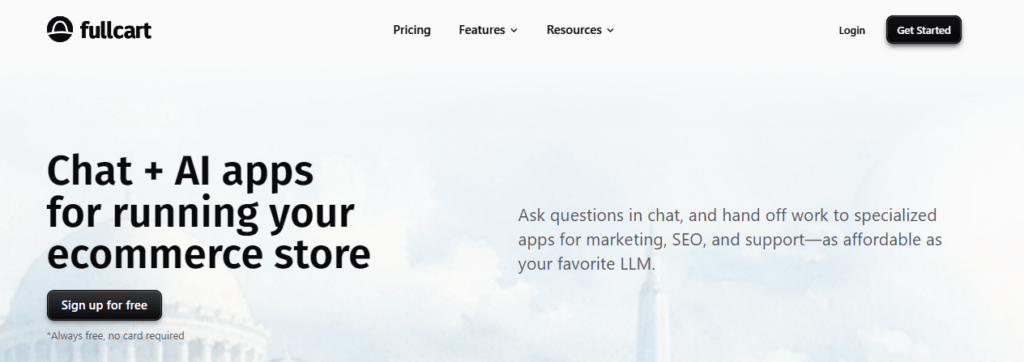
Fullcart describes its ecosystem as “Chat + AI apps for running your ecommerce store.”
- The Chat Layer: A conversational interface powered by a proprietary semantic SQL engine. You talk to it like a human colleague.
- The AI Apps: Specialized, autonomous agents that handle specific departments like marketing, inventory, finance, and customer support.
Meet Your Digital Workforce: Fullcart’s Specialized AI Apps
Instead of navigating complex menus, Fullcart allows you to “hire” digital employees. These AI apps work in parallel 24/7, constantly scanning your connected data sources for optimization opportunities.
1. The Data Analyst
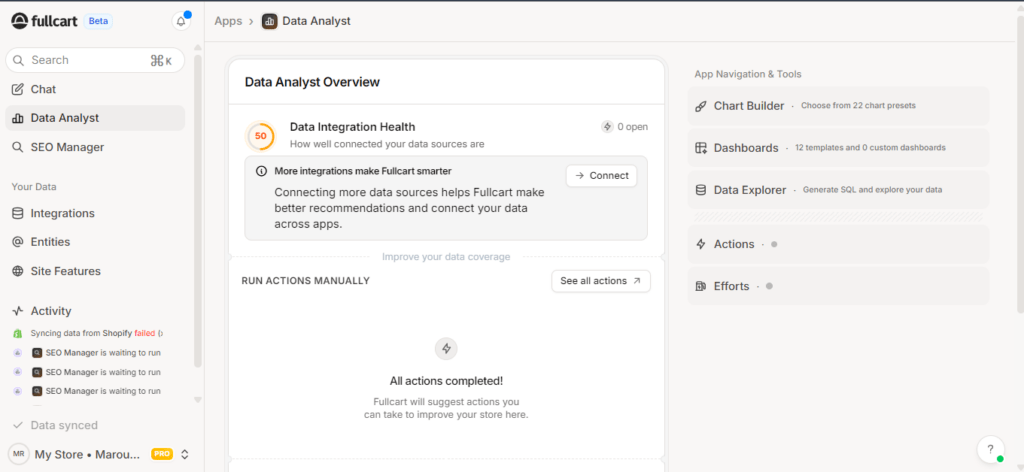
The Data Analyst app democratizes complex data science for non-technical founders and operators. Built on a distributed Online Analytical Processing (OLAP) engine, it queries billions of rows in milliseconds.
- Custom Dashboards on Demand: Instead of spending hours configuring widgets, you simply type, “Build me a dashboard showing LTV (Life Time Value) and customer acquisition cost for the last 90 days, broken down by traffic source.” The AI generates the charts instantly, which you can save and share with your team.
- Cross-Platform KPI Tracking: It unified data from Shopify, Amazon, Meta, Google, and TikTok, providing a single source of truth for your conversion rates and profitability.
2. The Inventory Manager
Getting inventory wrong is arguably the most expensive mistake an e-commerce brand can make. Stocking out before a peak season leaves cash on the table; overstocking ties up capital in dead inventory.
- Demand Forecasting: Fullcart’s Inventory Manager uses predictive AI to analyze historical data, seasonality, and current ad velocity to forecast exactly when you will run out of stock.
- Automated Purchase Orders: When inventory hits a critical threshold, Fullcart can automatically draft a purchase order for your supplier, update expected restock dates on your storefront, and even notify customers who are on a waitlist.
3. The Marketing Manager
Marketing automation tools like Klaviyo and Attentive have long dominated the market, but they often require deep technical expertise to set up complex flows.
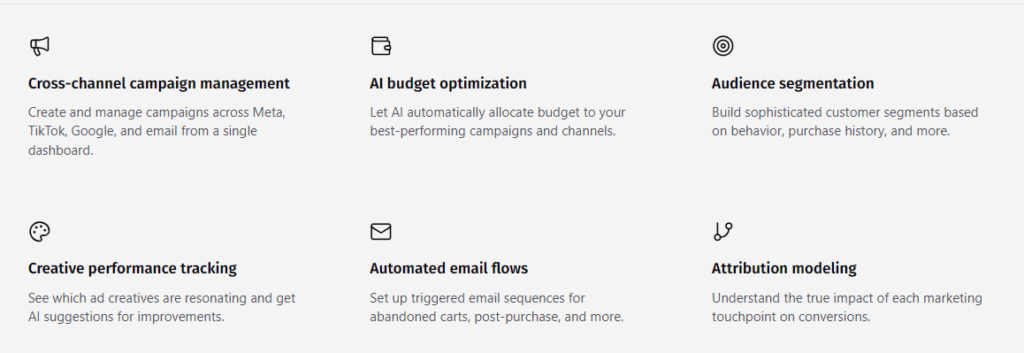
- Zero-Code Audience Segmentation: Fullcart unifies customer profiles across all touchpoints. You can instantly create segments like “VIP customers who bought during Black Friday but haven’t purchased in 6 months.”
- Automated Email & SMS: The AI generates campaign copy, schedules sends based on predictive optimal times, and sets up behavioral flows (abandoned cart, post-purchase win-backs). Crucially, Fullcart takes zero margin on email/SMS sends, passing the base cost directly to you.
- Ad Budget Optimization: It continuously monitors ad performance and dynamically shifts your budget toward the highest-performing campaigns across Meta and Google, ensuring your ad dollars are always working efficiently.
4. The SEO & AEO Manager
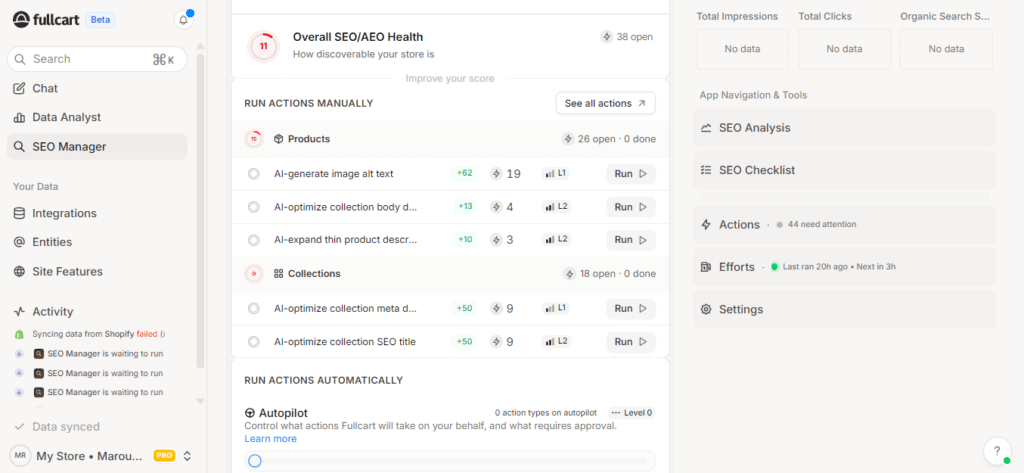
Search Engine Optimization (SEO) and Artificial Intelligence Engine Optimization (AEO) are critical for organic growth, but they require constant maintenance.
- Daily Hygiene Checks: The AI crawls your site daily, surfacing broken links, missing meta descriptions, and site speed issues.
- Content Generation: It doesn’t just track keyword rankings; it plans, writes, and publishes SEO-optimized blog content tailored to your brand voice, designed to capture long-tail search traffic.
5. The Support Agent
Customer service can easily overwhelm a scaling team. Fullcart handles the frontline efficiently while turning returns into a revenue-retention mechanism.
- Contextual Responses: Before you answer a ticket, Fullcart surfaces the customer’s entire purchase history, LTV, and an AI-generated summary of the issue.
- Branded Self-Service Returns: Fullcart offers a return portal built right in. Instead of paying hefty fees to third-party return apps, Fullcart incentivizes customers to take store credit or exchanges, helping you retain revenue.
- Shipping Protection: Similar to tools like Route or Extend, Fullcart allows you to offer shipping protection at checkout. However, unlike legacy tools that take a 2% to 2.5% cut of your cart value, Fullcart lets you keep 100% of the premium, providing full visibility into automated claims resolutions.
Talk to Your Data: The Semantic SQL Engine
One of the most impressive features of Fullcart is its semantic SQL engine. In traditional business intelligence (BI) tools, getting specific answers requires knowing SQL or relying on a data engineer.
With Fullcart, you simply ask questions in plain English. Because the AI is grounded in your actual connected data (not hallucinating from external web sources), the answers are accurate, fast, and actionable.
Examples of Natural Language Prompts You Can Use:
- “Show me the most ordered products from the Summer Sale collection compared to the Black Friday campaign.”
- “What is our current inventory turnover rate, and which products are at risk of becoming dead stock?”
- “Identify the marketing channel driving the highest Customer Lifetime Value over the last 12 months.”
Actionable Strategy: Do not just ask for data; ask for actions. Follow up a query like “Which ad is performing worst?” with “Pause it and allocate the remaining budget to the top-performing creative.” —
Putting Ecommerce on Autopilot: Understanding Autonomy Levels
Giving AI the keys to your e-commerce store can be intimidating. Fullcart mitigates this risk by offering granular control over how much autonomy the AI possesses, categorized into distinct levels.
Level 1 (L1): Insights & Suggestions (Manual Control)
At this level, Fullcart operates much like an advanced read-only tool. It scores your store health, surfaces improvements, and drafts emails or ad variants. However, it will not execute a single action without your explicit click of an “Approve” button. This is ideal for new users building trust with the platform.
Level 2 (L2): Supervised Automation
This is the “Autopilot” sweet spot for most businesses. Routine actions—like syncing tracking numbers, answering basic FAQ support tickets, or updating inventory counts—run entirely automatically. However, high-impact financial changes, such as finalizing a massive supplier purchase order or drastically changing a daily ad budget, are paused and sent to you for sign-off.
Level 3 (L3): Full Autonomy
For high-trust operators with well-defined policies, guardrails, and substantial historical data, Level 3 allows Fullcart to execute all actions autonomously. The AI relies strictly on the parameters you’ve set, ensuring the store operates efficiently 24/7 without requiring human bottlenecks.
The Financial Reality: Pricing and Tool Consolidation
To truly understand the value of Fullcart, you have to look at what it replaces. E-commerce software pricing has historically punished growth; the more you sell, the higher your monthly software fees climb through tiered GMV (Gross Merchandise Value) pricing.
Fullcart takes a drastically different approach with simple, transparent pricing.
Fullcart Pricing Tiers
| Feature | Free Plan | Pro Plan ($30 per user/month) |
| Data Sources | 1 Data Source | Unlimited Data Sources |
| Action Quota | 100 actions per month | 10,000 actions per month per user |
| Historical Data | 3 months look-back | 12 months look-back |
| Team Members | Unlimited | Unlimited |
| Audit Logs | Not included | Comprehensive Action Audit Log |
The ROI of Consolidation
Let’s look at a conservative estimate for a Shopify merchant processing 4,000 orders a month. A traditional tool stack might look like this:
- Triple Whale (Pixel Tracking/Dashboards): ~$300+/month
- Klaviyo (Email/SMS): ~$500+/month
- Loop Returns (Return Portal): ~$250/month
- Black Crow AI (Predictive Audiences): Custom (often $500+/month)
- ChatGPT Plus (Ad-hoc AI): $20/month per user
Total Legacy Stack Cost: ~$1,500+ per month.
By replacing these fragmented, single-purpose tools with Fullcart’s Pro Plan at $30 per user/month, a small team of three operators spends just $90/month. The savings in software subscriptions alone can easily fund an entire ad campaign, not to mention the hours saved by eliminating context switching between tabs.
Enterprise-Grade Architecture for SMBs
Performance and security are non-negotiable when dealing with customer data and financial transactions. Fullcart brings enterprise-level infrastructure to small and medium-sized businesses.
- Global Edge Delivery: The platform is deployed on worldwide CDN infrastructure, ensuring sub-100ms response times regardless of where your team or customers are located.
- Multi-Tenant Isolation: Your data is logically separated. It is never mixed with other organizations, ensuring your proprietary sales data isn’t used to train a competitor’s AI.
- Bank-Level Encryption: All data is encrypted in transit via TLS, and database-level encryption protects your data at rest.
- Privacy Compliance: Fullcart is fully compliant with GDPR and CCPA. It features built-in tools for data export and swift deletion requests, ensuring you remain compliant with international privacy laws.
Signup to Fullcart now for Free
Who Should Use Fullcart (And Who Should Wait)
While Fullcart is incredibly powerful, it is not a magic bullet for every single business. It is vital to assess your current stage of growth before migrating your tech stack.
Who This Is Perfect For:
- Scaling Shopify and Amazon Sellers: If you are processing at least 100 orders a month and have established a baseline of historical data, Fullcart can immediately identify trends and optimize operations.
- Time-Constrained Entrepreneurs: Solo founders or small teams who are spread too thin managing marketing, logistics, and customer service simultaneously.
- Non-Technical Operators: Business owners who prefer conversational interfaces and want deep data insights without needing to learn SQL or hire a data scientist.
Who Should Wait:
- Pre-Revenue Startups: If you have just launched your store and have zero sales, zero ad spend, and zero customer data, Fullcart has nothing to analyze. The AI requires a foundation of data to build predictive models. Focus on finding product-market fit first, and return to Fullcart when you have consistent traffic and sales.
- Enterprise Megacorps with Custom Legacy Tech: Highly complex legacy enterprises relying on on-premise servers and custom-coded ERPs may find the transition to an out-of-the-box AI platform requires a heavy migration process better suited for custom enterprise builds.
Step-by-Step: How to Get Started with Fullcart AI
Migrating to a new operational hub sounds daunting, but Fullcart’s onboarding is designed to take roughly 15 to 30 minutes. Here is how you can deploy your AI workforce today without overcommitting:
- Start on the Free Tier: Create an account (no credit card required) to access the Free plan.
- Connect Your Primary Data Source: Link your most critical platform first—usually your Shopify or Amazon Seller Central account. The platform will take a few minutes to securely sync your historical data (orders, products, customer profiles).
- Run a Semantic Test: Open the Chat interface and ask a complex question about your business. Try, “What was our most profitable product last month, and what was the return rate on it?” Verify the accuracy against your native Shopify dashboard to build trust in the semantic SQL engine.
- Connect Secondary Channels: Once you trust the data integration, connect Meta Ads, Google Analytics, and your email provider to enable cross-platform attribution and audience segmentation.
- Set Autopilot Guardrails: Navigate to the AI Apps section. Ensure your autonomy level is set to Level 1 or Level 2. Set strict budgetary limits on the Marketing Manager so it cannot overspend on ads without your approval.
- Decommission Redundant Apps: As you verify that Fullcart’s support portal, email flows, and dashboards are functioning properly, begin pausing your subscriptions to legacy, single-purpose apps to realize immediate ROI.
Conclusion: Embracing the AI Revolution in Ecommerce
The days of managing an e-commerce brand through a dozen disconnected browser tabs are rapidly coming to an end. The competitive advantage in 2026 and beyond will not belong to the merchant who works the longest hours, but to the merchant who leverages intelligent automation most effectively.
Fullcart – AI-Powered Ecommerce Analytics represents a massive leap forward in e-commerce management. By transitioning from a read-only, fragmented software stack to a unified, bidirectional AI workforce, you reclaim your most valuable asset: time. With AI handling the heavy lifting of inventory forecasting, ad optimization, and data analysis, you are finally free to focus on what AI cannot do—building a compelling brand, designing incredible products, and forging genuine connections with your community.
Signup to Fullcart now for Free
Related articles :
- Top Ways to Make Money from AI in 2026
- Shopify: E-commerce Dropshipping Platform
- What is e-commerce? Explanatory guide with definition and advice
- 13 Proven Strategies to Increase Organic Traffic for Ecommerce in 2025
- 6 Great YouTube Channels for eCommerce