 By
By 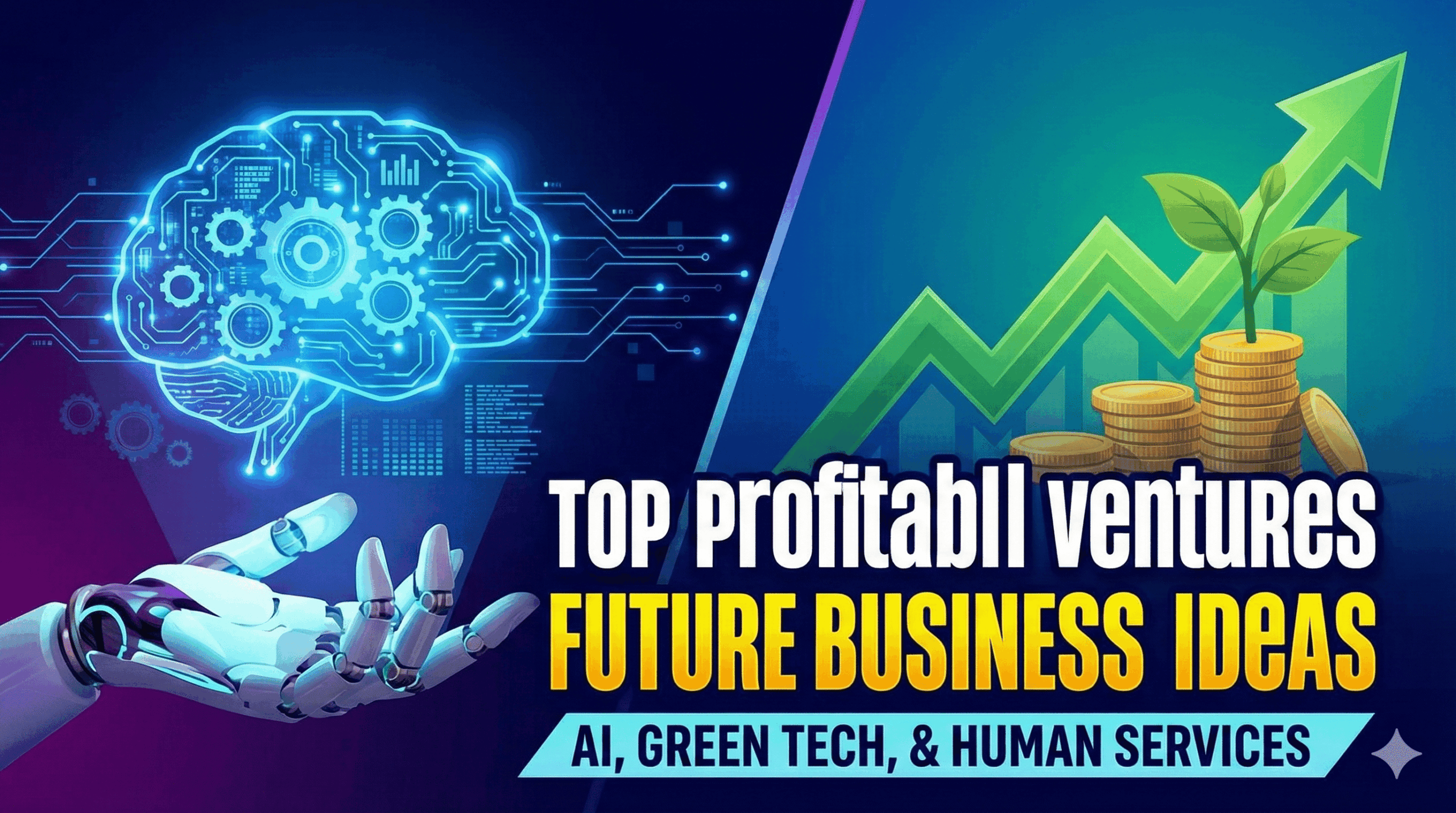
The year 2026 marks a pivotal shift in the global economy. We have moved past the initial hype of the “AI revolution” and entered a phase of systematic integration and maturity. The novelty of digital transformation has been replaced by a critical need for resilience, efficiency, and genuine human connection.
For entrepreneurs, this landscape offers unprecedented opportunities—but only for those who look beyond the obvious. The most profitable business ideas in 2026 aren’t just about using technology; they are about solving the specific friction points created by rapid technological adoption and economic volatility. Whether it’s managing the ethical compliance of artificial intelligence, building infrastructure for the circular economy, or creating sanctuary spaces for human well-being, the ventures that will thrive this year are those that offer stability in a changing world.
This comprehensive guide explores 15 high-potential business ideas for 2026, categorized by industry and trend. These are not merely concepts; they are actionable pathways tailored to the current economic climate, designed to help you build a venture that is both profitable and sustainable.
1. The AI “Second Wave”: Implementation & Governance
In 2026, businesses are no longer asking “What is AI?” They are asking, “How do we control it, trust it, and make it profitable?” The “Second Wave” of AI is defined by governance, specialization, and the transition from experimental pilots to full-scale production.
Idea 1: AI Compliance & Ethics Consulting
As governments worldwide roll out stricter regulations on artificial intelligence (similar to the EU AI Act), corporations are scrambling to ensure their systems are compliant. The “wild west” era of data usage is over.
- The Business Model: Launch a consultancy that audits corporate AI models for bias, data privacy violations, and regulatory compliance. You act as the “external auditor” for algorithms.
- Why It Wins in 2026: Liability is a major concern. Companies are terrified of lawsuits arising from AI “hallucinations” or discriminatory hiring algorithms. A firm that offers a “Certificate of AI Trust” provides the insurance and assurance these corporations desperately need.
- Actionable Step: Specialize in a specific niche, such as “AI Compliance for HR Recruitment Tools” or “FinTech Algorithm Auditing,” to quickly establish authority.
Idea 2: Niche “Small Language Model” (SLM) Development
While giants battle over Large Language Models (LLMs), the profitable ground for SMEs is in Small Language Models (SLMs). These are highly specialized, efficient models trained on proprietary data for specific industries.
- The Business Model: Develop and license custom, secure AI models for sectors that cannot risk data leakage, such as legal firms, boutique medical clinics, or specialized manufacturing.
- Why It Wins in 2026: Generalist models (like ChatGPT) are often too broad and inaccurate for hyper-specific technical tasks. A law firm doesn’t need a model that writes poetry; it needs one that understands 2026 tax code amendments perfectly.
- Actionable Step: Partner with industry veterans (e.g., a retired architect) to curate a high-quality dataset that can train a model to outperform general AI in that specific domain.
Idea 3: “Agentic” Workflow Architecture Agency
The buzzword of 2026 is “Agentic AI”—systems that don’t just answer questions but perform actions (e.g., “Book the flight, pay the invoice, and update the CRM”).
- The Business Model: A service agency that redesigns company operations to accommodate autonomous AI agents. You don’t just install software; you restructure the human workflow so that AI agents can handle end-to-end processes like accounts payable or customer onboarding.
- Why It Wins in 2026: Most businesses have the tools but lack the operational know-how to use them. They are trying to plug jet engines into horse carts. Your business builds the jet.
- Actionable Step: Offer a “Workflow Audit” as a lead magnet, showing companies exactly how many hours of human labor can be offloaded to agentic workflows.
2. Sustainability & The Circular Economy
Sustainability in 2026 is no longer just a marketing tactic; it is a financial survival strategy. With volatile commodity prices and supply chain fragility, businesses that help others “waste less” are seeing massive margins.
Idea 4: Reverse Logistics & Refurbishment Hubs
E-commerce returns have become a logistical nightmare and an environmental disaster. The “Circular Economy” demands that these products be reused, not landfilled.
- The Business Model: A B2B logistics company that exclusively handles returns for mid-sized e-commerce brands. You receive the returns, inspect them, refurbish/clean them, and restock them or resell them on secondary markets.
- Why It Wins in 2026: New “Right to Repair” and waste-prevention laws are forcing retailers to take responsibility for their products. They rarely have the internal infrastructure to handle this efficiently.
- Actionable Step: Focus on high-value, durable goods like electronics, premium furniture, or designer fashion, where the margin on a refurbished item remains high.
Idea 5: Residential Energy Retrofitting Services
With energy costs remaining unpredictable and climate awareness peaking, homeowners are looking to upgrade aging properties.
- The Business Model: A specialized contracting firm that updates older homes with 2026-standard energy tech: smart electrical panels, heat pump installations, and AI-driven insulation solutions.
- Why It Wins in 2026: Many governments are offering tax credits for green home improvements. Furthermore, as EV adoption saturates, older homes need electrical grid upgrades to handle charging loads.
- Actionable Step: Market yourself as a “Net-Zero Transition Partner.” Do not just sell a heat pump; sell a roadmap to a zero-carbon home.
Idea 6: Hyper-Local Vertical Farming Networks
Global supply chains are still prone to disruption from geopolitical tension and climate events. “Food security” is a trending concern for restaurants and local grocers.
- The Business Model: Set up micro-vertical farms in urban basements or shipping containers that supply high-margin greens (microgreens, herbs, gourmet mushrooms) to local high-end restaurants.
- Why It Wins in 2026: Chefs are willing to pay a premium for produce that was harvested two hours ago and has zero transport carbon footprint. It bypasses the volatility of international shipping.
- Actionable Step: Secure “subscription” contracts with 5-10 local restaurants before you even plant your first seed to ensure cash flow from day one.
3. The Human-Centric Economy: Wellness & Connection
As screens dominate our professional lives, the premium on “real” experiences and physical well-being has skyrocketed. The “Loneliness Epidemic” and “Digital Fatigue” are the problems; human connection is the solution.
Idea 7: Digital Detox & “Deep Work” Retreats
In a world of constant notifications, the ability to focus is the new luxury.
- The Business Model: Organize premium, offline retreats designed for executives and creatives. These are not just vacations; they are structured environments with no Wi-Fi, focused on “Deep Work” sessions, meditation, and face-to-face networking.
- Why It Wins in 2026: Burnout is at an all-time high. Professionals are realizing that they cannot produce high-level work while constantly connected. They will pay significantly for a curated environment that forces them to disconnect.
- Actionable Step: Location matters less than the program. You can rent a large cabin near a city. The value proposition is the structure and the rule enforcement (taking phones away).
Idea 8: Elder-Tech Concierge Services
The population is aging, but technology is accelerating. This gap creates a massive need for compassionate, technical support.
- The Business Model: A service that visits seniors to set up and maintain their technology—specifically health-tech (remote monitoring devices), smart home voice assistants (for safety), and communication tools to keep them connected to family.
- Why It Wins in 2026: “Aging in place” is the goal for most families. Technology makes this possible, but only if it works. Adult children are often too busy or remote to be the IT support for their parents.
- Actionable Step: Build trust by partnering with local geriatric care managers or retirement communities. Background checks and patience are your biggest assets here.
Idea 9: Bio-Data Health Coaching
Wearable technology (smart rings, continuous glucose monitors) has become mainstream. However, most users have drowning in data but starving for insights.
- The Business Model: A coaching business that interprets a client’s biological data to create hyper-personalized nutrition and fitness plans. You don’t just say “eat healthy”; you say, “Your glucose spikes at 8:00 AM, so switch your breakfast to X.”
- Why It Wins in 2026: Generic health advice is dead. People want precision health. Using AI tools to analyze their data allows you to offer “medical-grade” lifestyle advice without being a doctor (staying within coaching boundaries).
- Actionable Step: Obtain certification in functional nutrition or data analysis to add credibility. Use privacy-compliant apps to aggregate client data securely.
4. B2B Services for a Volatile Economy
The economic outlook for 2026 is one of “cautious growth.” Interest rates are stable but higher than in the 2010s, meaning capital is expensive. Businesses need efficiency, risk management, and cash flow protection.
Idea 10: SME Cash Flow & Risk Management Consulting
Small businesses are excellent at their craft but often terrible at financial forecasting. In an economy where one bad month can be fatal, they need protection.
- The Business Model: A fractional financial service that uses predictive analytics software to forecast cash flow for small businesses. You help them plan for seasonal dips, manage debt, and hedge against supply chain price hikes.
- Why It Wins in 2026: “Resilience” is the keyword for SMEs this year. They are willing to pay a monthly retainer for the peace of mind that comes with knowing exactly how much cash they will have in six months.
- Actionable Step: Target volatile industries like construction, hospitality, or retail, where cash flow gaps are most common.
Idea 11: Cybersecurity for IoT & Remote Teams
The perimeter of the office is gone. Employees are working from coffee shops, and factories are run by IoT sensors. This expanded surface area is a hacker’s dream.
- The Business Model: specialized cybersecurity firm focusing on “Edge Security”—protecting the devices (laptops, sensors, tablets) that are outside the corporate firewall.
- Why It Wins in 2026: As 5G enables more remote devices, the threat landscape expands. Large firms have internal teams, but mid-sized companies are exposed and vulnerable.
- Actionable Step: Offer a “Remote Worker Security Kit” product—a pre-configured router and VPN package for employees working from home, sold B2B to employers.
Idea 12: “Fractional” C-Suite Agencies
Startups and SMEs need high-level leadership but cannot afford the $250k+ salaries of full-time executives.
- The Business Model: An agency that provides “Fractional” (part-time) CTOs, CMOs, or CFOs. A single executive splits their time between 3-4 non-competing companies.
- Why It Wins in 2026: This model offers flexibility. If a company pivots, they can switch from a “Growth CMO” to a “Retention CMO” without firing anyone. It aligns with the “gigification” of high-skilled labor.
- Actionable Step: Build a roster of experienced executives who are looking for semi-retirement or variety in their work. Your business handles the matchmaking and billing.
5. Specialized Digital Platforms
The internet is becoming fragmented. The era of the “town square” social media is fading, replaced by smaller, tighter-knit communities and immersive experiences.
Idea 13: Paid Micro-Community “Tribes”
People are tired of algorithmic feeds filled with ads. They want connection with like-minded peers in a safe, high-quality space.
- The Business Model: Curate and manage paid, membership-only communities on platforms like Circle or Discord. Niches could range from “Eco-conscious Architects” to “Amateur Mycology Enthusiasts.”
- Why It Wins in 2026: Users are realizing that “free” content comes at the cost of their data and attention. They are willing to pay for “Tribes”—communities where the signal-to-noise ratio is high and the connections are valuable.
- Actionable Step: The value is not the content; it’s the peer group. Your job is to be the “Host,” facilitating introductions and ensuring high-quality discussions.
Idea 14: AR/VR Retail Experience Design
With Apple’s Vision Pro and Meta’s Quest lines maturing, “Spatial Computing” is entering the mainstream retail sector.
- The Business Model: A design studio that creates 3D virtual showrooms for e-commerce brands. Allow customers to “walk through” a virtual furniture store or “try on” digital watches in AR.
- Why It Wins in 2026: Retailers are desperate to reduce return rates. Letting a customer visualize a product in 3D in their own living room significantly increases buyer confidence.
- Actionable Step: Build a portfolio using standard 3D modeling tools (Blender, Unity) and target high-ticket e-commerce stores (furniture, luxury goods) first.
Idea 15: Print-on-Demand Eco-Products
This is the low-risk entry point for 2026, but with a twist: stricter sustainability.
- The Business Model: An e-commerce store using print-on-demand technology, but exclusively for biodegradable, organic, or upcycled materials. No cheap polyester.
- Why It Wins in 2026: Gen Z and Alpha consumers inspect labels. They want the convenience of online shopping but refuse to support “fast fashion” waste. A brand that guarantees “Zero Waste Production” (which POD inherently helps with) aligns with their values.
- Actionable Step: Use your marketing to highlight the absence of inventory waste. Make the “made to order” aspect a feature of your sustainability story, not just a logistical detail.
How to Choose Your 2026 Business Path
With so many options, how do you decide? In 2026, successful selection comes down to the “3 P’s Framework”:
1. Proof of Resilience
Ask yourself: If the economy dips next month, is this business a “must-have” or a “nice-to-have”?
- Resilient: Compliance consulting, elderly care, energy efficiency (saves money).
- Risky: Luxury travel, high-end experimental gadgets.
2. Proximity to AI
Does this business compete with AI, or does it leverage it?
- Dangerous: Copywriting, basic translation, generic coding.
- Safe: Strategic consulting (using AI data), physical services (plumbing, care), emotional connection (coaching).
3. Personal Alignment
Does this leverage your unfair advantage? In a world of automated content and generic services, your unique background is the only thing AI cannot replicate. If you have a background in nursing, the “Elder-Tech” idea is infinitely more viable for you than a “Crypto-Trading Bot.”
Conclusion: The Year of Pragmatic Innovation
The business ideas of 2026 are characterized by a return to basics, powered by advanced technology. The most successful entrepreneurs this year will not be the ones chasing the flashiest new toy, but the ones who use those toys to solve fundamental human problems: the need for connection, the need for security, and the need for a sustainable future.
Whether you choose to audit the algorithms that run our world or grow the food that feeds your neighborhood, the key to success in 2026 is trust. In an era of deepfakes and automated interactions, being a reliable, transparent, and human-centric business is the ultimate competitive advantage.
Related articles :
- 28 Profitable Online Business Ideas to Start in 2026
- How to Start a Business in 2026: All the Steps
- The New Trends of Entrepreneurship
- How to become rich and a millionaire quickly
- The Goldmine of Content: Exploring Top Money-Making YouTube Channels