
 By
By 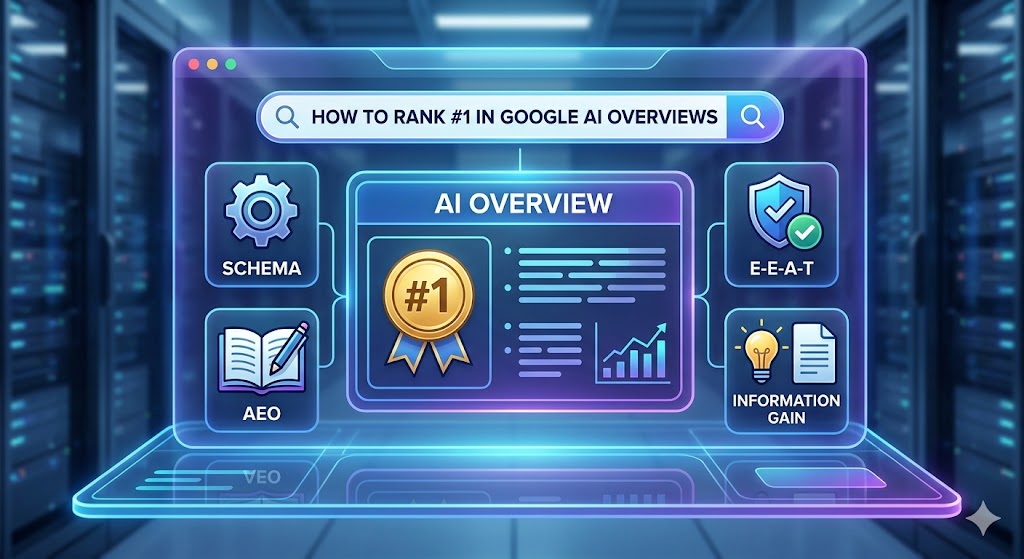
The search landscape has fundamentally shifted. Securing a traditional “blue link” at the top of Google’s Search Engine Results Pages (SERPs) is no longer the ultimate finish line. With the rapid integration of generative AI into search, the new prime real estate is Google’s AI Overviews.
Appearing as the definitive, AI-generated summary at the very top of the page, AI Overviews provide users with immediate, synthesized answers to complex queries. If your content isn’t being cited in these overviews, your organic click-through rates (CTR) are likely taking a hit.
Ranking #1 in an AI Overview requires a paradigm shift from traditional Search Engine Optimization (SEO) to Answer Engine Optimization (AEO). Search engines no longer just match keywords; they extract facts, evaluate entities, and synthesize data.
This comprehensive guide will walk you through the exact, data-backed strategies required to optimize your content, satisfy Google’s generative algorithms, and rank #1 in Google’s AI Overviews.
1. The Paradigm Shift: SEO vs. Answer Engine Optimization (AEO)
To understand how to rank in AI Overviews, you must first understand how Google’s AI evaluates content. Traditional SEO focuses on ranking a single webpage based on backlinks, keyword density, and user experience. Generative search, however, doesn’t rank a single page to display; it reads multiple high-authority pages, extracts the best information, and weaves it into a single response.
Your goal is no longer just to get a user to click your link. Your goal is to make your content the most extractable, factual, and structurally sound source for the AI to quote.
What AI Overviews Look For:
- Semantic Completeness: Does your page cover the topic from every angle, answering the immediate question and all logical follow-up questions?
- Extractability: Is the answer buried in a wall of text, or is it neatly packaged in a standalone, easy-to-parse paragraph?
- Information Gain: Are you adding unique data, original research, or first-hand experience, or simply regurgitating what the top 10 results already say?
2. Master the “Answer-First” Content Structure
Google’s Large Language Models (LLMs) are highly sophisticated, but they still prefer content that is easy to digest. If the AI has to work hard to find the answer to a user’s query, it will simply pull the answer from a competitor’s site instead.
The Definition-First Architecture
The single most effective structural change you can make is adopting the inverted pyramid style of writing. Every major section of your article should begin with a direct, concise answer.
- The Query Header: Use an H2 or H3 that directly mirrors the user’s search intent (e.g., What is Answer Engine Optimization?).
- The Direct Answer (The Target Snippet): Immediately following the header, write a 50 to 70-word paragraph that directly answers the question. Do not use fluff, preamble, or context-setting here. Provide immediate gratification.
- The Justification: Use the following paragraphs to provide context, statistics, examples, and deep-dive explanations.
- The Conclusion/Implication: Wrap up the section with a clear takeaway.
Formatting for Machine Readability
AI systems love structured data, and visual formatting acts as a roadmap for extraction. Break up your content to make it infinitely scannable:
- Use Bullet Points and Numbered Lists: When answering “How-to” queries, always use numbered steps. When listing benefits, use bullet points. AI Overviews frequently pull lists directly into their summaries.
- Keep Paragraphs Short: Limit paragraphs to 2–3 sentences. Long, winding blocks of text are harder for natural language processing (NLP) models to confidently extract.
- Add Mini-Definitions: If you introduce a complex industry term, provide a one-sentence definition inline. This prevents the AI from having to seek context elsewhere.
3. Target Long-Tail and Question-Based Queries
AI Overviews are specifically designed to handle complex, multi-layered questions that traditional search struggles with. Consequently, broad, generic keywords (like “shoes” or “SEO”) rarely trigger robust AI summaries. The magic happens in the long-tail queries.
Finding AI-Triggering Keywords
Users are engaging with search engines more like conversational chatbots. They aren’t typing “best dog food”; they are typing, “What is the best grain-free dog food for a senior golden retriever with a sensitive stomach?”
To capture this traffic:
- Leverage Question Modifiers: Build your content strategy around “Who, What, Where, When, Why, and How” queries.
- Analyze “People Also Ask” (PAA): The questions that appear in Google’s PAA boxes are prime candidates for AI Overview triggers. Dedicate H2s or H3s in your article to answering these specific questions.
- Target Comparison Queries: “Versus” queries (e.g., Tool A vs. Tool B) heavily trigger AI Overviews. Create structured comparison tables and distinct pros/cons lists to make this data easily extractable.
4. Elevate E-E-A-T and Trust Signals
Experience, Expertise, Authoritativeness, and Trustworthiness (E-E-A-T) are no longer just guidelines for human raters; they are deeply ingrained in how Google’s AI decides which sources are safe to cite. Generative AI models are prone to “hallucinations” (making things up), so Google heavily weights trust signals to ensure the AI only quotes verified facts.
Demonstrate Real-World Experience
AI ignores copycat content. If your article looks exactly like the ten other articles ranking on page one, you offer no “Information Gain.” To stand out, you must inject unique insights:
- First-Hand Case Studies: Share actual results from your own business or clients.
- Original Data: Conduct surveys or analyze your own platform’s data to generate statistics no one else has.
- Expert Quotes: Interview subject matter experts and include their direct quotes. AI systems look for attribution to verify claims.
Transparent Authorship
Anonymous corporate content is losing ground to verified experts. To build trust with the AI algorithm:
- Ensure every article has a clearly defined author with a detailed bio.
- Link the author’s bio to their active LinkedIn profile or other professional hubs to establish a recognizable “entity” across the web.
- If you are writing on Your Money or Your Life (YMYL) topics (health, finance, legal), ensure the content is medically or legally reviewed by a credentialed professional, and state this clearly on the page.
Cite Authoritative Sources
When making factual claims, link out to high-authority, primary sources (e.g., academic journals, official government sites, original research papers). Format your citations clearly so the AI understands you are referencing a trusted entity.
5. Implement Advanced Technical SEO for AI
While Answer Engine Optimization focuses heavily on content, traditional technical SEO is the foundation that makes AEO possible. If Googlebot cannot efficiently crawl, render, and index your page, you will never appear in an AI Overview.
Schema Markup (Structured Data)
Schema markup is the language of search engines. It translates your human-readable text into machine-readable code, explicitly telling the AI what your content is about. For AI Overviews, specific schemas are incredibly powerful:
- FAQPage Schema: This directly maps your question-and-answer pairs, allowing the AI to bypass parsing your prose and pull the answer directly from the code.
- Article Schema: Helps the AI identify the headline, author, and publication date.
- HowTo Schema: Perfect for step-by-step guides, breaking down the process into defined, extractable actions.
- Organization and Person Schema: Helps solidify your brand and authors as distinct entities in Google’s Knowledge Graph.
Core Web Vitals and Page Experience
Google’s AI prefers pages that load quickly and are free of intrusive elements.
- Speed: A slow, bloated page wastes crawl budget and provides a poor user experience. Optimize your images, minify your CSS/JS, and ensure a fast server response time.
- Clean Layouts: Avoid aggressive pop-ups, interstitial ads, or layouts that push the main content below the fold. The AI needs to “see” the answer immediately.
Perfect Crawlability
Ensure your robots.txt file is not accidentally blocking essential directories. Furthermore, avoid relying entirely on client-side JavaScript to load your core content. If the text isn’t immediately visible in the raw HTML, the AI may miss it entirely during its initial crawl.
6. Embrace Multi-Modal Content Integration
Google’s AI is increasingly multi-modal, meaning it understands and synthesizes text, images, video, and audio simultaneously. AI Overviews frequently feature visual elements alongside text to provide a richer user experience.
Optimize Your Visuals
- Context-Rich Images: Don’t use generic stock photos. Create custom infographics, charts, and process diagrams that actually explain the concept in your text.
- Descriptive Alt Text: Your alt text shouldn’t just be a keyword; it should describe exactly what the image is and how it relates to the surrounding content.
- Video Integration: Embed short, highly relevant YouTube videos into your content. Ensure the video has accurate closed captions (transcripts), as Google’s AI reads video text to match it with user queries.
7. The “Always-On” Content Refresh Strategy
AI Overviews have a strong bias toward freshness, especially for topics that evolve quickly (technology, statistics, news). An incredibly comprehensive guide from 2023 will likely lose its AI citation to a slightly less comprehensive but highly accurate article published yesterday.
Managing Content Decay
To maintain your #1 spot in an AI Overview, you must treat your content as a living document:
- Regular Audits: Identify your top-performing pages and review them quarterly.
- Update Statistics: Never leave a statistic older than 12–18 months in your content. Track down the newest data, update the number, and update the citation link.
- Refresh the “Published On” Date: When you make significant, meaningful updates to a piece of content (not just changing a comma), update the timestamp to signal to Google that the content has been modernized.
Conclusion: Future-Proofing for the Generative Era
Ranking #1 in Google’s AI Overviews is not about tricking an algorithm; it’s about radically aligning your content with the needs of the user and the processing capabilities of machine learning models.
By mastering the answer-first structure, targeting complex long-tail queries, establishing undeniable E-E-A-T, and keeping your technical SEO flawless, you transition your website from a mere list of links into a foundational source of truth for the AI age.
The shift to Answer Engine Optimization is ongoing, and the models will continue to evolve. Stay adaptable, write for clarity, and prioritize information gain above all else.
Related articles :
- The Shifting Sands of Search: Navigating Google’s New AI Overview for SEO
- Link Anchors in SEO: Complete Guide
- Updating your SEO content: 19 quick and effective techniques
- Internal linking: the backbone of SEO
- Is SEO Dead in 2026 with the rise of AI tools?