
How to add Table of Content to Scrowp Theme
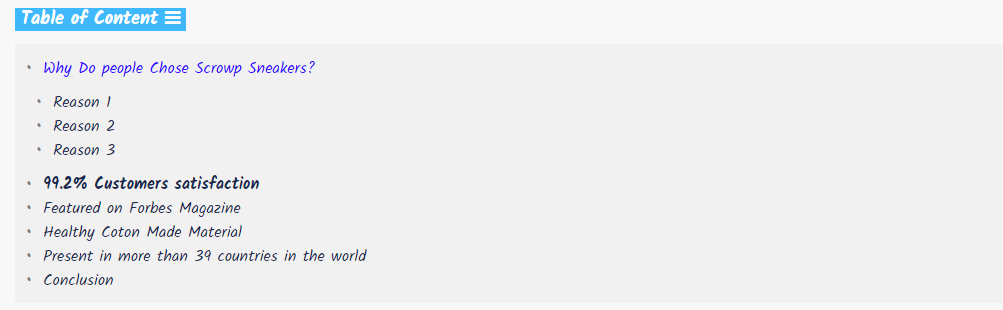
A table of contents is a great way to make a post or a page scannable. It does not matter if a post is long or short. On Scrowp theme, adding one just got super easy.
All you need to do is to enable the table of content with a simple click and the feature is then automatically generated on all your articles.
The importance of the table of content
At Scrowp Theme, we are always looking for ways to make the navigation easier and attractive for the visitors, but also SEO friendly, to position your articles on top of search engines.
Attractive feature for readers
One of the tools that can help you improve the scanability of an article is a table of contents just below the blog article title. For longer articles, this is a must-have but even shorter articles can benefit from them.
Readers can easily toggle the table of content, click on a header and more straight to its paragraph, this way the readers can easily see the main topics of your article.
SEO benefit : Jump link
The second benefit of the table of content is the Jump link. You can see these links either before the meta description of underneath a search result and these allow you to see the sections of a page from within the SERP, and to click directly to the relevant section.
The table of content add an ID attribute to every header and use those to automatically fill the table of contents. Now, Google and other search engines can use these anchors to show them in search.
How the table of content works ?
The feature automatically renders a table of contents for the current page and it takes into account all headers (h2, h3, …h6) and hierarchy. The table of content block automatically updates whenever you make changes to your text.
How to enable it and customize it ?
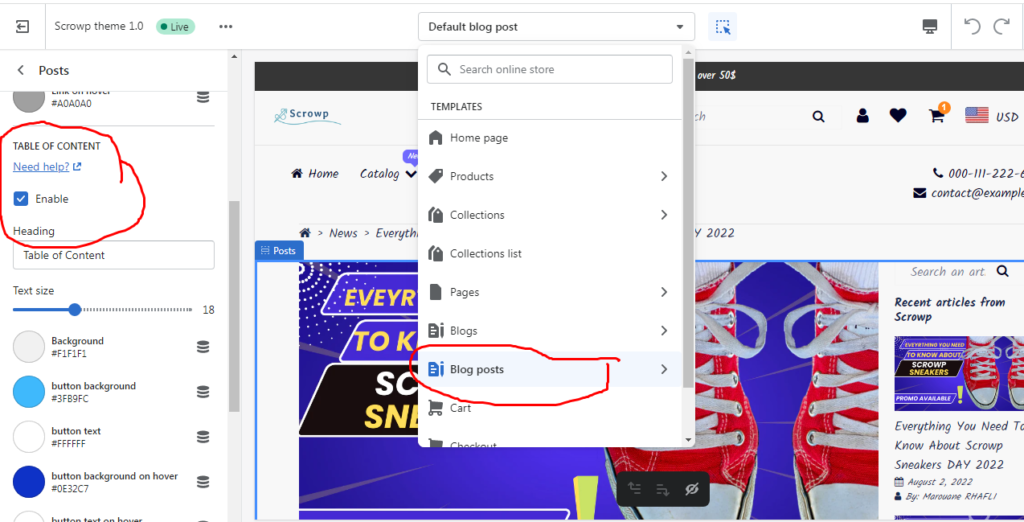
You can enable/disable the table of content with a simple click directly from the theme editor when you are on a blog post
A table of contents (TOC) is a powerful on-page SEO asset that improves user experience, strengthens content structure, and can indirectly boost rankings by enhancing engagement metrics and crawlability. While a TOC is not a magic ranking factor on its own, it supports many of the signals that modern search engines reward, especially on long-form content.
What a TOC Is in SEO
A table of contents in SEO is a clickable list of a page’s main sections, usually placed near the top and linked with anchor/jump links to headings down the page. It acts as a navigation hub that lets users and search engines quickly understand the structure and topics covered in the content.
For long guides, tutorials, and pillar pages, a TOC becomes part of the core information architecture, not just a cosmetic element. Each item in the TOC typically maps to an H2 or H3 heading, which makes the hierarchy of information more explicit and easier to process.
User experience and engagement gains
User experience is at the heart of modern SEO, and a TOC directly improves how people interact with long content. By offering a scannable overview and one-click access to specific sections, visitors can skip straight to what matters, instead of scrolling endlessly.
Those UX gains translate into engagement signals that search engines can interpret as content quality indicators. A well-designed TOC can help:
- Reduce bounce rate, because users quickly find relevant sections instead of leaving in frustration.
- Increase dwell time and pages-per-session, since visitors are more likely to keep exploring when navigation is effortless.
Structural and crawlability benefits
Search engines rely on clear structure to understand what a page is about and how its parts relate to each other. A TOC reinforces that structure by creating a logical outline of topics and subtopics, supported by internal anchor links.
This structure helps crawlers move through the document more efficiently and understand the hierarchy and relevance of sections. As a result, a TOC can:
- Improve indexing of important subsections, especially when each section targets a specific query or keyword cluster.
- Clarify topical coverage, which supports semantic understanding and can help content perform better for long-tail and related searches.
SERP visibility and linkability
Clickable tables of contents can influence how a page appears in search results by enabling rich SERP features. When Google recognizes in-page anchor links, it may display sitelink-style jump links under the main result, giving the listing more real estate and specific entry points.
This extra visibility can drive higher click-through rates because users see that the page answers distinct questions within one comprehensive resource. In addition:
- Each TOC item has its own URL fragment (e.g., /guide/#pricing), which can be shared or linked to directly, creating linkable “micro-assets” inside a single article.
- Well-structured pages with clear sections are also more likely to be used in featured snippets or “People Also Ask” answers, especially for specific subtopics covered in those anchors.
Best practices to maximize SEO impact
To get the most SEO value from a table of contents, it needs to be implemented thoughtfully and aligned with user intent. Simply adding a generic list of headings without thinking about structure and usability will not move the needle.
Strong TOC implementations usually:
- Use descriptive, keyword-relevant section titles that clearly reflect what each part covers.
- Link only to meaningful sections, avoiding “fluff” headings that do not solve a real user need.
- Maintain consistent heading hierarchy (H1 → H2 → H3) so both users and search engines can follow the logical flow.
From a technical perspective, using clean anchor IDs, accessible markup, and ensuring the TOC works well on mobile prevents UX issues that could negate SEO benefits. Testing how users interact with the TOC—click patterns, scroll depth, and engagement—helps decide where it adds value and where it might be unnecessary clutter.