
 By
By 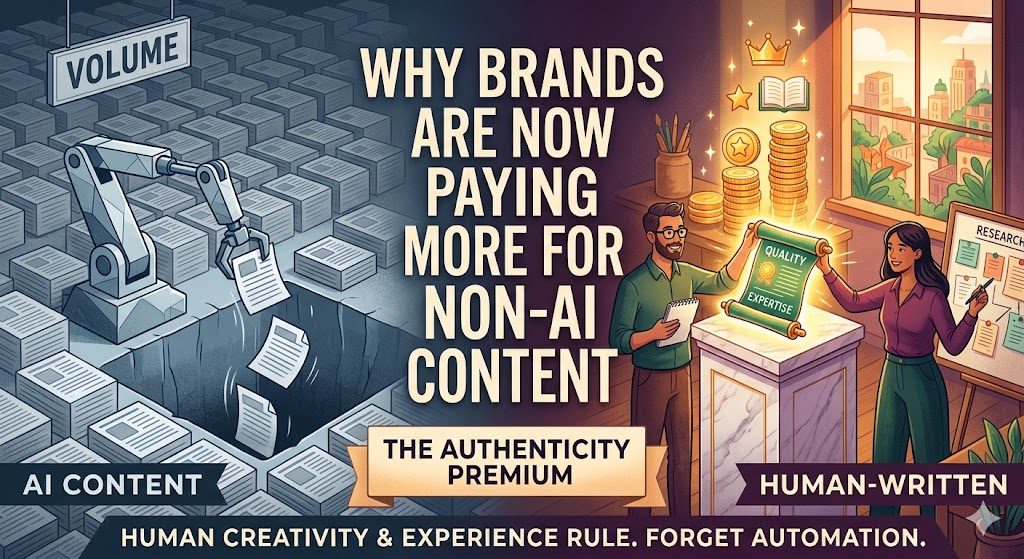
When generative artificial intelligence burst onto the mainstream scene, it promised a revolution in digital marketing. The proposition was tantalizingly simple: infinite content produced at near-zero cost. Marketing teams rejoiced, content creators panicked, and the internet braced for a tsunami of articles, blog posts, and social media updates.
However, as the dust settles on the initial AI boom, a surprising and counterintuitive trend has emerged. Instead of a complete takeover by algorithms, there is a growing, highly lucrative market for authentic, human-written text. Today, forward-thinking brands are intentionally seeking out—and paying a significant premium for—non-AI content.
Why the sudden reversal? The answer lies in the fundamental principles of economics, psychology, and search engine optimization (SEO). When average content becomes infinitely abundant, its value drops to zero. Conversely, original thought, lived experience, and genuine human connection become scarce commodities.
In this comprehensive guide, we will explore the exact reasons behind this shift, how search engines are forcing brands to adapt, and why investing in premium human content is now one of the highest-ROI strategies in digital marketing.
The Rise and Plateau of AI-Generated Content
To understand why human content commands a premium, we first need to look at the lifecycle of the AI content boom and the structural problems that quickly became apparent to marketers.
The Initial Allure of Infinite Content
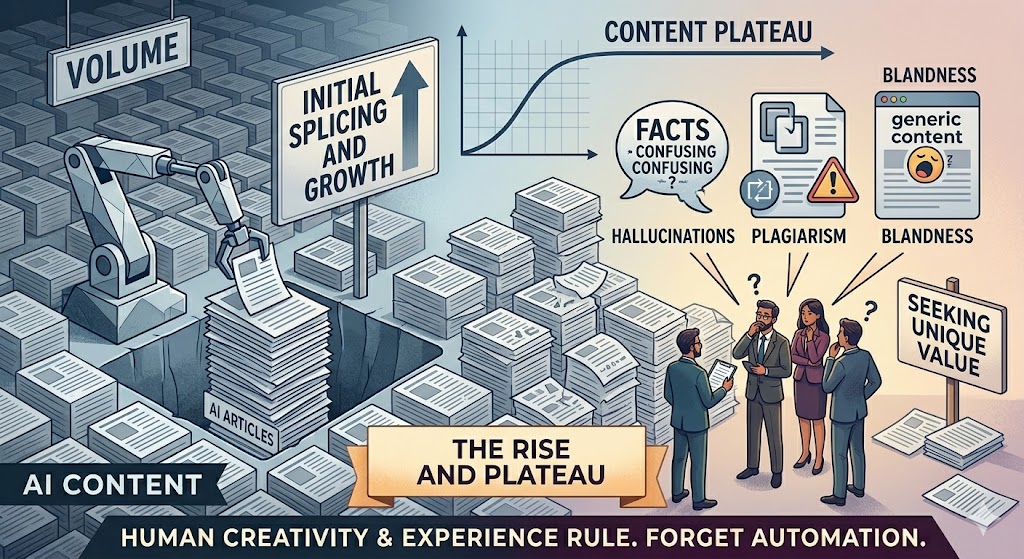
In the early days of advanced Large Language Models (LLMs), the focus was strictly on volume. Brands that previously published two blog posts a week were suddenly publishing twenty. SEO strategies shifted toward programmatic generation—spinning up thousands of landing pages targeting every conceivable long-tail keyword. For a brief moment, the strategy worked. Traffic spiked, and the cost-per-word plummeted.
The Backlash: Hallucinations, Plagiarism, and Blandness
The honeymoon phase was short-lived. Brands quickly realized that while AI excels at syntax and grammar, it struggles fundamentally with originality. LLMs are predictive text engines; they function by guessing the next most logical word based on existing data. By definition, they can only regurgitate and rephrase what has already been published.
This led to the “Sea of Sameness.” Entire industries found their search results flooded with identical, vanilla content. Furthermore, unchecked AI generated “hallucinations” (confident but factually incorrect statements) and flirted with plagiarism, creating severe legal and reputational risks for established brands.
The SEO Imperative: Google’s Shift Toward E-E-A-T
The most significant driver behind the demand for non-AI content is Google itself. Search engines are in the business of serving relevant, high-quality information to users. When AI threatened to drown search results in low-effort spam, Google responded aggressively.
Decoding E-E-A-T
For years, Google has relied on a framework known as E-A-T (Expertise, Authoritativeness, Trustworthiness) to evaluate content quality. Recently, they added a crucial extra “E”—Experience.
- Experience: Has the author actually used the product, visited the location, or lived through the scenario they are writing about?
- Expertise: Does the author possess the necessary credentials or deep knowledge of the subject?
- Authoritativeness: Is the author or website recognized as a leader in this specific field?
- Trustworthiness: Is the site secure, transparent, and factually accurate?
Why AI Fails the “Experience” Test
AI inherently fails the first “E” of the E-E-A-T framework. An algorithm has never tested a hiking boot, felt the frustration of a software bug, or managed a remote team. It cannot provide a first-hand review or a lived anecdote. Google’s algorithms, particularly the Helpful Content Updates, are increasingly designed to identify and demote content that lacks genuine human experience, rewarding sites that offer first-hand insights.
The Information Gain Score
Google also utilizes a concept known as “Information Gain.” This measures how much new information an article brings to a topic compared to what is already indexed. Because AI models only summarize existing data, their Information Gain score is virtually zero. Brands are paying human writers a premium because humans can conduct original research, interview experts, and synthesize new ideas that score high in Information Gain, thereby securing top search rankings.
The Core Reasons Brands Pay a Premium for Human Writers
Beyond algorithmic survival, there are deeply rooted business and psychological reasons why brands are opening their wallets for top-tier human talent.
1. Deep Subject Matter Expertise (SME)
Generalist writers have largely been replaced by AI, but Subject Matter Experts are in higher demand than ever. A seasoned cybersecurity analyst writing about network vulnerabilities brings a level of nuance, jargon fluency, and practical insight that no AI can replicate. Brands pay more because these writers aren’t just creating content; they are transferring their hard-earned industry credibility directly to the brand.
2. Unique Brand Voice and Personality
Every successful brand has a distinct voice. Apple sounds different than Wendy’s; Nike sounds different than IBM. While AI can be prompted to write in a “witty” or “professional” tone, it inevitably reverts to a recognizable, robotic cadence. Human writers inject humor, irony, empathy, and cultural zeitgeist into their work. A premium writer understands how to modulate tone perfectly to resonate with a specific target audience, ensuring the brand doesn’t sound like a generic chatbot.
3. Emotional Intelligence and Empathy
Purchase decisions are heavily influenced by emotion. Whether a consumer is buying enterprise software or a pair of running shoes, they want to feel understood. Human writers draw on empathy to identify user pain points and address them authentically. They know how to write a compelling hook that triggers curiosity or an inspiring conclusion that motivates action. AI lacks emotional intelligence, often resulting in copy that is structurally perfect but emotionally hollow.
4. Original Research and Data Interpretation
The most linkable, high-ranking content on the internet is usually backed by original research. Humans are required to design surveys, analyze proprietary company data, interview internal stakeholders, and interpret the results in a meaningful way. Brands pay a premium for this investigative journalism approach because it generates proprietary content that competitors (and their AI tools) cannot legally or practically copy.
High-Stakes Industries: Where Human Content is Non-Negotiable
While a local bakery might get away with an AI-generated Facebook post, certain industries face catastrophic consequences if they rely on automated content. In these sectors, the premium for non-AI content is considered a mandatory insurance policy.
Your Money or Your Life (YMYL) Niches
Google categorizes topics that can directly impact a reader’s health, financial stability, or safety as YMYL. This includes healthcare, personal finance, legal advice, and insurance. In these niches, Google’s E-E-A-T standards are ruthlessly strict. An AI-generated article dispensing medical advice is not only an SEO death wish but a massive liability. Medical brands and financial institutions gladly pay top dollar for content written and medically/legally reviewed by credentialed human professionals.
B2B SaaS and Technical Audiences
The Business-to-Business (B2B) Software as a Service (SaaS) sector targets highly educated, skeptical buyers. Developers, CTOs, and IT managers can spot AI-generated technical content from a mile away. It insults their intelligence and immediately degrades the brand’s authority. B2B brands must hire specialized technical writers who can dive deep into documentation, use cases, and complex architecture.
Luxury and High-End E-commerce
Luxury is fundamentally about exclusivity, craftsmanship, and storytelling. A brand selling a $5,000 watch cannot rely on cheap, automated product descriptions. The copy must reflect the meticulous attention to detail that went into the product itself. Human copywriters are essential for weaving the brand’s heritage, prestige, and sensory details into the content.
The Hidden Costs of Cheap AI Content
When executives see the price tag of premium non-AI content, they often compare it to the “free” cost of ChatGPT. However, this is a false equivalence. The true cost of AI content includes several hidden liabilities that ultimately make it more expensive in the long run.
Brand Reputation Damage
Trust takes years to build and seconds to destroy. Publishing an article with an obvious AI hallucination or a tone-deaf response to a sensitive cultural issue can result in severe PR backlash. The cost of repairing a damaged reputation far outweighs the cost of hiring a professional writer.
The Burden of Heavy Editing and Fact-Checking
AI content is never truly ready to publish. It requires a “human-in-the-loop” to check facts, edit for flow, align the copy with brand guidelines, and format the piece. By the time a senior editor has spent three hours fixing a mediocre AI draft, the company has spent just as much money on hourly wages as they would have by outsourcing to a premium freelancer from the start.
Decreased Conversion Rates and High Churn
Traffic is a vanity metric; conversions pay the bills. AI content might temporarily trick an algorithm, but it rarely persuades a human to enter their credit card information. Bland, uninspiring copy leads to high bounce rates, low time-on-page, and abysmal conversion rates. Premium human content pays for itself by guiding the reader seamlessly through the sales funnel.
The New Content Economics: ROI of Premium Non-AI Content
The shift toward human-written content requires a fundamental change in how marketing departments view their budgets. We are moving from a paradigm of volume to a paradigm of value.
Quality Over Quantity: The Shift in Strategy
Instead of publishing ten generic 500-word blog posts a month, brands are reallocating that exact same budget to produce one or two spectacular, 2,500-word definitive guides. These “cornerstone” pieces—rich with custom graphics, expert quotes, and unique insights—attract high-quality backlinks, dominate search rankings, and serve as lead-generation magnets for years.
Long-Term Compounding Value
Premium non-AI content is an asset, not an expense. A well-researched, deeply human piece of thought leadership will continue to drive organic traffic and establish authority long after it is published. While AI content decays rapidly as competitors generate the exact same text, human content compounds in value, creating a durable competitive moat.
How to Build a Human-First Content Strategy
If you are a brand looking to pivot away from the algorithmic “Sea of Sameness” and invest in high-converting, premium content, here is a blueprint for building a human-first strategy.
Lean into Opinion and Perspective
Stop writing encyclopedia entries. If a user wants a sterile definition of a concept, they will ask an AI chatbot. If they visit your website, they want to know what you think about it. Encourage your writers to take a stance, argue a contrarian point of view, and inject strong opinions into your content. Perspective is the ultimate differentiator in the AI era.
Conduct Primary Research and Interviews
Make original data the foundation of your content calendar.
- Survey your customer base and publish the findings.
- Record internal meetings and extract insights from your product team.
- Have your writers interview industry leaders and embed those quotes into the text. This guarantees that your content is 100% unique and highly linkable.
Use AI as an Assistant, Not an Author
Paying for non-AI content does not mean banning AI from your marketing department. The most effective premium writers use AI extensively—but strictly as an assistant. AI is incredible for generating outlines, summarizing raw interview transcripts, organizing data sets, and brainstorming headline variations. By letting AI handle the tedious administrative tasks, human writers can dedicate all their cognitive energy to strategy, storytelling, and emotional connection.
Prioritize Portfolio Over Speed When Hiring
When looking for premium writers, ignore metrics like “words per hour.” Instead, look for a portfolio that demonstrates deep industry knowledge, a compelling voice, and a track record of driving real business results. Ask potential hires about their research process, how they source subject matter experts, and how they approach brand voice.
Frequently Asked Questions (FAQs)
Q: Will Google penalize my site if I use AI content? A: Google’s official stance is that they do not penalize AI content strictly because it is AI. However, they aggressively penalize content that is unhelpful, spammy, or lacks original value. Because unedited AI content usually falls into these categories, relying heavily on it often leads to a drop in rankings following Core Updates.
Q: How much more does premium human content cost compared to AI or low-tier writers? A: While entry-level content mills might charge $0.05 per word, premium Subject Matter Experts and specialized copywriters typically charge anywhere from $0.30 to over $1.00 per word, or shift to project-based flat rates. The investment reflects the research, interviews, and strategic thinking involved.
Q: How can I prove to my stakeholders that human content is worth the investment? A: Shift the focus away from “cost per word” and toward “cost per acquisition” (CPA) and “return on investment” (ROI). Track metrics like time-on-page, bounce rate, backlink acquisition, and lead generation. A single premium article that generates 50 high-quality leads is infinitely more valuable than 100 AI articles that generate none.
Q: Can AI ever replicate human emotion in writing? A: While AI will continue to improve at simulating emotion, it cannot genuinely experience it. Readers are incredibly adept at sensing authenticity. Until an AI can actually experience the world, it will always be mimicking human emotion rather than generating it authentically.
Conclusion
The digital landscape is undergoing a massive correction. The initial frenzy of AI-generated content proved that while technology can scale the production of words, it cannot scale the meaning behind them. Brands are waking up to the reality that in an internet flooded with automated noise, a genuine human voice is the ultimate luxury.
Paying a premium for non-AI content is no longer an optional indulgence; it is a critical requirement for surviving Google’s algorithm updates, building unshakeable brand authority, and forging deep, profitable connections with consumers. By investing in real human experience, original research, and emotional intelligence, brands can elevate themselves above the sea of sameness and secure their place at the forefront of their industries. The future of content isn’t artificial; it is profoundly, stubbornly human.
Related articles :
- How to Hire Your First AI Agent to Manage Your Emails and Calendar (2026 Guide)
- How to Build a Profitable Faceless YouTube Channel Using AI Video Generators (Like Veo)
- The Laziest Way to Make Money Online in 2026: 7 Automated Paths to Wealth
- The 2026 “Route to $10,000/Month”: A Blueprint for Leveraging AI and High-Value Systems