
 By
By 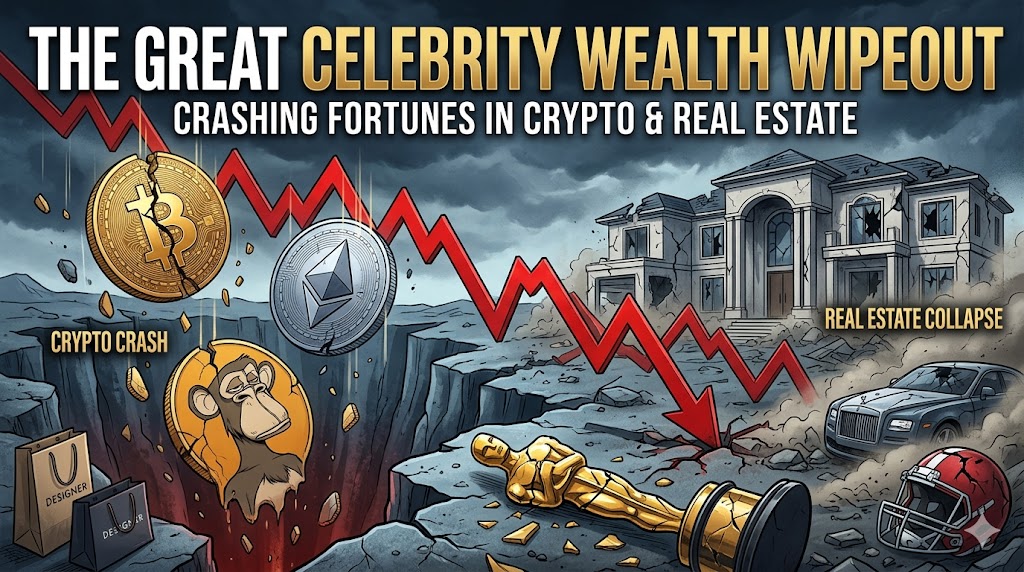
For years, the public has been conditioned to view celebrity wealth as an impenetrable fortress. Whether through chart-topping albums, blockbuster movies, or lucrative athletic contracts, A-listers seem to possess a financial safety net that the average person can only dream of. However, the financial landscape of 2026 has proven that no one—regardless of their star power or net worth—is immune to the unforgiving forces of the market.
Over the past few years, a potent mix of economic volatility, tightening regulations, and bursting speculative bubbles has created a perfect storm. We have witnessed some of the most high-profile financial wipeouts in modern history, particularly in two of the most hyped asset classes of the decade: cryptocurrency and luxury real estate.
While the clickbait headlines often scream about celebrities who “lost it all,” it is important to ground ourselves in reality. A superstar losing $30 million might not force them into literal bankruptcy, but they did lose everything they put into these specific investments. For these individuals, generational wealth vanished into thin air, entirely wiping out portfolios that were meant to secure their legacies.
This article delves deep into the stories of five celebrities whose highly publicized investments in crypto, NFTs, and real estate plummeted to near-zero valuations. Beyond the schadenfreude of seeing the ultra-wealthy stumble, we will explore the underlying market mechanics that caused these crashes and, most importantly, extract actionable lessons to help you safeguard your own financial future.
The 2026 Financial Landscape: Why Even the Elite Are Losing Fortunes
Before dissecting the individual celebrity losses, we must first understand the macroeconomic environment that made these catastrophic financial wipeouts possible. The current year, 2026, stands as a year of reckoning for speculative assets.
The Crypto Winter That Left Permanent Frostbite
The cryptocurrency market has always been characterized by extreme volatility, but the recent era has fundamentally reshaped how digital assets are viewed. The collapse of major exchanges, most notably FTX, sent shockwaves through the industry that are still being felt today.
While the broader crypto market has seen attempts at recovery, the speculative “Wild West” era is definitively over. Institutional capital has re-engaged, but far more selectively. The introduction of stricter regulatory frameworks in 2025 and 2026—such as the GENIUS Act for stablecoins and aggressive anti-touting enforcement by the SEC—has severely restricted the ability of influencers and celebrities to pump digital assets without severe legal consequences. For celebrities who held massive amounts of equity in defunct exchanges or illiquid NFTs, the “crypto winter” resulted in total, unrecoverable losses.
The Luxury Real Estate Bubble Burst
Simultaneously, the luxury real estate market has experienced a brutal correction. During the pandemic-era boom, ultra-high-net-worth individuals purchased sprawling estates at unprecedented premiums, often viewing them as invincible stores of value.
However, as interest rates stabilized at higher levels and holding costs for mega-mansions skyrocketed, the music stopped. The pool of buyers willing to drop tens of millions of dollars on bespoke, highly customized properties shrank drastically. Celebrities who purchased properties at the peak of the market, or who embarked on massive, hyper-personalized renovations, found themselves trapped with illiquid assets. When they were finally forced to sell, it was at jaw-dropping discounts.
5 Celebrities Who Faced Massive Crypto and Real Estate Losses
The intersection of excessive capital, terrible timing, and bad advice led to the following five celebrity financial disasters. Here are the stars who watched their crypto and real estate investments evaporate.
1. Justin Bieber: The 99% NFT Wipeout
At the absolute peak of the Non-Fungible Token (NFT) craze in early 2022, FOMO (Fear Of Missing Out) infected Hollywood. Leading the charge was pop icon Justin Bieber, who made headlines by purchasing a Bored Ape Yacht Club NFT (Ape #3001) for a staggering 500 Ethereum—the equivalent of roughly $1.3 million at the time.
Bieber’s purchase was seen as a major validating moment for digital art. However, as the hype cycle collapsed, so did the floor price of the Bored Ape collection. By early 2026, reports revealed that the broader NFT market had contracted by over 90%, leaving early celebrity adopters holding the bag. Bieber’s once-prized digital asset plummeted to a valuation of barely $11,000.
This represents a catastrophic 99% loss on his initial investment. Bieber’s situation is a textbook example of the dangers of investing in hyper-speculative, illiquid assets driven entirely by social momentum rather than intrinsic value. He didn’t just lose money; he lost almost the entire principal of a million-dollar investment in a matter of a few short years.
2. Tom Brady: A $30 Million Fortune Vaporized in FTX
Seven-time Super Bowl champion Tom Brady built a reputation for making incredibly smart, calculated decisions on the football field. Unfortunately, his financial playbook in the crypto space ended in a devastating sack.
Brady and his then-wife, Gisele Bündchen, became marquee ambassadors for the cryptocurrency exchange FTX. In exchange for heavily promoting the platform and starring in ubiquitous television commercials, Brady was compensated not in cash, but in equity. He received an estimated $30 million in FTX stock.
When FTX collapsed amid allegations of massive fraud and mismanagement by founder Sam Bankman-Fried, Brady’s equity went to absolute zero overnight. Furthermore, the fallout didn’t end with the loss of his shares. Throughout 2024, 2025, and into 2026, Brady and other celebrity promoters found themselves entangled in massive class-action lawsuits filed by everyday investors who claimed they were duped by the endorsements. While some celebrities managed to reach settlements to extract themselves from the legal nightmare, the financial damage to Brady was twofold: the complete evaporation of a $30 million asset and millions more drained by legal defense fees.
3. Kanye West: The Malibu Mansion Money Pit

Moving away from the blockchain and into tangible assets, Kanye West (Ye) provides a masterclass in how to lose a fortune in luxury real estate. In 2021, the rapper and designer purchased a stunning, brutalist beachfront home in Malibu, California, designed by legendary Japanese architect Tadao Ando. The purchase price was a staggering $57.3 million.
West decided to completely gut the property, removing the windows, doors, plumbing, and electricity, reportedly with the intention of turning it into an open-air bomb shelter. However, the project was abandoned mid-renovation, leaving the architectural masterpiece exposed to the harsh ocean elements.
When West finally listed the property to offload the decaying asset, the market balked. Selling a gutted shell of a house—even one with a famous architectural pedigree—proved nearly impossible. The property was eventually sold at a catastrophic loss, closing for an estimated $21 million. Factoring in the purchase price, taxes, and the cost of the destructive renovations, West realized a real estate loss exceeding $36 million. It is a stark reminder that real estate is not always a safe harbor, especially when you destroy the utility of the asset.
4. Logan Paul: The CryptoZoo Catastrophe
Influencer and WWE superstar Logan Paul became the face of one of the most notorious crypto gaming failures in recent memory: CryptoZoo. Paul heavily promoted the blockchain-based game to his massive audience, promising a fun, interactive ecosystem where users could buy, trade, and breed digital animals to earn passive income.
The reality was far darker. The game never fully materialized as promised, and the token’s value crashed, leaving thousands of fans with worthless digital assets. The fallout severely damaged Paul’s reputation and unleashed a wave of scrutiny.
Facing intense public backlash and mounting legal threats, Paul was forced into damage control. He eventually committed over $2.3 million of his own money to buy back NFTs from disappointed investors, a process that dragged heavily into the mid-2020s. Between the multi-million dollar refund program, the collapse of his own holdings in the project, and the hefty legal fees required to navigate the subsequent class-action lawsuits, Paul’s foray into crypto game development resulted in a massive, multi-million dollar net loss.
5. Gisele Bündchen: An $18 Million Investment Erased
Much like her ex-husband Tom Brady, supermodel Gisele Bündchen took a devastating financial hit due to the implosion of FTX. As part of her ambassador agreement with the exchange, Bündchen received an estimated $18 million in equity. She also took on the role of “Environmental and Social Initiatives Advisor” for the company.
When the exchange went bankrupt, her $18 million investment was instantly reduced to zero. In later interviews, Bündchen expressed her shock and feeling of betrayal, noting that she, like many others, had trusted the financial advisors and the seemingly legitimate façade of the company.
Her loss highlights a crucial reality of the crypto boom: the illusion of institutional safety. Because FTX had secured naming rights to sports arenas and backing from elite Silicon Valley venture capital firms, celebrities assumed it was a safe bet. Bündchen’s $18 million wipeout serves as a cautionary tale that even the most well-connected individuals can be blindsided when they invest in complex financial instruments they do not fully understand.
The Psychological Toll of Losing Millions
Understanding how these celebrities lost their money requires looking beyond the balance sheets and into human psychology. The financial markets are driven by emotion, and the rich and famous are just as susceptible to cognitive biases as retail investors.
The “Fear of Missing Out” (FOMO) Trap
For individuals who already possess immense wealth, the drive to invest in highly speculative assets like NFTs or altcoins is rarely about survival; it is about status and FOMO. When every other A-lister is bragging about their Bored Ape or their crypto portfolio at exclusive parties, the pressure to participate becomes overwhelming. This herd mentality causes investors to bypass standard due diligence. They buy at the absolute top of the market, driven by hype rather than fundamentals, making them the ultimate “exit liquidity” for early adopters.
The Endorsement Backlash
For celebrities, the pain of a financial wipeout is compounded by public humiliation and legal liability. Losing $30 million is painful; being sued by thousands of everyday people who lost their life savings because they trusted your endorsement is a public relations nightmare. The psychological stress of navigating class-action lawsuits and SEC scrutiny often overshadows the initial financial loss, causing lasting damage to their personal brands and future earning potential.
Actionable Lessons: How to Protect Your Wealth in 2026
You may not have $50 million to lose on a Malibu mansion or $30 million to risk on a crypto exchange, but the mechanisms that wiped out these celebrities are the exact same ones that can destroy a retail investor’s retirement fund. Here is how you can use their high-profile mistakes to protect your own money.
1. Diversify Beyond Hype Assets
The biggest mistake Justin Bieber and Logan Paul made was tying massive amounts of capital into unproven, hyper-speculative digital assets with no underlying utility.
- The Lesson: Never allocate more than a tiny, speculative percentage of your portfolio (e.g., 1% to 5%) to highly volatile assets like crypto or NFTs. The core of your wealth should be anchored in productive assets like diversified index funds, treasury bonds, and cash-flowing real estate.
2. Understand the Liquidity of Real Estate
Kanye West treated a $57 million architectural masterpiece like a casual DIY project. He forgot a fundamental rule of real estate: the more customized and bizarre you make a property, the smaller your pool of future buyers becomes.
- The Lesson: Real estate is a highly illiquid asset. If you are buying a home as an investment, you must consider its resale value and broad market appeal. Over-improving a property or stripping it of its basic functionality is a guaranteed way to destroy your equity.
3. Ignore Celebrity Financial Advice
If the FTX debacle taught us anything, it is that being a world-class athlete or a legendary comedian does not make you a financial genius. Celebrities are paid to act, sing, and play sports—they are not fiduciary financial advisors.
- The Lesson: Never buy an asset simply because a famous person promotes it on social media or in a Super Bowl commercial. In many cases, they were paid millions to read a script and have absolutely no understanding of the underlying product.
4. Due Diligence is Non-Negotiable
Tom Brady and Gisele Bündchen relied on the fact that venture capitalists had vetted FTX. They outsourced their critical thinking.
- The Lesson: No matter how legitimate a platform appears, you must understand where you are putting your money. If an investment promises abnormally high yields with “zero risk,” or if the business model is so complex that you cannot explain it to a middle schooler, walk away.
The Future of Celebrity Investments in Crypto and Real Estate
As we navigate through 2026, the era of reckless celebrity financial endorsements appears to be drawing to a close. The landscape has fundamentally shifted in two major ways.
Tighter Regulations and the SEC Crackdown
The Securities and Exchange Commission (SEC) has made it abundantly clear that they will pursue individuals who promote unregistered securities without disclosing their compensation. The massive fines and settlements handed down over the past three years have created a chilling effect in Hollywood. Talent agencies and publicists are now incredibly risk-averse, advising their high-profile clients to steer clear of anything related to digital tokens or decentralized finance protocols.
A Shift Back to Traditional Markets
Following the brutal real estate corrections and crypto wipeouts, celebrity capital is retreating to safer havens. We are seeing a resurgence in celebrities investing in tangible, understandable businesses—such as sports franchises, consumer packaged goods (like tequila and energy drinks), and traditional venture capital funds focused on enterprise software and AI. The appetite for “get-rich-quick” schemes has been replaced by a desire for slow, steady, and legally compliant wealth preservation.
Conclusion
The financial disasters of Justin Bieber, Tom Brady, Kanye West, Logan Paul, and Gisele Bündchen serve as monumental cautionary tales for investors at every level. In 2026, the market has proven once again that it does not care about your fame, your follower count, or your past successes.
Whether it is a 99% crash in the value of a digital ape, the overnight evaporation of millions in crypto exchange equity, or the self-inflicted destruction of a multi-million dollar beachfront mansion, the underlying themes remain identical: greed, lack of due diligence, and an overestimation of one’s own financial acumen.
By observing these high-profile mistakes, everyday investors can arm themselves with a vital truth. True financial security is not built on chasing the latest trend or following the advice of A-list stars. It is built on the boring, reliable principles of diversification, rigorous research, and a healthy skepticism of anything that seems too good to be true. Let the celebrities take the multi-million dollar losses; you can keep your portfolio safe by sticking to the fundamentals.
Related articles :
- Richard and Maurice McDonald: Net Worth, Legacy, and the Untold Financial Story Behind McDonald’s
- The Mindset of Millionaires: How the Wealthy Think Differently
- The Premium Domain Set to Explode in Value Ahead of the 2026 FIFA World Cup
- How to invest in crypto from Morocco — a practical, safe guide