 By
By 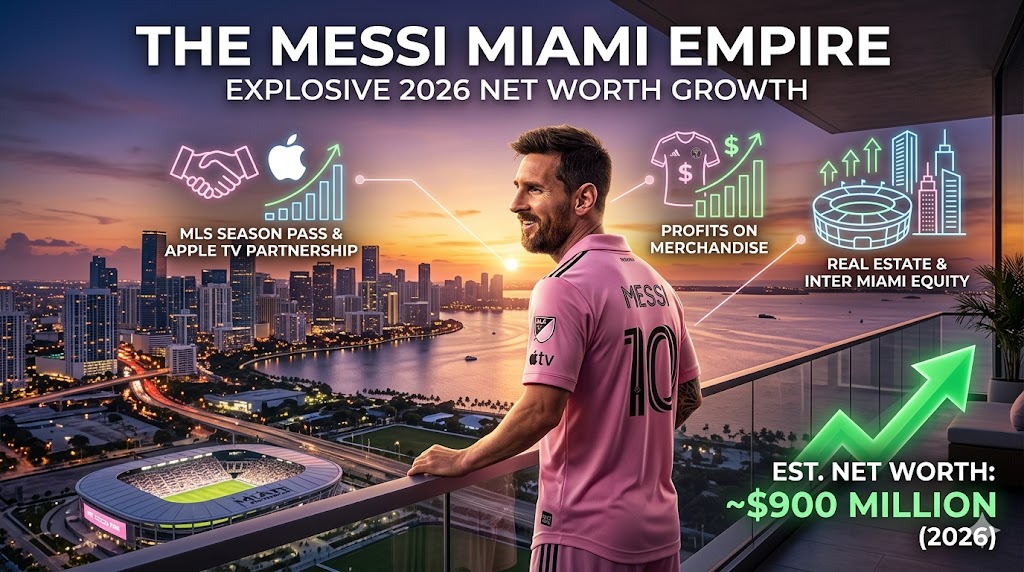
When Lionel Messi departed European football in the summer of 2023, the sports world held its collective breath. With monumental, billion-dollar offers reportedly on the table from the Middle East, his ultimate decision to sign with Major League Soccer’s Inter Miami was initially viewed by some as a lifestyle choice over a financial one. Fans and pundits alike wondered if the greatest player in history was sacrificing a historic payday for the sunny shores of South Florida.
Fast forward to April 2026, and that narrative has been entirely rewritten. Messi didn’t just sign a standard player contract; he architected a historic business partnership that has fundamentally disrupted the economics of modern sports. By leveraging his immense global brand, Messi transformed what appeared to be a standard twilight-years transfer into a sophisticated corporate merger.
Today, Lionel Messi is far more than a Designated Player. He is a media mogul, a brand partner, and a future sports franchise owner. His move to the MLS did not diminish his earning power; rather, it unlocked an entirely new ecosystem of wealth generation. By intertwining his financial success with the growth of an entire league and its corporate partners, Messi’s net worth has surged toward the $900 million mark. This article breaks down the intricate layers of Lionel Messi’s Miami empire, exploring exactly how his MLS transition became the smartest business move in the history of global sports.
Decoding the Inter Miami Contract
To understand the sheer magnitude of Messi’s wealth in 2026, one must first dismantle the mechanics of his Inter Miami contract. On paper, MLS rules are notoriously strict, featuring salary caps designed to maintain parity among clubs. However, the Designated Player rule—originally created for David Beckham—allows teams to sign players outside the salary cap constraints. Even so, the publicly reported numbers only tell a fraction of the story.
The MLS Salary Structure and the “Mas” Revelation
According to the Major League Soccer Players Association (MLSPA), Messi’s official guaranteed compensation sits around $20.4 million annually, featuring a base salary of $12 million. For context, this figure alone surpasses the entire payrolls of several other MLS franchises. Yet, this is merely the baseline of his earnings.
Inter Miami’s managing owner, Jorge Mas, famously pulled back the curtain on the actual financial package required to bring the Argentine legend to the United States. Mas revealed that Messi’s total compensation from the club ranges between $70 million and $80 million per year. This massive discrepancy between the MLSPA figures and the actual payout is bridged by aggressive marketing bonuses, strategic commercial rights, and signing incentives.
Furthermore, Messi’s influence and happiness in South Florida culminated in a crucial contract extension signed in late 2025, locking him in through the 2028 season. This extension ensures he will be the centerpiece of the club as they transition into their new, state-of-the-art stadium, Miami Freedom Park. The longevity of this deal guarantees a stable, massive influx of capital well past his 40th birthday.
The David Beckham Playbook: Franchise Equity
Perhaps the most lucrative mechanism woven into his contract is the promise of future ownership. In 2007, David Beckham shocked the world by moving to the LA Galaxy. The true genius of Beckham’s deal was an option to purchase an MLS expansion team for a fixed rate of $25 million—an option he later exercised to create Inter Miami.
Messi’s legal team learned from the Beckham playbook and amplified it. As part of his agreement, Messi secured the right to acquire a direct equity stake in Inter Miami upon his retirement from playing. Since his arrival, the valuation of Inter Miami has skyrocketed, transforming it into a billion-dollar enterprise. By taking equity rather than just cash, Messi has insulated his wealth against inflation and positioned himself to reap the benefits of the league’s overall valuation growth long after he hangs up his boots.
The Unprecedented Revenue-Sharing Agreements
What truly separates Messi’s Miami empire from any other athletic contract in history is how he successfully negotiated revenue-sharing agreements with the league’s most powerful corporate sponsors. He refused to be just an employee; he demanded to be a stakeholder.
Apple TV and the Streaming Revolution
In 2022, Apple made a monumental bet on live sports, signing a 10-year, $2.5 billion global broadcast agreement with Major League Soccer. It was an ambitious play, but it lacked a global catalyst. Enter Lionel Messi.
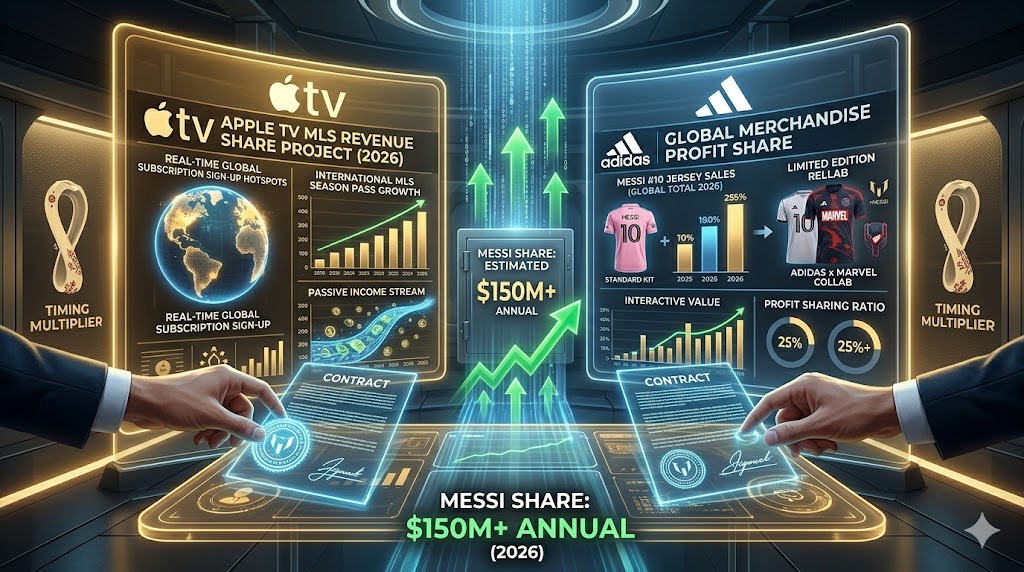
Understanding his unique leverage, Messi’s camp negotiated a revenue-sharing clause directly with the tech giant. As part of the deal, Messi receives a direct cut of the revenue generated by new international subscribers to the MLS Season Pass on Apple TV. The impact was instantaneous and historic. On the day of his Miami debut, Apple experienced a staggering 1,690% surge in MLS Season Pass sign-ups. By the end of 2023, subscriptions had doubled to over 2 million.
This model is unprecedented. An athlete actively profiting from the broadcast subscriptions they drive effectively makes Messi a partner in Apple’s media expansion. It transitions his income from fixed, linear wages to scalable, exponential technology revenue.
The Adidas Profit-Sharing Phenomenon
The synergy extended to his apparel sponsor. Messi has been the global face of Adidas for nearly two decades, eventually signing a lifetime deal with the German sportswear giant in 2017. Coincidentally, Adidas also holds the exclusive rights to manufacture kits for all MLS teams.
Recognizing that his arrival in America would trigger an avalanche of merchandise sales, Messi secured a profit-sharing agreement for all MLS-related Adidas apparel sales. When his pink number 10 Inter Miami jersey became the highest-selling soccer shirt globally, creating supply chain backlogs that lasted for months, Messi was quietly collecting a percentage of every single transaction.
This deep integration was later celebrated through unique pop-culture crossovers, such as a special edition Adidas x Marvel collaboration jersey. By blending global soccer, superhero pop culture, and sportswear, Messi and Adidas created a merchandising juggernaut that continues to pad his net worth well into 2026.
Comparing Football Royalty: Messi vs. Global Sports Titans
To truly grasp the scale of this financial empire, it is essential to contextualize his wealth against other titans of the sports world. The modern athlete is no longer just a competitor; they are multinational conglomerates.
If we look back at Lionel Messi’s 2025 financial baseline, his wealth was estimated around $850 million. His continued dominance in the US market, combined with escalating Apple and Adidas dividends, has securely pushed him closer to the $900 million mark.
This provides a fascinating contrast when compared to his eternal rival, as detailed in this analysis of Cristiano Ronaldo’s 2026 net worth. Ronaldo’s move to Saudi Arabia’s Al-Nassr was characterized by a monumental, guaranteed base salary reported at $200 million annually. While Ronaldo opted for an immediate, immense cash injection backed by a sovereign wealth fund, Messi opted for the American corporate equity model. Both strategies have propelled them toward billionaire status, but they represent two entirely different philosophies of wealth accumulation.
The equity and revenue-share model also starkly contrasts with athletes in individual sports. For example, unlike the massive singular paydays seen in traditional heavyweight boxing, such as Anthony Joshua’s 2025 earnings, Messi’s income is recurring, passive, and scalable. Similarly, while the modern influencer-boxing crossover has created highly lucrative niches—as seen in Jake Paul’s net worth in 2026—those fortunes rely heavily on constant self-promotion and event-by-event pay-per-view sales. Messi’s wealth, conversely, grows automatically every time a fan in Tokyo subscribes to Apple TV or a teenager in London buys an Adidas jersey.
Expanding the Portfolio: Investments, Crypto, and Real Estate
Beyond the football pitch and corporate boardrooms, Messi has quietly built a diverse investment portfolio designed for generational wealth preservation.
A South Florida Real Estate Fortress
Miami is famously known as a playground for the ultra-wealthy, and Messi has laid deep roots in the city’s luxury real estate market. Long before he officially signed with Inter Miami, Messi had been strategically acquiring premium properties in South Florida.
His real estate portfolio is headlined by a stunning $9 million luxury condominium in the iconic Porsche Design Tower in Sunny Isles Beach, famous for its robotic parking system that allows residents to drive their cars directly into their living rooms. He also owns the entire ninth floor of the Regalia tower nearby.
However, to accommodate his family’s daily life during the MLS season, Messi purchased a sprawling, $10.75 million waterfront mansion in Fort Lauderdale. Located in an exclusive gated community, the property boasts 170 feet of waterfront, a swimming pool, a fitness center, and a spa. These assets not only provide a lavish lifestyle but serve as heavily appreciating physical assets in one of America’s hottest real estate markets.
Digital Assets and The Bitget Partnership
Like many modern billionaires, Messi has diversified into the digital economy and the technology sector. Through his investment firm, Play Time, he has funded various sports-tech startups, gaming ventures, and digital media companies.
Most notably, Messi has engaged heavily with the cryptocurrency and blockchain space. He serves as a global brand ambassador for Bitget, a major cryptocurrency exchange. In an era where athlete-crypto partnerships have faced scrutiny, Messi’s agreements have been structured conservatively, favoring long-term ambassadorships over volatile token promotions. Industry analysts in 2026 estimate that top-tier crypto endorsements for global icons of his stature yield between $15 million and $30 million annually, further cementing his off-field revenue streams.
The “Messi Effect” and the 2026 FIFA World Cup
Timing is the ultimate multiplier of wealth, and Messi’s arrival in the United States could not have been orchestrated more perfectly. Currently, North America is operating as the epicenter of global soccer.
With the United States, Canada, and Mexico co-hosting the 2026 FIFA World Cup, the marketing dollars pouring into the sport are unprecedented. By establishing himself as the face of American domestic soccer in the years leading up to the tournament, Messi positioned himself directly in the path of this financial tsunami.
Corporate sponsors desperate to align themselves with the 2026 World Cup are funneling millions into the MLS and its associated stars. The “Messi Effect” has resulted in sold-out stadiums across the country, exponentially inflated secondary market ticket prices, and a massive surge in corporate hospitality packages. As an equity holder in the league’s success through his Apple and Adidas deals, the hype surrounding the 2026 World Cup is actively depositing money into Messi’s bank accounts. His mere presence in the country serves as a daily billboard for the upcoming tournament.
Tracking the Net Worth Growth to $900 Million
The evolution of Lionel Messi’s net worth is a masterclass in compounding value. To appreciate where he stands in 2026, it is helpful to look at his financial trajectory over the last decade.
In 2016, during the prime of his FC Barcelona days, his net worth hovered around an estimated $280 million. Supported by standard European contracts and traditional sponsorships, it grew steadily to approximately $400 million by 2020.
The significant pivot occurred during his transfer to Paris Saint-Germain (PSG) in 2021, which bumped his wealth into the $600 million tier, aided by massive signing bonuses and the integration of crypto-based fan tokens into his compensation.
However, the explosive growth—the leap from a very wealthy athlete to a near-billionaire mogul—occurred post-2022. Winning the FIFA World Cup in Qatar solidified his legacy as the undisputed greatest of all time, making him universally marketable. Following his strategic move to Inter Miami in 2023, his wealth accelerated rapidly. Valued at roughly $850 million in 2025, his continued revenue shares, real estate appreciation, and brand dominance have pushed his 2026 net worth to an estimated $900 million.
Conclusion: The Architect of Modern Athlete Business
Lionel Messi’s legacy on the football pitch has been secure for over a decade. He has won every trophy, broken every record, and captivated billions with his talent. But his legacy in the boardroom is just beginning to be fully understood.
His transfer to Inter Miami was not a retirement tour; it was an aggressive, visionary business acquisition. By moving to the MLS, Messi traded a high-tax, high-pressure European salary for American corporate equity. He transformed from a highly paid employee of a football club into a revenue-sharing partner with trillion-dollar tech companies and global sportswear conglomerates.
As his net worth crests $900 million in 2026, Lionel Messi has proven that his vision extends far beyond the penalty box. He has established a new financial paradigm for the modern superstar, proving that true wealth is not generated by how much a team is willing to pay you, but by how much of the ecosystem you are able to own.
Related articles :
- Cristiano Ronaldo Net Worth 2026: Salary, Endorsements & Business Empire
- Tiger Woods Net Worth 2025
- Anthony Joshua Net Worth (2025): How the Boxing Star Built His Fortune
- WorldCupFoot.com for Sale – Premium World Cup Domain | 2026 Opportunity