
 By
By 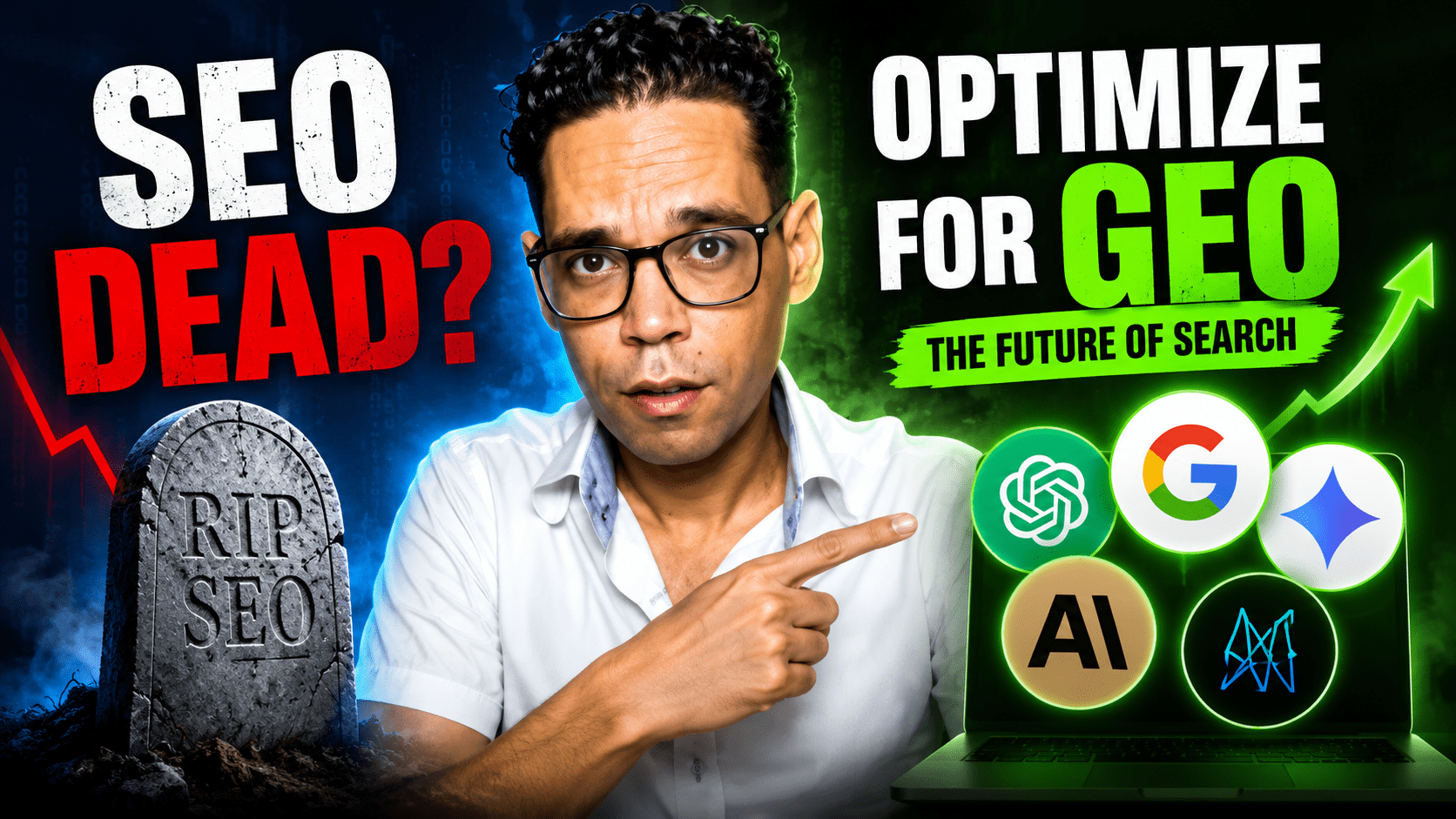
The rise of AI-powered search has sparked one of the biggest debates in digital marketing: Is SEO dead? With ChatGPT, Google AI Overviews, Gemini, Claude, and Perplexity changing how people discover information, many businesses believe traditional SEO is becoming obsolete. The reality is very different. SEO isn’t dying—it’s evolving. Welcome to the era of Generative Engine Optimization (GEO).
Is SEO Really Dead?
Every few years, someone claims that SEO is dead.
When Google introduced mobile-first indexing, people said SEO was over.
When voice search became popular, many predicted the end of traditional search.
Now, with AI-generated answers appearing directly in search engines, the same claim is circulating again.
But history keeps proving the opposite.
SEO has never disappeared—it has simply adapted.
Google still processes billions of searches every day. Businesses still rely on organic traffic to generate leads and sales. The difference is that users are no longer interacting only with traditional search results. They are also asking questions directly to AI assistants like ChatGPT, Gemini, Claude, and Perplexity.
Instead of replacing SEO, artificial intelligence has expanded it.
This evolution has introduced a new discipline known as Generative Engine Optimization (GEO).
What Is GEO?
Generative Engine Optimization (GEO) is the process of optimizing your content so that AI-powered search engines can discover, understand, trust, and cite your content when generating answers.
Unlike traditional SEO, where your goal is to rank on page one of Google, GEO focuses on becoming one of the trusted sources AI systems use when answering questions.
This includes platforms such as:
- ChatGPT
- Google AI Overviews
- Google AI Mode
- Perplexity AI
- Claude
- Microsoft Copilot
- Gemini
The objective is no longer just earning clicks.
The objective is becoming the source AI trusts.
SEO vs GEO
Although SEO and GEO share many similarities, their goals are slightly different.
| Traditional SEO | GEO |
|---|---|
| Rank higher on Google | Be cited by AI assistants |
| Optimize for search engines | Optimize for AI reasoning models |
| Focus on keywords | Focus on topical authority and entities |
| Increase website clicks | Increase AI visibility and brand mentions |
| Improve rankings | Improve citations and references |
The good news?
If you’ve been following SEO best practices for years, you’re already ahead.
GEO simply adds another layer to content optimization.
Why AI Search Is Changing Everything
Users are changing how they search.
Instead of typing:
Best Shopify theme
People now ask:
What is the best Shopify theme for high-converting stores?
Rather than reading ten articles, AI summarizes the answer in seconds.
This means only the most trustworthy, well-structured, and authoritative content gets referenced.
If your content isn’t selected by AI, you lose visibility.
If it is selected, your brand gains exposure—even before users visit your website.
What AI Search Engines Look For
Although every AI platform has its own ranking system, most evaluate similar quality signals.
1. Topical Authority
Publishing one article isn’t enough anymore.
AI favors websites that demonstrate deep expertise across an entire topic.
For example, if your niche is Shopify SEO, create content covering:
- Shopify SEO
- Technical SEO
- Shopify themes
- Core Web Vitals
- Structured Data
- Keyword Research
- Internal Linking
- Ecommerce SEO
The more comprehensive your coverage, the more likely AI is to recognize your website as an authority.
Try Semrush for your SEO/GEO optimization (paid affiliate link)
2. Helpful Content
AI systems prioritize content that genuinely answers questions.
Instead of writing for search engines, write for humans.
Ask yourself:
- Does this solve a problem?
- Is it actionable?
- Is it complete?
- Is it easy to understand?
Helpful content wins.
3. Expertise
Generic articles generated with AI are becoming increasingly common.
Unfortunately, AI can also recognize generic content.
Real experience matters.
Include:
- Case studies
- Screenshots
- Personal experiments
- Original research
- Real-world examples
These signals make your content significantly more valuable.
Read also : From Employee to Entrepreneur: How AI Has Lowered the Barrier to Starting a Business
4. Structured Content
AI models understand organized information much better than large blocks of text.
Use:
- Clear headings
- Bullet points
- Tables
- FAQs
- Lists
- Short paragraphs
A well-structured article is easier for both users and AI to understand.
5. Entity Optimization
Modern SEO is moving away from keyword stuffing.
Instead, search engines understand relationships between people, companies, products, and concepts.
For example, an article about Shopify should naturally reference related entities like:
- Shopify
- Ecommerce
- Liquid
- SEO
- Themes
- Conversion Rate Optimization
Entities provide context that helps AI understand your content more accurately.
How to Optimize for GEO
Let’s look at practical strategies you can implement today.
Write Comprehensive Content
Instead of publishing multiple thin articles, create in-depth resources that answer every aspect of a topic.
Long-form content often performs better because it covers more user intent.
Read also : Why Your Products Aren’t Showing Up in ChatGPT — And How to Fix It
Answer Questions Naturally
Think about how people interact with ChatGPT.
Instead of searching:
SEO
They ask:
How can I improve SEO for my Shopify store?
Include these conversational questions naturally throughout your content.
Add FAQ Sections
Frequently Asked Questions help both users and AI understand your content.
Example:
Is SEO dead?
No.
SEO continues to evolve alongside search technology.
What is GEO?
GEO stands for Generative Engine Optimization, the practice of optimizing content for AI-powered search engines.
Try Semrush for your SEO/GEO optimization (paid affiliate link)
Build Topical Clusters
One isolated article won’t establish authority.
Instead, create interconnected content.
Example:
Main Guide
→ What Is SEO?
Supporting Articles
- Technical SEO
- Ecommerce SEO
- GEO
- AI Search
- Structured Data
- Keyword Research
- Internal Linking
Connect everything using internal links.
This strengthens your website’s topical authority.
Improve EEAT
Google emphasizes:
- Experience
- Expertise
- Authoritativeness
- Trustworthiness
These principles also align closely with what AI systems value.
Show your expertise by including:
- Author bios
- Original images
- Case studies
- Client results
- References
Use Structured Data
Schema markup helps search engines understand your content.
Useful schema types include:
- Article
- FAQ
- Organization
- Breadcrumb
- Product
- Review
Structured data improves context for both search engines and AI systems.
Keep Content Updated
AI prefers fresh, accurate information.
Review your best-performing articles regularly.
Update:
- Statistics
- Screenshots
- Examples
- Tools
- Best practices
Fresh content builds trust.
The Role of Backlinks in GEO
Why?
Because links still signal authority.
If respected websites reference your content, AI is more likely to consider it trustworthy.
Focus on earning links naturally through:
- Original research
- Statistics
- Case studies
- Useful resources
- Guest posting
- Digital PR
Quality matters far more than quantity.
Measuring GEO Success
Unlike traditional SEO, GEO isn’t measured only through rankings.
You should also monitor:
- Organic traffic
- AI referral traffic
- Brand mentions
- AI citations
- Engagement metrics
- Conversion rates
As AI platforms continue evolving, new analytics tools will emerge specifically for GEO performance.
Common GEO Mistakes
Many website owners make the same mistakes.
Publishing AI-generated content without editing
AI should assist—not replace—human expertise.
Ignoring topical authority
Publishing random articles across unrelated topics weakens authority.
Stay focused on your niche.
Writing for algorithms
Always prioritize users first.
Google and AI reward content that genuinely helps people.
Forgetting internal linking
Every important article should connect naturally with related content.
Internal links strengthen your content ecosystem.
Neglecting technical SEO
Fast-loading pages, mobile responsiveness, crawlability, and Core Web Vitals still matter.
Without a technically sound website, even great content can struggle.
The Future of SEO
The future isn’t SEO versus GEO.
It’s SEO plus GEO.
Traditional search isn’t disappearing.
Instead, AI search is becoming another channel through which users discover content.
Businesses that adapt early will gain a significant competitive advantage.
The core principles remain unchanged:
- Create valuable content.
- Build authority.
- Earn trust.
- Demonstrate expertise.
- Solve real problems.
Whether your audience finds you through Google Search, ChatGPT, Gemini, Claude, or Perplexity, those fundamentals will continue driving long-term success.
Final Thoughts
SEO is far from dead.
It is entering its next chapter.
Generative Engine Optimization (GEO) doesn’t replace SEO—it extends it into the world of AI-powered search. Websites that combine strong technical SEO, topical authority, helpful content, and real expertise are the ones most likely to thrive in this new landscape.
If you’re investing in SEO today, don’t abandon your strategy. Instead, evolve it. Optimize your content not only for search engines but also for the AI systems increasingly shaping how people discover information.
The future belongs to brands that are both search engine friendly and AI friendly. Start building that foundation today, and you’ll be well positioned for the next generation of search.
Try Semrush for your SEO/GEO optimization (paid affiliate link)