 By
By 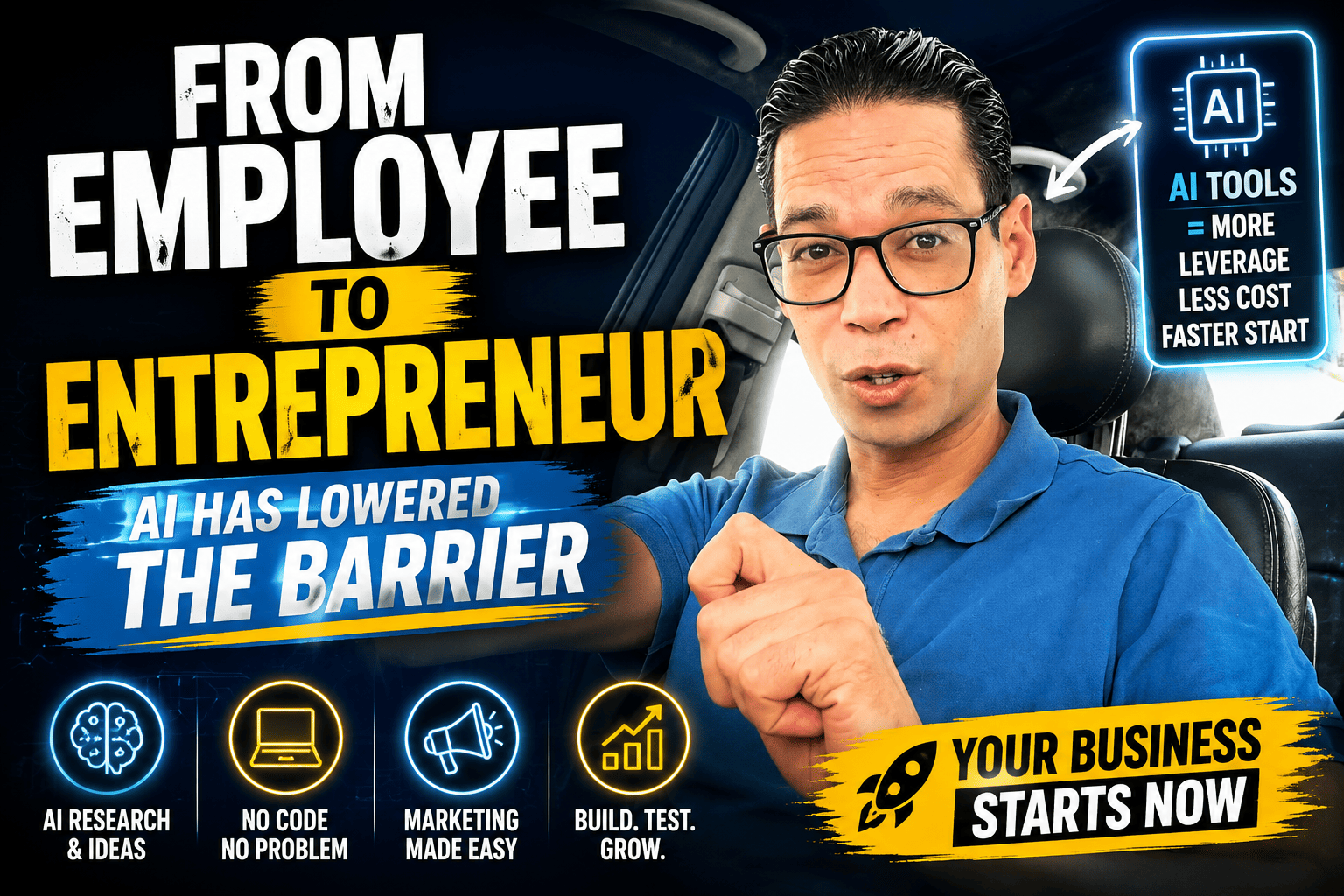
For decades, becoming an entrepreneur meant accepting a difficult trade-off.
You could keep your job, receive a predictable salary, and enjoy a certain level of stability. Or you could leave that security behind, invest your savings, hire people, learn multiple disciplines, and spend months—sometimes years—trying to build a business.
Artificial intelligence is changing that equation.
AI has not made entrepreneurship easy. Building something customers are willing to pay for still requires judgment, persistence, execution, and an understanding of the market. What AI has done is dramatically reduce the cost, time, and technical expertise required to turn an idea into a functioning business.
The distance between employee and entrepreneur is becoming shorter.
And that could prove to be one of the most important economic consequences of the AI revolution.
The Traditional Barriers to Entrepreneurship
Think about what launching even a relatively simple online business required 15 years ago.
You might need a web developer to create your website, a graphic designer to develop your branding, a copywriter to write your pages, a marketer to generate traffic, an accountant to organize your finances, and customer-support staff once customers started arriving.
Before earning your first dollar, you could already have thousands of dollars in expenses.
There was another barrier that was arguably even more important: knowledge.
Employees usually specialize.
A marketer understands marketing. A developer understands software. An accountant understands finance. A salesperson understands sales.
Entrepreneurs, however, are forced to understand a little of everything.
That knowledge gap prevented many talented people from ever starting.
Someone could have an excellent product idea but no idea how to build a website. Another person might understand a particular industry extremely well but know nothing about marketing.
AI doesn’t eliminate those knowledge gaps, but it can help people cross them much faster.
AI Is Becoming the Entrepreneur’s First Employee
One of the most interesting ways to think about AI is not as software, but as an extremely flexible assistant.
A founder can ask an AI system to research competitors in the morning, brainstorm product positioning before lunch, analyze customer reviews in the afternoon, and help draft an email campaign later that evening.
Read also : 5 Things Alex Hormozi Gets Wrong About E-Commerce (And What Shopify Owners Should Do Instead)
Tasks that previously required different specialists can increasingly be assisted by the same technology.
This is already happening.
An OpenAI analysis published in 2026 estimated that at least four million people in the United States used ChatGPT during March 2026 to help plan, start, operate, or grow a business.
OECD data tell a similar story about the broader adoption of AI. Across countries where data were available, 20.2% of firms reported using AI in 2025, compared with 14.2% in 2024 and 8.7% in 2023.
This matters because entrepreneurs are no longer simply experimenting with AI.
They are beginning to build businesses around it.
From Idea to Market Research in Hours
One of the first challenges for a new entrepreneur is determining whether an idea is actually worth pursuing.
Traditionally, market research could be expensive and slow.
Today, an aspiring founder can use AI to accelerate the initial research process.
Imagine someone working a full-time job who has an idea for an ecommerce product.
After work, they could use AI to organize competitor research, identify recurring complaints in customer feedback, compare positioning strategies, develop customer personas, brainstorm potential differentiators, and generate questions for customer interviews.
AI shouldn’t replace direct market research. An AI model cannot magically tell you whether customers will hand you their money.
But it can dramatically accelerate the process of asking better questions.
Instead of staring at a blank document wondering where to begin, the aspiring entrepreneur begins with a research assistant.
That changes the psychology of starting.
The first step becomes smaller.
You Don’t Need to Be a Developer Anymore
Technical ability used to represent one of the largest barriers to digital entrepreneurship.
Suppose you had an idea for a software product.
Without programming knowledge, your options were limited. You could learn to code, find a technical co-founder, or pay developers.
Each option created friction.
AI-assisted coding and no-code platforms have changed what a technically inexperienced founder can accomplish.
An entrepreneur can now use AI to explain code, generate prototypes, troubleshoot errors, create database structures, write basic scripts, and accelerate software development.
That doesn’t mean professional developers are obsolete.
Complex products still require engineering expertise, particularly around security, scalability, architecture, and reliability.
The important change is that entrepreneurs can get much further before they need significant capital or a large technical team.
An idea that previously required $50,000 to test might sometimes be validated with a prototype costing a tiny fraction of that amount.
And validation is everything.
The goal at the beginning isn’t necessarily to build the perfect company.
It’s to discover whether anyone wants what you’re building.
AI Has Reduced the Cost of Marketing
Building a product is only half the problem.
You need attention.
Marketing has historically been another major expense for new businesses. Entrepreneurs needed copywriting, graphic design, SEO research, advertising expertise, video production, social media management, and email marketing.
Generative AI can now assist with almost every part of that workflow.
A founder can brainstorm 30 content ideas, create an editorial calendar, draft an article, develop ad concepts, write product descriptions, generate email sequences, analyze keywords, create images, repurpose long videos into shorter content ideas, and analyze campaign performance.
The Federal Reserve Bank of San Francisco reported in 2026 that common small-business AI applications already include productivity, marketing, social media, SEO, written communications, graphic design, customer service, analytics, forecasting, and custom AI tools.
That is an extraordinary collection of capabilities for a small entrepreneur.
Previously, these functions might have represented several employees or freelancers.
Now one entrepreneur can coordinate many of them from a laptop.
Read also : Why Your Products Aren’t Showing Up in ChatGPT — And How to Fix It
The Rise of the One-Person Business
This leads to a bigger trend.
The definition of a “company” may be changing.
The traditional model looked something like this:
Founder → Funding → Employees → Growth
The emerging AI-powered model can look different:
Founder → AI + Automation → Revenue → Employees When Necessary
The distinction matters.
Instead of hiring people immediately because work needs to be completed, entrepreneurs can automate or accelerate parts of that work first.
Hiring becomes a strategic decision rather than an automatic requirement.
Research from the OECD reinforces this possibility. In a survey of more than 5,000 SMEs, 31% reported using generative AI. Among users, 65% said it improved employee performance, while 35% said it helped them scale and 29% said it helped them compete with larger companies.
The entrepreneur of the AI era therefore doesn’t necessarily ask:
“How many employees do I need?”
They may instead ask:
“How much can I accomplish before I need another employee?”
That is a fundamentally different way of building a company.
Employees Can Start Before They Quit
Perhaps the most important change is that aspiring entrepreneurs don’t necessarily need to resign immediately.
AI allows people to experiment.
An employee can spend evenings building a small ecommerce store, developing a digital product, testing a SaaS idea, creating a newsletter, growing a personal brand, selling consulting services, or developing an online course.
AI reduces the amount of time many supporting tasks require.
That makes entrepreneurship more compatible with employment during the validation stage.
This approach also reduces risk.
Instead of:
Quit → Build → Hope → Sell
you can pursue:
Build → Test → Sell → Validate → Decide
That sequence is much healthier financially.
Your salary can finance experimentation while you discover whether the market actually wants your offer.
Entrepreneurship stops being a dramatic leap and becomes a series of controlled experiments.
Skills Still Matter—But the Skills Are Changing
There is a dangerous misunderstanding surrounding AI entrepreneurship.
Some people assume that because AI can generate websites, copy, images, code, and business plans, expertise no longer matters.
The opposite may happen.
When everyone has access to similar tools, the advantage shifts toward the person who knows what to ask, what to ignore, what to improve, and what to execute.
AI can generate 100 business ideas.
It cannot guarantee that any of them are good.
AI can write sales copy.
It cannot guarantee that customers trust your brand.
AI can generate code.
It cannot guarantee that your software architecture is secure.
AI can suggest an SEO strategy.
It cannot guarantee that you’ll outrank established competitors.
AI increases output.
Judgment determines the value of that output.
This is why expertise, creativity, reputation, distribution, and strategic thinking may become even more valuable.
The New Entrepreneurial Advantage Is Speed
Imagine two aspiring entrepreneurs.
The first spends six months thinking about starting.
The second spends one weekend researching the market, builds a landing page with AI assistance, contacts 50 potential customers, collects feedback, modifies the offer, and begins testing.
Who learns faster?
The second entrepreneur.
AI’s greatest entrepreneurial advantage may therefore not be automation.
It may be iteration speed.
Entrepreneurs can move from:
Idea → Prototype → Feedback → Improvement
faster than ever before.
JPMorganChase Institute research published in 2026 found that newer businesses were adopting AI considerably faster: businesses founded in 2025 reached a 10% AI-adoption rate within six months, while firms founded in 2019 took more than six years to reach the same threshold.
New businesses have an advantage because they don’t have old systems to replace.
They can be AI-native from day one.
Read also : From Idea to Product: How Andrew Young Used Accio Work to Bring His Startup Board Game to Life
What AI Cannot Give You
Despite all this technological progress, entrepreneurship still contains something AI cannot automate:
responsibility.
An AI system can suggest a product.
You decide whether to sell it.
It can write an advertisement.
You decide whether the promise is ethical and accurate.
It can analyze numbers.
You decide whether to risk your capital.
It can recommend a strategy.
You live with the consequences.
Entrepreneurship ultimately means taking responsibility for decisions under uncertainty.
No technology removes that.
There are also legitimate risks surrounding AI adoption. Small businesses continue to report concerns involving accuracy, intellectual property, implementation knowledge, financial costs, regulation, cybersecurity, and the loss of human interaction.
The smartest entrepreneurs won’t blindly automate everything.
They will understand where AI creates leverage and where humans create trust.
From Employee to Entrepreneur
For generations, millions of people have had ideas they never pursued.
Some lacked money.
Others lacked technical skills.
Some didn’t know how to market.
Others couldn’t afford employees.
Many simply didn’t know where to begin.
AI doesn’t eliminate all of these barriers.
But it lowers enough of them to change what is possible.
A laptop, internet connection, specialized knowledge, AI tools, and the willingness to execute can now provide capabilities that once required an entire small organization.
The question is therefore shifting.
It used to be:
“Do I have the resources to start a business?”
Increasingly, it may become:
“What can I build with the resources I already have?”
AI will not turn every employee into an entrepreneur, nor should everyone become one.
But for the person sitting at work with an idea they have been postponing for years, the cost of testing that idea has never been lower.
You don’t necessarily need to quit tomorrow.
You don’t need a huge team.
You don’t need to know everything.
You need to identify a real problem, understand a specific customer, create something valuable, use technology intelligently, and start testing.
AI can provide leverage.
But the entrepreneur still has to provide the direction.
And that may be the defining opportunity of this new era: AI hasn’t eliminated the difficulty of entrepreneurship. It has made entrepreneurship accessible to far more people willing to try.