
 By
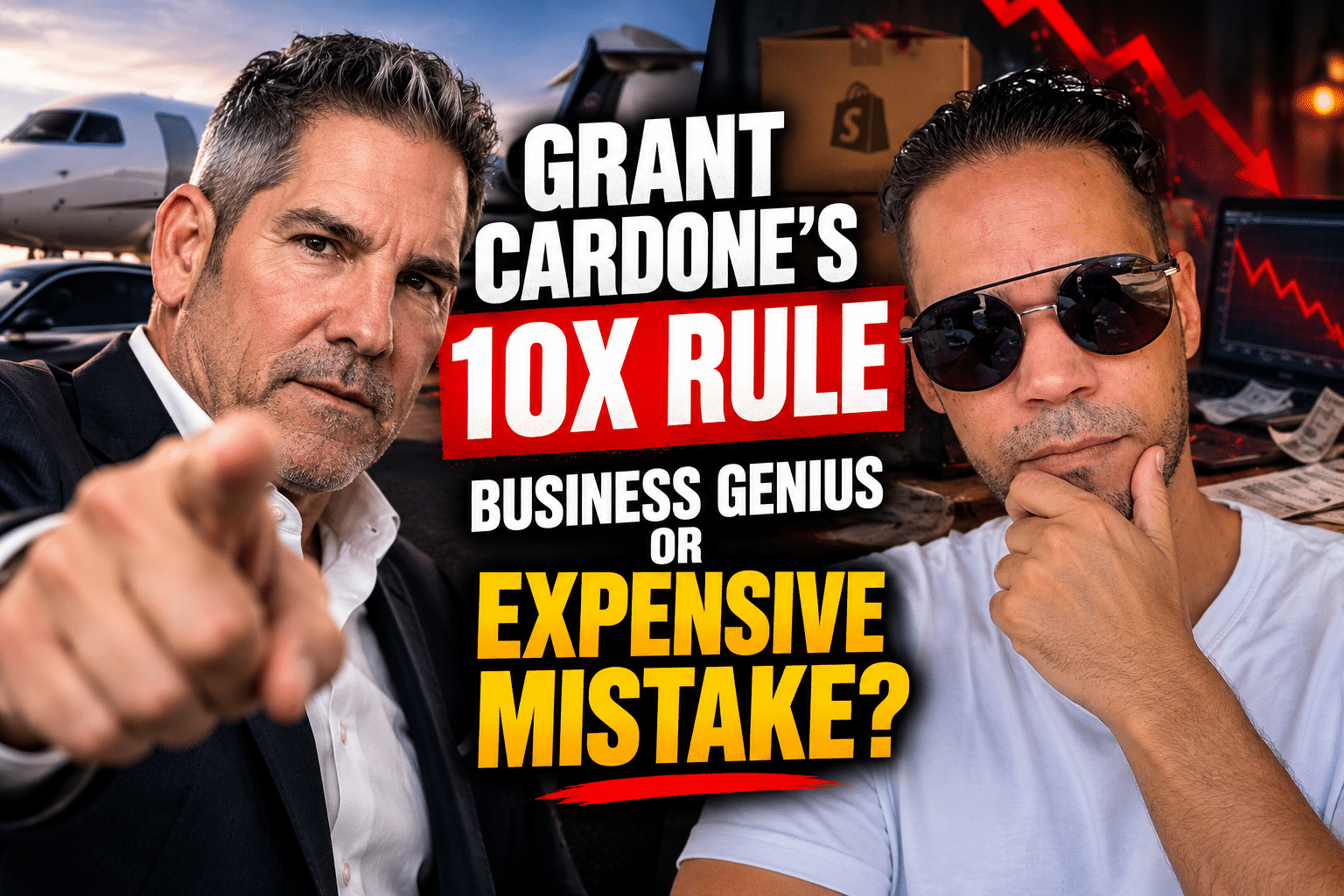
Grant Cardone has convinced millions of entrepreneurs that massive action is the secret to extraordinary success. But what happens when the famous 10X philosophy meets the brutal economics of e-commerce? The answer might surprise you.
There is a dangerous belief spreading throughout the entrepreneurial world: if your business isn’t growing, you’re simply not working hard enough.
Work longer. Advertise more. Sell harder. Think bigger.
And nobody has popularized this philosophy more successfully than Grant Cardone.
The American entrepreneur, real estate investor, and bestselling author built an influential personal brand around one powerful concept: the 10X Rule.
His message is straightforward. Set goals significantly higher than you initially believe possible and take massive action to achieve them.
It sounds inspiring. It certainly sells books, seminars, and training programs.
But after years of working in e-commerce, Shopify development, and digital marketing, I’ve reached a conclusion that some Grant Cardone followers probably won’t appreciate.
The 10X Rule can become one of the most expensive mistakes an inexperienced e-commerce entrepreneur makes.
Not because ambition is bad.
Not because hard work doesn’t matter.
But because applying a philosophy designed around massive action without understanding your business economics can accelerate failure instead of success.
Let’s examine why.
1. The Problem With the 10X Mentality
Grant Cardone’s 10X Rule encourages entrepreneurs to establish goals approximately ten times greater than their original targets and take significantly more action than they initially anticipated.
There is a valuable lesson here.
Most people underestimate the effort required to build a successful business. They expect quick results, underestimate competition, and abandon their projects when reality becomes difficult.
Cardone challenges that mentality.
And to that extent, I agree with him.
However, problems emerge when entrepreneurs interpret massive action as a substitute for strategic thinking.
Imagine launching a Shopify store.
You invest $2,000 in Facebook advertising and generate $1,500 in revenue.
Your campaign is losing money.
What should you do?
An inexperienced entrepreneur influenced by a simplistic interpretation of the 10X philosophy might conclude:
“I need to spend $20,000 instead of $2,000.”
But increasing your advertising budget doesn’t automatically improve your business.
If your underlying economics remain unchanged, you may simply multiply your losses.
Ten times the activity can produce ten times the mistakes.
And that is where motivation becomes dangerous.
2. E-commerce Is Not a Motivation Competition
One of the biggest misconceptions about entrepreneurship is that success primarily depends on determination.
Determination matters.
But e-commerce is fundamentally a business of numbers.
Your profitability depends on variables such as:
- Customer acquisition cost
- Product margins
- Conversion rates
- Average order value
- Customer lifetime value
- Shipping and fulfillment expenses
- Returns and refunds
- Customer retention
You can be the most motivated entrepreneur in the world and still operate an unprofitable business.
Consider two Shopify store owners.
Entrepreneur A: The 10X Hustler
This entrepreneur works 14 hours daily, launches dozens of advertisements, constantly introduces new products, and spends aggressively to increase revenue.
The store generates $100,000 in monthly sales.
However, after advertising, inventory, shipping, fees, and operating expenses, the business loses $5,000.
Entrepreneur B: The Strategic Operator
This entrepreneur works fewer hours but focuses on conversion optimization, organic traffic, customer retention, and profitable products.
The store generates $40,000 in monthly sales.
After expenses, it produces $10,000 in operating profit.
Which entrepreneur is more successful?
The answer should be obvious.
Yet social media frequently celebrates Entrepreneur A because revenue makes a more impressive screenshot than profitability.
Revenue is not profit. Activity is not progress. And growth is not automatically success.
These distinctions are essential in e-commerce.
3. Why More Advertising Can Destroy a Shopify Store
Let’s discuss one of the most expensive mistakes beginners make.
They believe advertising is primarily a question of budget.
If $100 generates sales, spending $1,000 should generate ten times as many sales.
Unfortunately, advertising platforms don’t work that predictably.
As you increase spending, your campaigns may reach less-qualified audiences. Acquisition costs can rise, creative performance can decline, and operational costs may increase.
Suppose you sell a product for $50.
Your expenses per order are:
| Expense | Amount |
|---|---|
| Product cost | $15 |
| Shipping | $5 |
| Advertising | $20 |
| Payment fees | $2 |
| Total variable cost | $42 |
| Contribution per order | $8 |
You make $8 per order before fixed overhead, taxes, and other expenses.
Now imagine increasing your advertising budget aggressively.
Your customer acquisition cost rises from $20 to $30.
Suddenly, the same product loses $2 per order before overhead.
Selling more products now means losing more money.
This is why I frequently emphasize that scaling should follow profitability, not replace it.
Before increasing your advertising budget, improve your product positioning, conversion rate, average order value, and retention strategy.
Massive action without economic discipline is not scaling.
It’s gambling with your operating capital.
4. Grant Cardone’s Sales Philosophy Doesn’t Translate Perfectly to Online Retail
Grant Cardone is widely recognized for his sales training and his emphasis on persistence, follow-up, and closing deals.
These techniques can be valuable in industries where direct selling plays a central role.
However, e-commerce operates differently.
An online shopper doesn’t necessarily want to negotiate with a salesperson.
They want a trustworthy website, transparent pricing, convenient checkout, reliable shipping, and confidence in their purchase.
You cannot compensate for a confusing checkout experience by simply becoming more aggressive.
You cannot persuade every visitor to purchase a product that doesn’t meet their needs.
And you cannot build long-term customer loyalty by focusing exclusively on immediate transactions.
Modern e-commerce requires a balance between marketing, technology, psychology, and customer experience.
Sometimes the best sales strategy isn’t to push harder.
It’s to remove the obstacles preventing customers from buying.
A faster website, clearer product information, authentic reviews, and better product images can improve results without increasing advertising expenditure.
The best online stores don’t necessarily sell harder. They make buying easier.
5. The Hidden Cost of the Hustle Culture
Another controversial aspect of the 10X philosophy is how easily people associate it with extreme working hours.
To be fair, Cardone’s philosophy is broader than simply working longer.
It emphasizes ambition, commitment, and taking enough action to achieve extraordinary goals.
Nevertheless, many followers interpret the message as a requirement to work constantly.
And that interpretation creates problems.
I’ve seen entrepreneurs spend enormous amounts of time on activities that produce little measurable value.
They redesign their websites repeatedly.
They publish content without understanding their audience.
They launch advertising campaigns without analyzing performance.
They obsess over competitors instead of improving their own businesses.
They confuse being busy with being productive.
Here’s an uncomfortable truth:
Working 16 hours on the wrong strategy doesn’t make you more entrepreneurial. It just makes you exhausted.
The objective of building a business should not be to create an endless job for yourself.
It should be to establish systems capable of generating sustainable value.
Automation, delegation, SEO, customer retention, and operational efficiency can create leverage.
And leverage is often more valuable than additional working hours.
6. Why SEO Challenges the 10X Philosophy
As someone who works extensively with search engine optimization, I’ve observed an interesting contrast between paid advertising and organic growth.
Advertising frequently requires ongoing expenditure to maintain traffic.
SEO, when executed effectively, can build assets that continue attracting potential customers over time.
A well-optimized product collection, an informative article, or a strong internal linking structure can contribute to traffic long after the original work is completed.
Of course, SEO requires investment, maintenance, and patience. Rankings and results are never guaranteed.
But its underlying philosophy is different.
Instead of asking, “How can I spend ten times more to generate ten times more traffic?”
You ask:
“How can I build an asset that attracts qualified visitors repeatedly?”
This is where strategic thinking becomes more powerful than indiscriminate activity.
For Shopify store owners, improving technical SEO, product descriptions, site architecture, and content quality may provide greater long-term value than constantly launching new advertising campaigns.
The goal is not necessarily to do more.
The goal is to make your efforts compound.
7. The Personal Branding Paradox
Here is where Grant Cardone deserves significant credit.
Regardless of whether you agree with his philosophy, his personal branding strategy offers valuable lessons.
He has built a recognizable identity around a simple message.
The 10X concept is memorable, repeatable, and easy to communicate.
It works across books, videos, events, and educational products.
His audience immediately associates him with ambition, sales, and massive action.
That consistency is powerful.
Many entrepreneurs struggle because they attempt to communicate too many unrelated messages.
Cardone demonstrates the commercial value of owning a recognizable idea.
But there’s an important distinction between studying how someone markets a philosophy and assuming that philosophy works equally well in every industry.
Grant Cardone’s success at marketing the 10X Rule does not prove that every business should operate according to a literal 10X approach.
A successful business philosophy can still have limitations.
And intelligent entrepreneurs should understand those limitations before applying it.
8. The Real Danger: Confusing Inspiration With Business Education
Motivational content serves a purpose.
It can encourage people to begin projects, overcome fear, and remain committed during difficult periods.
But inspiration and education are not the same thing.
Watching a motivational video might convince you to launch a Shopify store.
It won’t automatically teach you how to calculate contribution margins.
Listening to a successful entrepreneur might encourage you to invest in advertising.
It won’t necessarily teach you how to interpret customer acquisition costs or measure incremental profitability.
And believing in extraordinary goals won’t eliminate operational constraints.
This is where aspiring entrepreneurs must become more selective about the advice they follow.
Ask yourself whether the person offering guidance is explaining the mechanics of the business or primarily selling a mindset.
Both can have value.
But they solve different problems.
Motivation gets you started. Business knowledge helps you survive.
Confusing the two can become expensive.
9. What I Would Teach Instead of Blindly Following the 10X Rule
If I were advising someone launching their first Shopify business, I wouldn’t tell them to immediately multiply their advertising budget or workload by ten.
I would recommend a more disciplined approach.
First, validate demand.
Determine whether customers genuinely want your product before investing heavily in inventory or advertising.
Second, understand your numbers.
Calculate your margins, acquisition costs, fulfillment expenses, and break-even point.
Third, optimize before scaling.
Improve your product pages, checkout experience, customer trust, and conversion performance.
Fourth, build sustainable acquisition channels.
Combine appropriate paid marketing with SEO, content marketing, email, and customer retention.
Fifth, scale what works.
Once your business demonstrates repeatable, profitable performance, increase investment carefully while monitoring results.
This approach might not sound as exciting as taking massive action.
But entrepreneurship isn’t a competition to see who can spend money fastest.
It’s about creating a business that can survive, grow, and generate meaningful returns.
10. Is Grant Cardone Wrong About Everything?
Absolutely not.
And dismissing his entire philosophy would be intellectually lazy.
His emphasis on ambitious goals can challenge complacency.
His focus on consistent action can help entrepreneurs overcome procrastination.
His understanding of sales and personal branding offers lessons worth studying.
And his ability to communicate a recognizable business message is impressive.
The problem isn’t necessarily the original philosophy.
It’s applying that philosophy without considering the circumstances of your business.
A real estate investor, a commission-based salesperson, a software company, and a small Shopify retailer operate under different financial constraints.
A strategy that makes sense in one environment can become disastrous in another.
Entrepreneurs should learn from successful people without treating their advice as universal law.
That’s the difference between critical thinking and blindly following a business celebrity.
Final Thoughts: The Smartest Entrepreneur Isn’t Always the Hardest Worker
Grant Cardone’s 10X Rule contains a message that appeals to ambitious people.
Think bigger.
Take action.
Refuse to settle for mediocrity.
There’s nothing inherently wrong with those principles.
But the modern e-commerce industry has a serious problem with glorifying activity while ignoring profitability.
More advertisements.
More products.
More revenue.
More working hours.
More hustle.
Yet none of these automatically creates a successful business.
Sometimes the smartest decision is to stop an unprofitable campaign.
Sometimes it’s to eliminate products that don’t sell.
Sometimes it’s to invest in organic visibility instead of buying more traffic.
And sometimes it’s to work fewer hours while building better systems.
My philosophy is simple: Don’t multiply your actions until you’ve verified that those actions produce the right results.
Because multiplying a profitable strategy can accelerate success.
But multiplying a broken strategy can accelerate bankruptcy.
And that is why I believe blindly following the 10X Rule can be dangerous for inexperienced e-commerce entrepreneurs.
Grant Cardone has built a powerful brand around massive action.
The question is whether your business needs more action—or better decisions.
Now I Want Your Opinion
Is Grant Cardone’s 10X Rule genuinely useful for entrepreneurs, or has hustle culture convinced people that working harder is always the answer?
And here’s an even more controversial question:
Are business influencers teaching entrepreneurs how to become wealthy, or have they discovered that teaching entrepreneurship is itself one of the most profitable businesses?
Share your opinion in the comments.
About the author: Marouane Rhafli is an e-commerce consultant, Shopify developer, SEO/GEO specialist, and founder of Scrowp. He helps online businesses improve organic visibility, customer experience, and sustainable growth.
Editorial note: This article is an independent critique of business ideas and their application to e-commerce. The financial examples are hypothetical illustrations, not claims about Grant Cardone’s businesses or clients.