 By
By 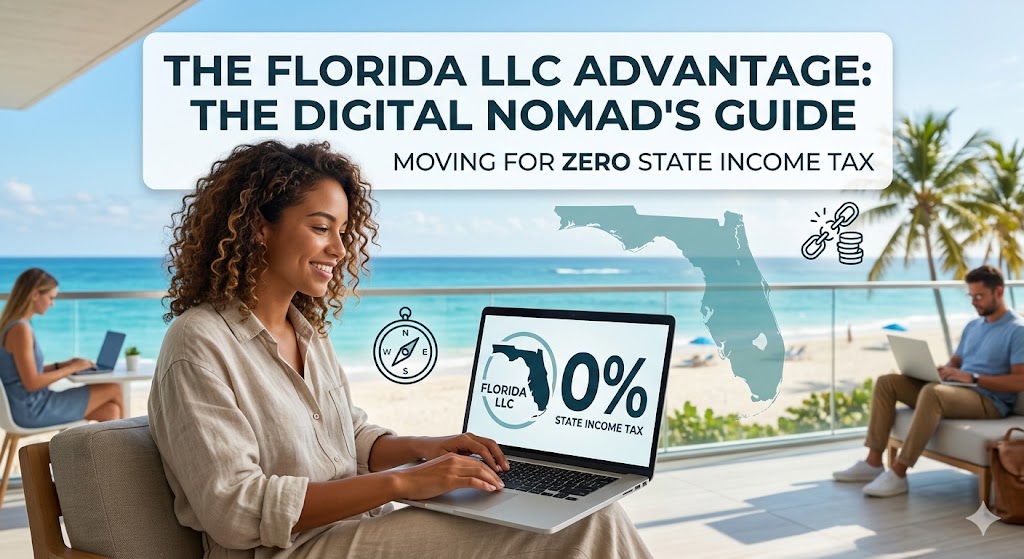
The modern workforce has fundamentally shifted. For decades, ambitious professionals were tethered to expensive metropolitan hubs like San Francisco, New York, or Chicago. You paid premium rent and surrendered a massive chunk of your earnings to state and local taxes, all for the privilege of commuting to a cubicle.
Today, the digital nomad lifestyle has shattered that paradigm. If your laptop is your office and a Wi-Fi connection is your commute, you possess the ultimate geographical freedom. But with that freedom comes a critical financial realization: where you choose to legally base your business matters just as much as how you run it.
If you are earning your living online—whether as a freelance consultant, an e-commerce entrepreneur, a software developer, or a content creator—every dollar you pay in state income tax is a dollar taken away from your business growth, your travel fund, or your retirement.
This is where the Florida LLC advantage comes into play. Combining a pro-business climate, year-round sunshine, and the highly coveted zero state income tax, Florida has become the ultimate destination for location-independent entrepreneurs. In this comprehensive guide, we will explore exactly why digital nomads are flocking to the Sunshine State, how to properly set up your Florida LLC, and the crucial steps required to legally establish your domicile so you can finally stop paying unnecessary state taxes.
Understanding the Zero State Income Tax Advantage
Before packing your bags and redirecting your mail, it is vital to understand the mechanics of Florida’s tax system and how it specifically benefits remote workers.
What Does “No State Income Tax” Actually Mean?
In the United States, your income is typically taxed at two primary levels: federal and state (and sometimes a third local/city level). While you cannot legally escape federal income taxes as a U.S. citizen or resident, state income taxes vary wildly depending on where you live.
States like California, New York, New Jersey, and Hawaii have some of the highest state income tax rates in the country, often climbing well over 10% for high earners. Florida is one of only nine U.S. states that levies absolutely zero state income tax on individual earnings.
If you operate as a sole proprietor or a single-member LLC, your business income “passes through” directly to your personal tax return. In Florida, because there is no personal state income tax, that pass-through business income is completely sheltered from state-level taxation.
How Much Can You Actually Save?
Let’s look at a practical example to illustrate the financial impact of relocating.
Imagine you are a digital nomad currently domiciled in California, running a successful marketing consultancy that generates $150,000 in taxable net income.
- In California: You will pay your federal taxes, plus self-employment taxes, plus roughly $9,000 to $12,000 in California state income taxes (depending on your exact deductions and brackets).
- In Florida: You pay your federal and self-employment taxes. Your state income tax bill is exactly $0.
Over the course of five years, moving from a high-tax state to Florida could easily save you $50,000 to $100,000—capital that can be reinvested into scaling your remote business, buying real estate, or funding your global travels.
Federal Taxes and Other Fees Still Apply
It is important to maintain realistic expectations. Moving to Florida does not make your business entirely tax-free. You are still fully responsible for:
- Federal income tax (IRS).
- Self-employment taxes (Social Security and Medicare).
- State sales tax (if you sell physical goods to Florida residents).
- Florida’s minimal annual LLC reporting fees.
However, removing the state income tax burden alone is often enough to dramatically alter a digital nomad’s financial trajectory.
Why Choose a Florida LLC for Your Nomad Business?
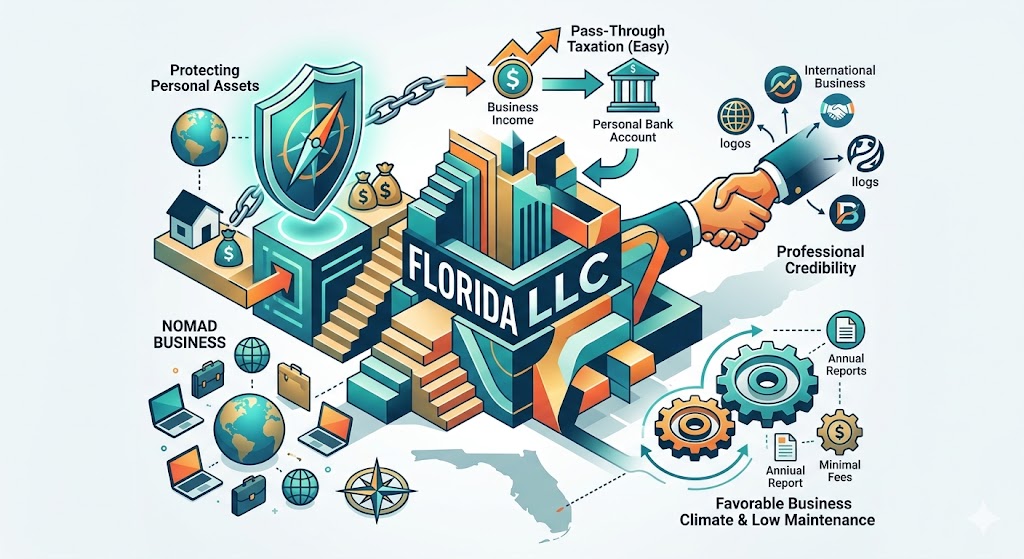
While avoiding state income tax is the primary draw, forming a Limited Liability Company (LLC) in Florida offers several independent benefits that make it the ideal structure for remote entrepreneurs.
Asset Protection and Limited Liability
The primary purpose of an LLC is right in the name: limited liability. If you operate as a sole proprietor and your business is sued by a disgruntled client or a vendor, your personal assets—your savings, your investments, your home—are at risk.
A Florida LLC creates a legal wall between your personal assets and your business liabilities. As long as you maintain the “corporate veil” (by not mixing personal and business funds), your personal wealth is protected from business-related lawsuits and debts.
Pass-Through Taxation Flexibility
By default, the IRS treats a single-member LLC as a “disregarded entity.” This means you don’t have to file a complex corporate tax return; you simply report your business income and expenses on Schedule C of your personal Form 1040.
Furthermore, as your digital nomad business grows, a Florida LLC gives you the flexibility to elect S-Corporation tax status. An S-Corp election can help you save significantly on self-employment taxes by allowing you to pay yourself a “reasonable salary” and take the remaining profits as distributions (which are not subject to Medicare and Social Security taxes).
Credibility with Clients and Vendors
Operating as “Jane Doe, LLC” carries significantly more professional weight than operating just as “Jane Doe.” Having a registered Florida LLC shows prospective clients, corporate partners, and financial institutions that you are a legitimate, established business entity. This credibility makes it easier to negotiate higher rates, secure vendor accounts, and open commercial lines of credit.
Favorable Business Climate and Low Maintenance
Florida consistently ranks as one of the most pro-business states in the country. The state government actively encourages entrepreneurship by keeping bureaucratic red tape to a minimum. Maintaining a Florida LLC is straightforward, requiring only a simple annual report filing and a modest fee to keep your company in good standing.
Step-by-Step Guide: How to Form a Florida LLC
Setting up your Florida LLC is a remarkably smooth process, much of which can be handled entirely online from anywhere in the world. (If you prefer to have a professional service handle the paperwork, check out our comprehensive Doola review for starting your US business). Here is the DIY step-by-step roadmap for digital nomads.
Step 1: Choose the Right Name for Your Business
Your business name must be distinguishable from any other entity already registered in Florida. You can perform a free name search on the Florida Division of Corporations website (Sunbiz.org). Furthermore, Florida law requires that your business name include an LLC designator, such as “Limited Liability Company,” “L.L.C.,” or “LLC.”
Step 2: Appoint a Florida Registered Agent
A registered agent is a person or authorized company responsible for receiving official legal and tax correspondence on behalf of your LLC. Crucial tip for digital nomads: Because you will likely be traveling, do not use yourself as your registered agent. Florida requires registered agents to have a physical street address in the state and be available during normal business hours. Hiring a professional registered agent service (usually costing between $50 and $150 per year) ensures you never miss important legal notices while you are out exploring the world.
Step 3: File the Articles of Organization
The official step to bring your Florida LLC into existence is filing the Articles of Organization with the Florida Division of Corporations. This can be done online via the Sunbiz portal. You will need to provide:
- Your LLC’s name and primary address.
- The name and address of your registered agent.
- The names of the LLC managers or authorized members.
- The required state filing fee (currently around $125).
Step 4: Draft an Operating Agreement
Although Florida law does not legally require you to file an operating agreement with the state, it is an essential internal document. Your operating agreement outlines the ownership structure, profit distribution, and operational rules of your LLC. Having this document is highly recommended, as banks often request it when you open a business account, and it strengthens your corporate veil.
Step 5: Obtain an Employer Identification Number (EIN)
An EIN is like a Social Security Number for your business. It is issued by the IRS for free and is required to open a business bank account, hire employees, and file certain taxes. You can apply for an EIN directly on the IRS website and receive it in minutes.
Step 6: Open a Florida Business Bank Account
To maintain your limited liability protection, you must completely separate your personal and business finances. Use your new EIN and Articles of Organization to open a dedicated business checking account. Many modern financial technology banks allow digital nomads to open these accounts entirely online without stepping foot in a physical branch.
Establishing Florida Domicile: Making the Move Official
Here is the most critical hurdle for digital nomads: You cannot simply form a Florida LLC, keep living in California or New York, and expect to pay zero state income tax. High-tax states are notoriously aggressive about tracking down lost tax revenue. If you want the tax benefits of Florida, you must legally make Florida your true home, a concept known as “domicile.” Domicile is the place you intend to return to after your travels.
The Difference Between Residency and Domicile
You can be a resident of multiple states (e.g., spending winter in Florida and summer in Colorado), but you can only have one legal domicile. To stop paying taxes to your former state, you must definitively break your domicile there and establish a new one in Florida.
Severing Ties with Your Former High-Tax State
To convince your former state’s tax board that you have left for good, you must sever as many ties as possible. This means:
- Selling or giving up your primary residence or lease in the old state.
- Closing bank accounts native strictly to that state.
- Relinquishing your old driver’s license.
- Canceling voter registration in the old state.
- Moving your precious belongings out of the state.
Steps to Prove Your Florida Domicile
To build a bulletproof case that Florida is your new permanent tax home, you should take the following steps as soon as you arrive:
- File a Declaration of Domicile: Go to the local county clerk’s office in Florida and file this official, notarized document declaring Florida as your permanent home.
- Get a Florida Driver’s License: Surrender your old license and get a Florida one immediately.
- Register to Vote: Register as a Florida voter and actually participate in local/national elections from your Florida address.
- Register Your Vehicle: Update your car insurance and register your vehicle in Florida to get Florida license plates.
- Establish a Real Address: A standard P.O. Box will not work for establishing domicile. You need a physical residential address. If you are traveling full-time, consider using a specialized mail-forwarding service designed for nomads (like Escapees or St. Brendan’s Isle) that provides a legal street address for domicile purposes, or rent a modest home base.
- Transfer Professionals: Hire a Florida-based doctor, dentist, accountant, and lawyer.
The 183-Day Rule Explained
Many states use the “183-day rule” (spending more than half the year in a state) to determine residency. If you are a digital nomad who travels internationally for 10 months of the year, you might not spend 183 days anywhere. However, if your legally established domicile is Florida, and you do not spend enough time in any other single U.S. state to trigger their residency rules, your income defaults to being taxed in your domicile state: Florida. Therefore, your state income tax remains zero.
Navigating the Digital Nomad Lifestyle in Florida
Beyond the massive tax advantages, Florida is an incredible place to live and work. The state has embraced remote work, boasting infrastructure and communities that cater perfectly to the location-independent professional.
Best Florida Cities for Remote Workers
- Miami: The hub for tech, crypto, and international business. Miami offers a vibrant, fast-paced lifestyle, incredible nightlife, and a massive community of global entrepreneurs. It is more expensive, but unparalleled for networking.
- St. Petersburg: Located on the Gulf Coast, “St. Pete” is highly walkable, artsy, and features a booming craft coffee and brewery scene. It has become a massive haven for millennial and Gen-Z remote workers seeking a laid-back, creative vibe.
- Orlando: Beyond the theme parks, Orlando has a rapidly growing tech sector, excellent co-working spaces, and a highly accessible international airport, making global travel exceptionally easy.
- Jacksonville: Offering a much lower cost of living than South Florida, Jacksonville provides miles of beaches, sprawling parks, and a quieter environment for focused work.
Networking and Co-working
Because the state draws so many transplants from high-tax states, you will find active networking groups, Meetups, and masterminds focused entirely on remote entrepreneurship. You’ll also have local access to top-tier digital marketing talent, including Florida-based Shopify SEO agencies that can help scale your newly relocated business.
Common Pitfalls to Avoid When Moving Your LLC
While the transition is straightforward, digital nomads often fall into a few specific traps that can jeopardize their legal and tax status.
Foreign Qualification vs. Domestic LLC
The most common mistake remote workers make is forming a Florida LLC while continuing to physically live and work from a high-tax state (like New York). If you live in New York and run a Florida LLC, New York will still demand state income taxes on the money you earn while sitting in New York. Furthermore, New York will require your Florida LLC to register as a “Foreign Entity” doing business in NY, subjecting you to double the registration fees and bureaucratic headaches. The zero-tax strategy only works if you actually change your personal domicile to Florida.
Ignoring the Annual Report
Florida LLCs are low maintenance, but not no maintenance. Every year, between January 1 and May 1, you must file an Annual Report with the Sunbiz portal and pay a fee (approximately $138.75). If you fail to do this, the state will hit you with a hefty $400 late fee and eventually dissolve your LLC. Set a calendar reminder.
Commingling Personal and Business Funds
It is tempting for solo digital nomads to use their business debit card to buy personal groceries or pay for a personal Netflix account. This is called “commingling funds” and it allows courts to “pierce the corporate veil.” If you are sued, the judge can rule that your LLC is a sham, leaving your personal assets entirely vulnerable. Always keep business and personal finances 100% separate.
Frequently Asked Questions (FAQs) About Florida LLCs and Taxes
Can I use a mail-forwarding service as my Florida LLC business address? Yes, but with caveats. While a mail forwarding service can act as your mailing address, your Registered Agent must have a physical street address in Florida. Many high-quality mail forwarders and registered agent services cater specifically to RVers and digital nomads, offering physical addresses that satisfy state requirements.
Do I have to pay Florida state income tax if my clients are in California or New York? Generally, no. For a service-based digital nomad, income is typically sourced to where the work is performed, not where the client is located. If you are a legally domiciled Florida resident performing your marketing work on your laptop from Florida (or from a beach in Mexico), you owe no state income tax, even if your client is in San Francisco.
What happens if I travel internationally most of the year? If you travel internationally but maintain your legal domicile in Florida, your federal tax obligations remain (though you should look into the Foreign Earned Income Exclusion, FEIE). Because your state domicile is Florida, you will not owe state income taxes while overseas, provided you haven’t accidentally established tax residency in another state or country.
Can a non-US citizen form a Florida LLC? Absolutely. There are no citizenship or residency requirements to form an LLC in Florida. Non-U.S. citizens can establish a Florida LLC to access the U.S. market, though their specific tax liabilities will depend on international tax treaties and whether they have effectively connected income (ECI) in the United States.
Conclusion: Is the Florida Move Right for You?
The transition to a location-independent lifestyle represents a profound shift in how you value your time and freedom. It only makes sense to apply that same strategic thinking to your finances.
Stop leaving your hard-earned money on the table in high-tax states. Plan your move, structure your Florida LLC, and start investing those tax savings back into your business—whether that means funding your global travels or executing a massive Shopify SEO strategy to dominate your niche.
Whether you plan to rent an apartment in the vibrant heart of Miami, buy a quiet home base on the Gulf Coast, or simply use Florida as your legal anchor while you travel the globe full-time, the Florida LLC advantage is undeniably powerful.
By taking the time to carefully establish your domicile, set up your legal entity correctly, and cleanly sever ties with your former state, you secure the ultimate digital nomad setup. Stop leaving your hard-earned money on the table in high-tax states. Plan your move, structure your Florida LLC, and start investing those tax savings back into your business and your freedom.
Related articles :
- Why Successful Shopify Stores Live and Breathe SEO
- Shopify: E-commerce Dropshipping Platform
- Top 10 SEO-Friendly Shopify Themes for 2025
- A Brand Growth Specialist | Ecom & SEO Expert (Consultation)