
 By
By 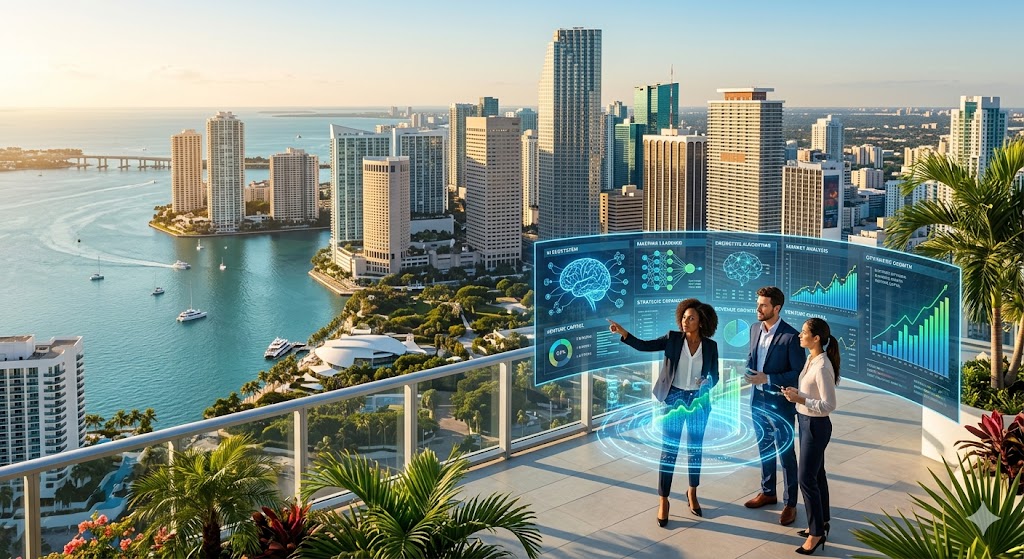
In the early 2020s, the narrative surrounding the South Florida tech scene was dominated by viral tweets, flashy announcements, and a massive influx of venture capitalists trading Silicon Valley fog for Biscayne Bay sunshine. The migration was legendary, establishing Miami and its surrounding areas as a thriving, emerging tech hub. But hype, as many founders quickly realize, does not pay payroll. As we navigate through 2026, the foundational question for venture capitalists, enterprise operators, and founders alike has shifted. The question is no longer whether artificial intelligence companies are launching in the 305—it is whether these AI startups are actually surviving, scaling, and reaching profitability.
The transition from an “emerging” hub to a mature, established ecosystem is historically brutal. It requires a fundamental shift from broad, experimental technology to specialized, revenue-generating solutions. For AI startups operating in South Florida, the macroeconomic climate of 2026 presents a dual-edged sword. On one hand, global AI funding has continued to shatter records, with early-stage AI ventures commanding massive valuation premiums. On the other hand, investor patience for “growth at all costs” has evaporated, replaced by a ruthless demand for demonstrable product-market fit, capital efficiency, and clear paths to positive unit economics.
The reality is that AI startups in South Florida are not just surviving; a specific, highly disciplined cohort of them is thriving. However, the ecosystem has distinctly bifurcated. The gap between the hyper-successful enterprises raising mega-rounds and the silent majority of struggling ventures has never been wider. To understand the true health of the South Florida AI startup scene, we must look beyond the headlines and dive deep into the venture capital data, the operational frameworks of the survivors, and the unique friction points of building a deep-tech company in a sunshine state.
The State of the South Florida AI Ecosystem in 2026
To accurately gauge survival, we must first look at the capital flowing through the ecosystem. The venture capital landscape in South Florida has demonstrated remarkable resilience, proving that the region’s tech boom was not merely a pandemic-era anomaly.
Venture Capital Influx: The Data Behind the Growth
By the end of 2025, the Miami-Fort Lauderdale metro area recorded its best year for venture capital since the pandemic peaks, raising between $3.5 billion and $4 billion in total VC funding. What makes this figure significant is not just the volume, but the concentration of capital within the artificial intelligence sector. Nationally, AI startups secured roughly a third of all venture capital, and South Florida mirrored this aggressive allocation.
In the fourth quarter of 2025 alone, South Florida startups raised over $612.7 million across 109 distinct deals, bringing the average deal size to a healthy $5.6 million. This data indicates a market with both high transaction volume—suggesting a robust top-of-funnel pipeline for new company formation—and enough depth to support substantial, late-stage rounds. Furthermore, demographic data from early 2026 estimates that Miami now hosts approximately 248 startups per 10,000 residents. This extraordinary density of entrepreneurial activity cements the region’s status as a high-concentration zone for early-stage experimentation and technological deployment.
The Maturation of Deal Flow
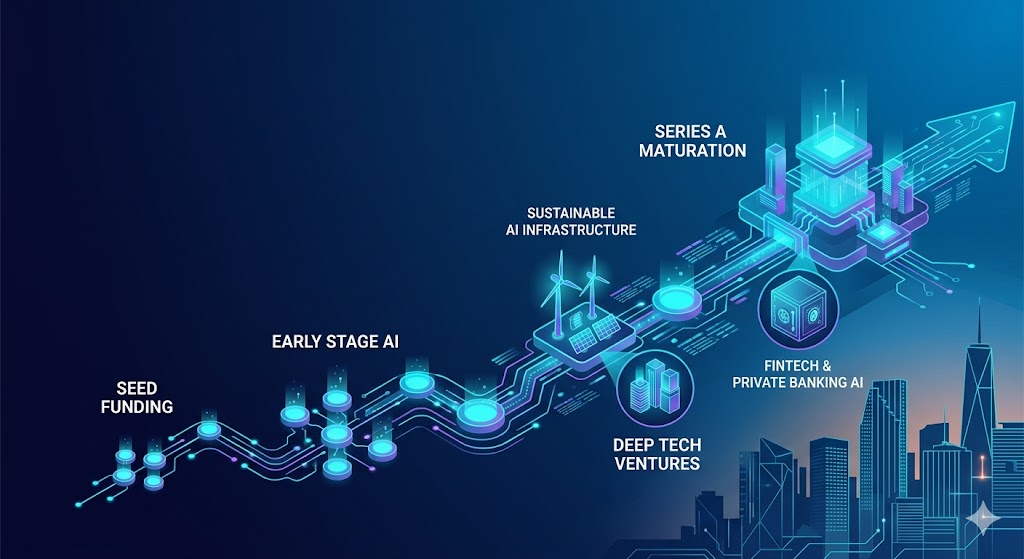
The nature of the investments has also matured. Investors in the South Florida ecosystem are no longer writing checks for thin “wrapper” applications built loosely on top of foundational models. They are financing deep-tech infrastructure and complex vertical solutions.
Nationwide data from early 2026 highlights that seed-stage AI companies command a massive 42% premium in valuations compared to non-AI startups. Moving up the ladder, the median valuation for Series A AI startups has crossed the $50 million milestone—roughly 30% higher than their non-AI counterparts. In Miami, this premium is heavily evident in deals like Flex, which raised a $60 million Series B to build AI-native private banking, and Exowatt, which secured a staggering $120 million to develop renewable energy solutions tailored to the massive power demands of AI data centers. The capital is present, but it is moving exclusively toward founders who can prove that their technology is a mission-critical infrastructure rather than a novel luxury.
What Separates the Survivors from the Statistics?
With so much capital available, why do some South Florida AI startups fail within their first eighteen months while others achieve unicorn status? The differentiating factors lie in product philosophy, customer acquisition architecture, and the fundamental business models they choose to deploy.
The Shift to Hyper-Vertical AI
The era of horizontal AI tools attempting to be “everything for everyone” has largely passed, dominated by tech megacaps like OpenAI, Anthropic, and Google. The startups surviving in South Florida are those adopting a hyper-vertical approach. They are embedding themselves deeply into specific, traditional industries that form the backbone of the Florida economy: real estate (PropTech), finance (FinTech), and healthcare (MedTech).
Instead of building a generic CRM, surviving startups are building systems tailored to the exact, idiosyncratic workflows of specialized professionals. By narrowing their total addressable market (TAM) initially, these startups create a deeply defensible moat. They solve high-ticket pain points so effectively that churn becomes virtually non-existent, allowing them to expand laterally once market dominance in a specific niche is achieved.
Mastering Zero-Click Content for Customer Acquisition
Survival is inextricably linked to customer acquisition cost (CAC). In a landscape where paid advertising on platforms like Google and Meta has become prohibitively expensive for early-stage AI ventures, the survivors are pioneering highly capital-efficient go-to-market motions.
The most successful B2B AI startups in the region are aggressively leveraging “zero-click” content strategies. Rather than gating all their intellectual property behind landing pages or relying on click-bait to drive traffic to external blogs, these founders are delivering massive, native value directly within social feeds, particularly on LinkedIn and X. They publish comprehensive frameworks, deep-dive industry analyses, and highly tactical operational advice natively on the platform.
By providing immediate value without requiring the user to click a link or leave the platform, they appease social media algorithms (which heavily penalize external links) and build intense, organic authority. This zero-click methodology builds an audience of high-intent enterprise buyers. When these prospects eventually need an AI solution, they bypass the search engine entirely and go directly to the brand that has been natively educating them for months, drastically driving down the startup’s CAC and preserving vital early-stage runway.
Sustainable Revenue-to-Funding Ratios
In previous cycles, success was often measured by the size of the funding round. In 2026, the ultimate metric of survival is the revenue-to-funding ratio. Startups that raise $10 million but only generate $500,000 in Annual Recurring Revenue (ARR) are finding themselves in fatal “down-round” territory when it comes time to raise a Series B. Conversely, startups that bootstrap or raise modest seed rounds while aggressively pushing toward $2 million to $5 million in ARR are the ones dictating their terms to venture capitalists. The survivors view funding as fuel to scale a working engine, not as a lifeline to figure out what the engine should be.
Case Studies: The AI Startups Thriving in the 305
To truly understand the survival mechanics of the ecosystem, we must analyze the companies actively shaping it. The following AI startups represent the vanguard of South Florida’s 2026 technological landscape.
Famous Labs: Unprecedented Commercial Velocity
In a landscape often bogged down by heavy Research and Development (R&D) and agonizingly long enterprise sales cycles, Miami-based Famous Labs stands out for its sheer commercial velocity. The company’s flagship product, Famous.ai, provides generative AI tools designed specifically for automated content and brand creation.
As of early 2026, Famous Labs reported a staggering $32 million in ARR. This exceptional market traction supported a financing round that propelled the company to a $300 million valuation—a revenue-to-funding ratio that is almost unheard of in the early-stage AI space. Famous Labs survived and thrived by bypassing hard-tech, infrastructural complexity. Instead, they focused entirely on solving an immediate, ubiquitous, and painful problem for marketers and agencies: the need for fast, scalable, and rigidly on-brand creative assets. Their trajectory proves that capturing a broad, product-led market with exceptional speed can be just as defensible as spending years building deep technical moats.
Cast AI: Solving the Cloud Cost Crisis
As AI adoption scales globally, the hidden crisis for every tech company is the astronomical cost of cloud computing and data storage. Cast AI, with a significant presence in the Miami tech ecosystem, identified this exact friction point. They utilize artificial intelligence to autonomously analyze, optimize, and manage cloud resources across platforms like AWS, Google Cloud, and Azure.
By automating cloud infrastructure, Cast AI solves a critical cost issue, routinely delivering up to 60% savings for their enterprise clients. They recently secured a Series C funding round, proving that AI solutions aimed at immediate, bottom-line cost reduction are highly resilient to economic downturns. When a startup’s product directly increases a client’s profit margins, survival is virtually guaranteed.
1PLTFRM and Aracor AI: Dominating the Financial and Legal Hubs
Brickell is widely recognized as the heart of Miami’s finance and investment sector, acting as the primary gateway to Latin American capital. Startups like 1PLTFRM and Aracor AI have capitalized on this geographic advantage.
1PLTFRM is building an AI-powered central nervous system specifically for private investment firms. Founded by Isidro Fernandez, the platform automates up to 12 distinct steps in the complex private investment process—from initial deal flow ingestion and room booking to investor relations and task delegation. By winning the Endeavor Miami 2025 Startup Pitch Competition, 1PLTFRM validated its product-market fit. Because it was built by financiers for financiers, it removes administrative friction, allowing investors to focus purely on relationships and judgment.
Similarly, Aracor AI secured a highly competitive $4.5 million seed round to fuel its automation of complex legal contracts. Operating in a financial hub where corporate law and venture capital intersect daily, Aracor AI found a rich, target-dense environment to deploy its technology, bypassing the broader, saturated consumer AI market.
DermaSensor: Pioneering MedTech AI
South Florida has a robust and historically significant healthcare sector. DermaSensor is leveraging this by developing AI-powered skin cancer detection devices. Having raised $16 million in a Series B round, DermaSensor highlights a critical truth about the ecosystem: hardware and healthcare innovation requires sustained, patient capital. Their survival is a testament to the maturity of investors in the region who are willing to fund life-saving AI technology that requires navigating arduous FDA approvals and clinical trials, moving far beyond the quick-flip SaaS model.
The Unique Friction of Building in South Florida
Despite the success stories, the South Florida ecosystem is not without its significant challenges. Founders must navigate a unique set of regional friction points to ensure their survival.
The Talent Acquisition vs. Relocation Dilemma
While Miami attracts immense capital, the engineering talent pool—specifically senior machine learning engineers, data scientists, and large language model (LLM) architects—is still catching up to legacy hubs like San Francisco and Seattle.
Founders face a difficult choice: compete locally for a limited pool of elite AI talent, which drives up compensation packages, or recruit globally and bear the high costs of relocating engineers to a city where real estate prices have skyrocketed. Surviving startups often adopt a hybrid model. They maintain their executive leadership, sales teams, and venture relationships in Miami, while building distributed, remote engineering pods in secondary markets or internationally to keep burn rates manageable.
Navigating the Hype Distraction
South Florida is famous for its lifestyle, nightlife, and endless circuit of tech parties, boat days, and networking mixers. For an early-stage founder, this environment can be incredibly toxic to productivity. The “hype distraction” has killed more promising AI startups in Miami than a lack of capital ever could. Founders who spend their time chasing the scene rather than writing code, interviewing users, and iterating their product inevitably run out of runway.
The Blueprint for AI Startup Survival
Surviving the South Florida AI landscape requires more than just a great algorithm. It demands a rigorous, almost militaristic approach to company building. Founders who make it to Series B and beyond generally share a common operational blueprint.
Implementing High-Performance Operational Frameworks
To survive the critical 18-month post-seed runway—where the pressure to find true product-market fit is immense—founding teams must adopt intense, high-performance frameworks. The most effective founders in the region are executing what is commonly referred to as “Monk Mode” protocols.
Drawing heavily from deep work philosophies, these founders actively isolate themselves from the distraction-heavy Miami networking scene. A typical Monk Mode sprint involves 90-day cycles of extreme operational intensity: eliminating all non-essential meetings, stripping away superficial networking events, and dedicating a minimum of four to six hours daily to uninterrupted, deep cognitive work. Whether it is architecting a complex AI pipeline, writing SEO-optimized documentation, or manually onboarding the first 100 enterprise clients, this level of sustained, distraction-free focus is what allows lean teams to out-ship their heavily funded, but distracted, competitors. They understand that while networking can open a door, only deep work builds the product that keeps the door open.
Leveraging the Gateway to Latin America
One of the greatest, often underutilized, advantages of building in South Florida is its position as the undisputed economic gateway to Latin America (LatAm). The LatAm market is experiencing its own massive digital transformation, and the appetite for enterprise AI solutions is voracious.
Surviving South Florida startups look south just as often as they look north. By building platforms with localized language support, understanding cross-border compliance, and tapping into LatAm-focused venture funds operating out of Brickell, AI founders can unlock a massive, less saturated customer base. Startups that treat Miami not as the southernmost point of the US market, but as the northernmost point of the Latin American market, secure a massive strategic advantage.
Strategic Networking and Capitalizing on Ecosystem Events
While avoiding the distraction of superficial parties is crucial, surviving founders know exactly when and where to deploy their networking capital. The ecosystem has evolved to support high-value, operator-driven events.
For example, conferences like Startup OLÉ Miami, scheduled for April 2026, are designed specifically to connect startups with serious institutional investors, corporate partners, and international scale-ups. The existence and growth of these highly specialized events signal a maturation of the city. Founders who survive do not network to be seen; they attend these conferences with targeted lists of venture partners, prepared data rooms, and clear, structured requests for capital or strategic partnerships.
Conclusion: The Verdict on South Florida’s AI Scene
So, are AI startups actually surviving in South Florida? The data, the deal flow, and the emerging market leaders provide a definitive answer: Yes, but only the disciplined ones.
The year 2026 has stripped away the superficial veneer of the early tech boom. The ventures surviving today are those that have traded the hype for hyper-specialization. They are tackling massive, boring B2B pain points in traditional industries like finance, real estate, and healthcare. They are acquiring customers through highly efficient, zero-click value delivery, and they are ruthlessly guarding their operational focus through deep work frameworks that prioritize shipping product over attending parties.
South Florida has undeniably cemented its place as a powerhouse in the global AI landscape. It possesses the capital depth, the density of founders, and the geographic advantages necessary to build billion-dollar enterprises. For the founders willing to execute with precision, solve tangible problems, and maintain unwavering focus, the South Florida ecosystem is no longer just a place to launch an AI startup—it is one of the best places in the world to ensure it survives.
Related articles :
- Top Ways to Make Money from AI in 2026
- 30 AI Side Hustles You Can Start With $0 (Make Money Online in 2026)
- The Visual Revolution: How to Use AI Videos to Make Money Online
- What Are The Negative Impacts Of Artificial Intelligence