
 By
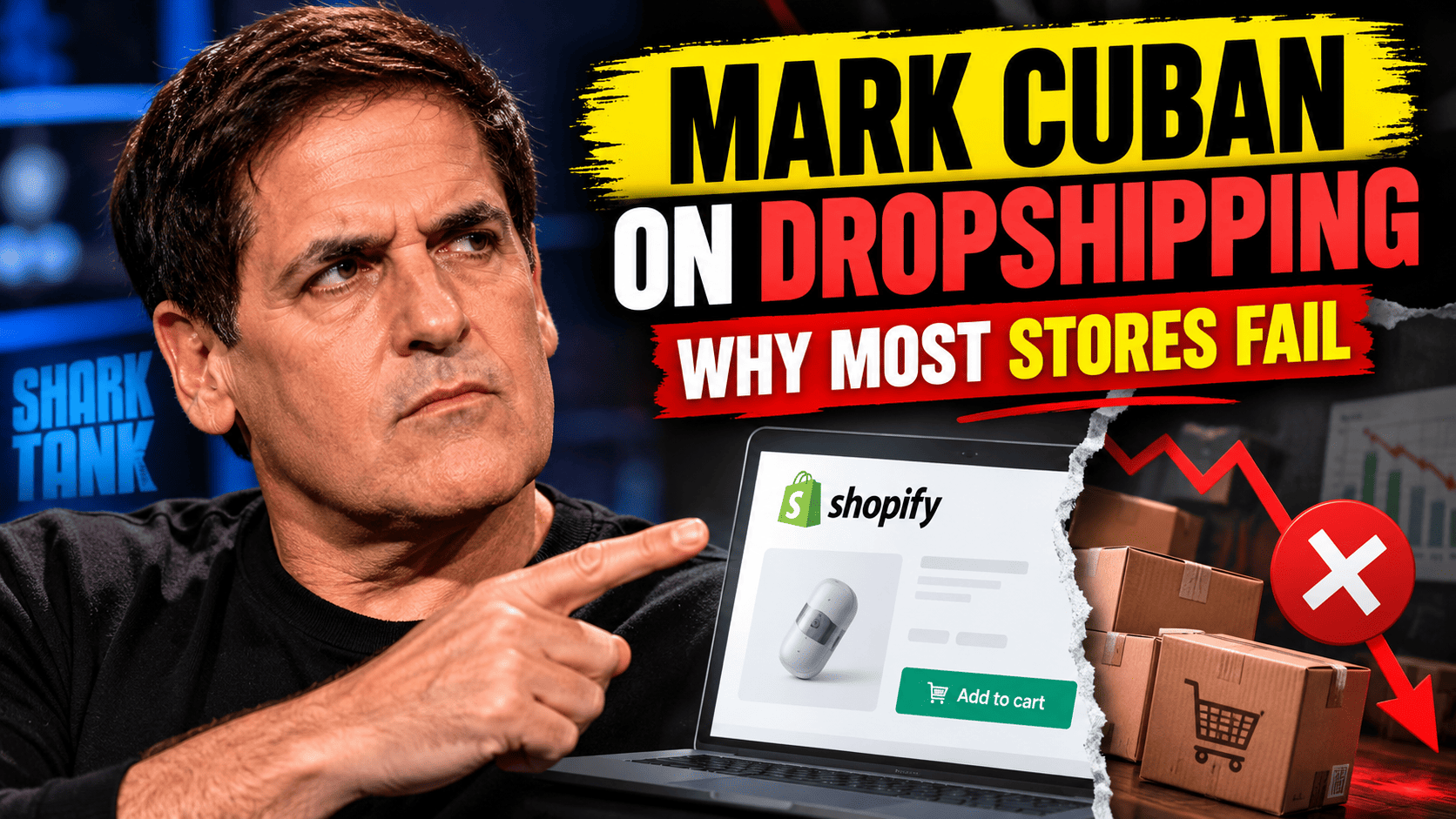
The dropshipping industry sells a powerful dream: launch a Shopify store, find a trending product, run a few advertisements, and start making money without owning inventory. But billionaire entrepreneur Mark Cuban sees a fundamental problem with this kind of business model.
For years, online entrepreneurs have promoted dropshipping as one of the easiest ways to start an e-commerce business. You don’t need a warehouse, manufacturing equipment, or thousands of dollars in inventory. In theory, all you need is a website, a supplier, and customers.
It sounds like the perfect business opportunity.
But there’s an uncomfortable question that many aspiring entrepreneurs never ask:
Are you actually building a business, or are you simply making money for someone else’s business?
That question sits at the center of Mark Cuban’s criticism of certain dropshipping businesses.
The billionaire entrepreneur, investor, and former Shark Tank star has built his reputation around a philosophy that emphasizes competitive advantages, sales, customer relationships, and long-term business value.
And when you apply those principles to modern dropshipping, some serious weaknesses become impossible to ignore.
1. Mark Cuban Has Actually Criticized Dropshipping
Unlike many celebrity business comparisons circulating online, Cuban’s connection to this topic isn’t entirely hypothetical.
In a 2024 interview with The U.S. Sun, Cuban criticized certain dropshipping side hustles, particularly those in which entrepreneurs effectively generate profits for suppliers while struggling to create a scalable business of their own.
His broader concern was about controlling the value chain and making sure entrepreneurs build businesses that benefit themselves rather than simply enriching intermediaries.
This distinction matters.
Cuban wasn’t necessarily arguing that every dropshipping business is doomed to fail. Instead, his criticism highlights a structural problem: if you don’t control the product, customer experience, or competitive advantage, what exactly do you own?
Consider a typical dropshipping store.
An entrepreneur discovers a trending product on a supplier marketplace, imports it into Shopify, adds a markup, and begins advertising it.
But hundreds of other stores can potentially sell that same product.
The supplier controls availability and fulfillment. Advertising platforms influence customer acquisition costs. Shipping companies determine delivery performance.
Meanwhile, the store owner carries much of the responsibility for marketing, refunds, customer complaints, and reputation.
That isn’t automatically a bad business model.
But it is a fragile one when the retailer has no meaningful differentiation.
2. The Biggest Dropshipping Lie: Revenue Equals Success
One of the most misleading trends in online entrepreneurship is the obsession with revenue screenshots.
You’ve probably seen the videos:
“I made $50,000 dropshipping in 30 days.”
“My Shopify store generated $100,000 this month.”
“Here’s how I built a six-figure e-commerce business.”
The numbers sound impressive.
But revenue alone tells us very little about whether a business is successful.
Imagine a Shopify store generating $50,000 in monthly sales.
Its expenses might look something like this:
| Expense | Monthly Amount |
|---|---|
| Total revenue | $50,000 |
| Product and supplier costs | $22,000 |
| Paid advertising | $18,000 |
| Shipping and fulfillment | $3,000 |
| Refunds and chargebacks | $2,000 |
| Platform and operating expenses | $1,500 |
| Operating profit | $3,500 |
Illustrative example, not actual financial results from a particular business.
The store generated $50,000 in revenue but retained only $3,500 in operating profit before taxes.
That’s a 7% operating margin.
Now imagine advertising costs increase by 20%, with everything else remaining unchanged.
Advertising expenses rise to $21,600, reducing operating profit to approximately negative $100.
A seemingly successful store becomes unprofitable almost overnight.
This is why understanding unit economics matters far more than posting impressive dashboards.
Cuban has repeatedly emphasized the importance of sales, but sales must contribute to a viable business.
Revenue is evidence that customers are buying. Profitability and cash flow help determine whether the business can survive.
3. Mark Cuban’s Most Important Principle: Build a Competitive Advantage
One of Cuban’s most consistent business principles is that entrepreneurs need to understand what makes their companies different.
During a discussion with entrepreneurs at UC Berkeley, he encouraged founders to evaluate whether their business ideas were unique, differentiated, and sustainable.
This creates an uncomfortable challenge for traditional dropshipping.
What makes your store different?
Is it the product?
Probably not, if dozens of competitors sell exactly the same item.
Is it the price?
That advantage can disappear when another seller accepts a smaller margin.
Is it shipping?
Not necessarily, particularly if you rely on the same suppliers as everyone else.
Is it your Shopify theme?
A professional website helps build trust, but competitors can also create attractive stores.
The real challenge is creating something customers cannot easily replace.
That could mean developing a recognizable brand, securing exclusive supplier relationships, providing superior customer service, or building expertise around a specific market.
For example, compare two online stores selling ergonomic office accessories.
The first store offers random products copied from a supplier catalog.
The second specializes in workspace ergonomics, publishes detailed educational guides, tests its products, provides useful comparisons, and develops relationships with office professionals.
Both might technically use dropshipping.
But the second store has a stronger foundation for building customer trust and repeat business.
The difference isn’t the fulfillment method.
It’s the value the business creates beyond the transaction.
Read also : Gary Vee’s Social Media Advice Won’t Save Your Shopify Store — Here’s Why
4. Why Mark Cuban Would Challenge the One-Product Store Mentality
One-product Shopify stores can be effective.
They allow entrepreneurs to focus their messaging, simplify the customer journey, and test demand without managing an enormous catalog.
However, many beginners confuse a one-product store with a complete business strategy.
They assume that discovering a winning product automatically guarantees long-term success.
It doesn’t.
A product can become popular because of a temporary social media trend, a viral video, or seasonal demand.
But trends fade.
Competitors appear.
Advertising becomes more expensive.
Customers move on.
Cuban’s business philosophy encourages entrepreneurs to think beyond temporary opportunities.
A successful business needs a reason to continue existing after the initial excitement disappears.
If your entire business depends on a single viral TikTok product, you’re not necessarily building a sustainable brand.
You may simply be participating in a temporary market opportunity.
There’s nothing inherently wrong with that approach, provided you understand the risks.
But it should not be confused with building a defensible e-commerce company.
5. The Customer Relationship Is More Valuable Than the Product
One of the most overlooked aspects of Cuban’s business philosophy is his focus on understanding customers.
In interviews, he has consistently emphasized the importance of sales, customer needs, and creating genuine value.
This directly challenges how many dropshipping beginners approach e-commerce.
They spend hours researching products.
They analyze competitor advertisements.
They test different pricing strategies.
They install Shopify applications designed to increase conversions.
But they rarely speak to actual customers.
They don’t ask why people buy.
They don’t investigate why customers abandon their carts.
They don’t analyze complaints beyond issuing refunds.
And they often fail to understand the problems their products are supposed to solve.
This is a major strategic mistake.
Consider a Shopify store selling pet accessories.
Instead of constantly searching for new trending products, the owner could interview pet owners, identify common frustrations, and build a product selection around those needs.
Customer feedback might reveal demand for more durable accessories, clearer sizing information, or faster replacement services.
These insights could become meaningful competitive advantages.
The best product research doesn’t always begin with a supplier catalog. Sometimes it begins with a conversation.
6. The Hidden Danger of Depending Entirely on Paid Advertising
Many dropshipping businesses are built around one simple equation:
Find a product, purchase traffic, and sell the product for more than the total acquisition and fulfillment costs.
When the numbers work, the model can generate revenue quickly.
But what happens when the cost of acquiring customers increases?
What happens when an advertising account is suspended?
What happens when a competitor begins bidding on the same audience?
Businesses that depend entirely on paid advertising face significant platform risk.
This is where search engine optimization becomes especially important.
Unlike paid advertising, which generally stops delivering purchased traffic when spending stops, SEO can help a website attract visitors through organic search results over time.
However, organic traffic isn’t free in the economic sense. Creating content, improving technical SEO, and maintaining rankings all require resources.
The advantage is diversification.
A Shopify business with multiple acquisition channels is generally less exposed to sudden changes in any single advertising platform.
SEO and AI Search Are Becoming Part of the Competitive Advantage
Modern e-commerce businesses should think beyond ranking for a handful of product keywords.
They should develop content that demonstrates product knowledge, answers customer questions, and establishes topical relevance.
For example, a store selling ergonomic chairs could publish articles about posture, home office design, chair adjustment, and product comparisons.
That content can support traditional Google visibility while also making useful product information easier for AI-powered search systems to discover and interpret.
At Scrowp, we focus on helping Shopify merchants improve their stores through better website structure, SEO, user experience, and e-commerce optimization.
The objective should not simply be attracting more visitors.
It should be attracting relevant visitors and giving them convincing reasons to become customers.
That distinction aligns with Cuban’s emphasis on creating genuine business value.
7. Dropshipping Isn’t the Problem. Having No Business Strategy Is.
It would be easy to interpret Cuban’s criticism as proof that dropshipping is a bad idea.
But that conclusion would be too simplistic.
Dropshipping is fundamentally a fulfillment model.
It describes how products reach customers, not necessarily how a business creates value.
A strong brand can use third-party fulfillment.
An established retailer can sell products without physically holding every item in inventory.
A specialized Shopify store can develop valuable customer relationships while working with external suppliers.
The problem emerges when entrepreneurs treat the absence of inventory as a substitute for a business strategy.
Low barriers to entry are attractive because they make entrepreneurship more accessible.
But they also make competition easier.
If almost anyone can copy your business overnight, your competitive advantage is limited.
The solution isn’t necessarily to abandon dropshipping.
It’s to build something worth protecting.
That might include original branding, exclusive products, stronger supplier agreements, proprietary educational content, or exceptional customer support.
The most successful version of a dropshipping business may eventually look less like the traditional dropshipping model and more like a specialized retail brand.
8. Mark Cuban’s Cost Plus Drugs Offers an Important Lesson
One of the most interesting examples of Cuban’s approach to business is Mark Cuban Cost Plus Drug Company.
The company focuses on improving access to prescription medications through a transparent pricing model.
Rather than relying primarily on vague marketing promises, its business proposition centers on addressing a specific customer problem: the cost and complexity of purchasing medications.
The model has important differences from ordinary e-commerce, including regulation, sourcing, and pharmaceutical distribution.
Still, the broader lesson is relevant.
Cuban’s approach starts with identifying an inefficiency and designing a business around solving it.
Many inexperienced dropshippers reverse that process.
They find a product first.
Then they try to manufacture demand through advertising.
A more sustainable approach is to identify a real customer problem and find the best product or service to address it.
This change in thinking can transform how entrepreneurs approach product research.
Instead of asking, “What product is trending today?”
Ask, “What problem are customers struggling to solve, and how can my business solve it better?”
That question has much greater long-term potential.
9. AI Won’t Save a Bad Dropshipping Business
Artificial intelligence has made launching online stores significantly easier.
Entrepreneurs can use AI tools to generate product descriptions, research keywords, analyze customer reviews, develop advertising concepts, and automate repetitive tasks.
Some tools can even help build large portions of a Shopify store.
But there’s a dangerous assumption emerging in the industry:
That automation automatically creates a profitable business.
It doesn’t.
AI can accelerate execution, but it cannot guarantee product-market fit.
It cannot turn an unreliable supplier into a reliable one.
It cannot make an uncompetitive product unique simply by rewriting its description.
And it cannot eliminate the need to understand customers.
The real opportunity is using AI to improve the quality of business decisions.
For example, specialized AI agents can help merchants analyze SEO opportunities, identify technical issues, prioritize content improvements, and organize research.
Tools such as Accio Work illustrate how AI agents can support specific business workflows.
But technology should remain a tool for executing a sound strategy, not a replacement for one.
Cuban’s emphasis on learning, preparation, and understanding the market remains highly relevant in an increasingly automated economy.
10. What Shopify Entrepreneurs Can Learn From Mark Cuban
If we translate Cuban’s broader business philosophy into practical advice for Shopify store owners, several principles stand out.
First, understand your numbers. Revenue is important, but you must also understand contribution margins, customer acquisition costs, refunds, operating expenses, and cash flow.
Second, build a competitive advantage. Don’t assume that finding a trending product is enough. Develop something that makes customers choose your business over alternatives.
Third, know your customers. Their questions, complaints, and purchasing behavior can reveal opportunities that competitor research alone cannot identify.
Fourth, diversify customer acquisition. Paid advertising can be effective, but SEO, email marketing, content, and repeat purchases can help reduce dependence on a single channel.
Fifth, prioritize long-term value. A business that generates smaller but consistent profits may be more valuable than one that produces impressive short-term revenue and then disappears.
Finally, treat dropshipping as a starting point, not an identity. Your goal should be to build a real e-commerce company, regardless of how orders are fulfilled.
11. My Perspective as a Shopify and SEO Specialist
As someone who works with Shopify businesses, I believe the biggest problem in e-commerce isn’t the technology.
It’s the expectations.
Many entrepreneurs enter the industry believing that launching a store is the difficult part.
It isn’t.
Today, creating a functional online store is easier than ever.
The real challenges begin after launch.
How do you attract qualified customers?
How do you establish credibility?
How do you compete against larger retailers?
How do you improve conversion rates without destroying margins?
How do you create a reason for customers to return?
And most importantly, how do you build a business that can survive when the next advertising trend disappears?
These questions require strategy, not simply another Shopify application or another AI-generated product description.
I don’t believe dropshipping is dead.
I believe the era of treating dropshipping as an effortless shortcut to wealth deserves to end.
Entrepreneurs who focus on branding, customer relationships, organic visibility, and sustainable profitability can still build meaningful businesses using dropshipping.
But they need to stop confusing a store with a company.
A Shopify store is infrastructure. A business is the system of value, customers, operations, and economics built around it.
That is the distinction more entrepreneurs need to understand.
Conclusion: Mark Cuban Challenges the Dream, Not Entrepreneurship
Mark Cuban’s criticism of dropshipping is uncomfortable because it challenges one of the most attractive promises in online entrepreneurship.
The promise that you can build a profitable business without significant capital, inventory, experience, or specialized knowledge.
Some entrepreneurs do succeed with relatively lean resources.
But low startup costs don’t eliminate competition, customer expectations, or financial risk.
Cuban’s broader philosophy suggests that successful businesses need more than an opportunity to resell products.
They need differentiation, customer understanding, sales capabilities, and a sustainable reason to exist.
For aspiring Shopify entrepreneurs, the lesson is clear.
Don’t abandon e-commerce because dropshipping has weaknesses.
Instead, stop building businesses that depend entirely on temporary advantages.
Build something customers trust.
Build something competitors cannot easily replicate.
Build something that creates value beyond a single transaction.
Because the ultimate goal shouldn’t be to own a dropshipping store. It should be to own a business worth keeping.
About the author: Marouane RHAFLI is the founder of Scrowp, a Shopify and SEO specialist, and an e-commerce consultant focused on helping online merchants improve organic visibility, conversion rates, and long-term business performance.