
 By
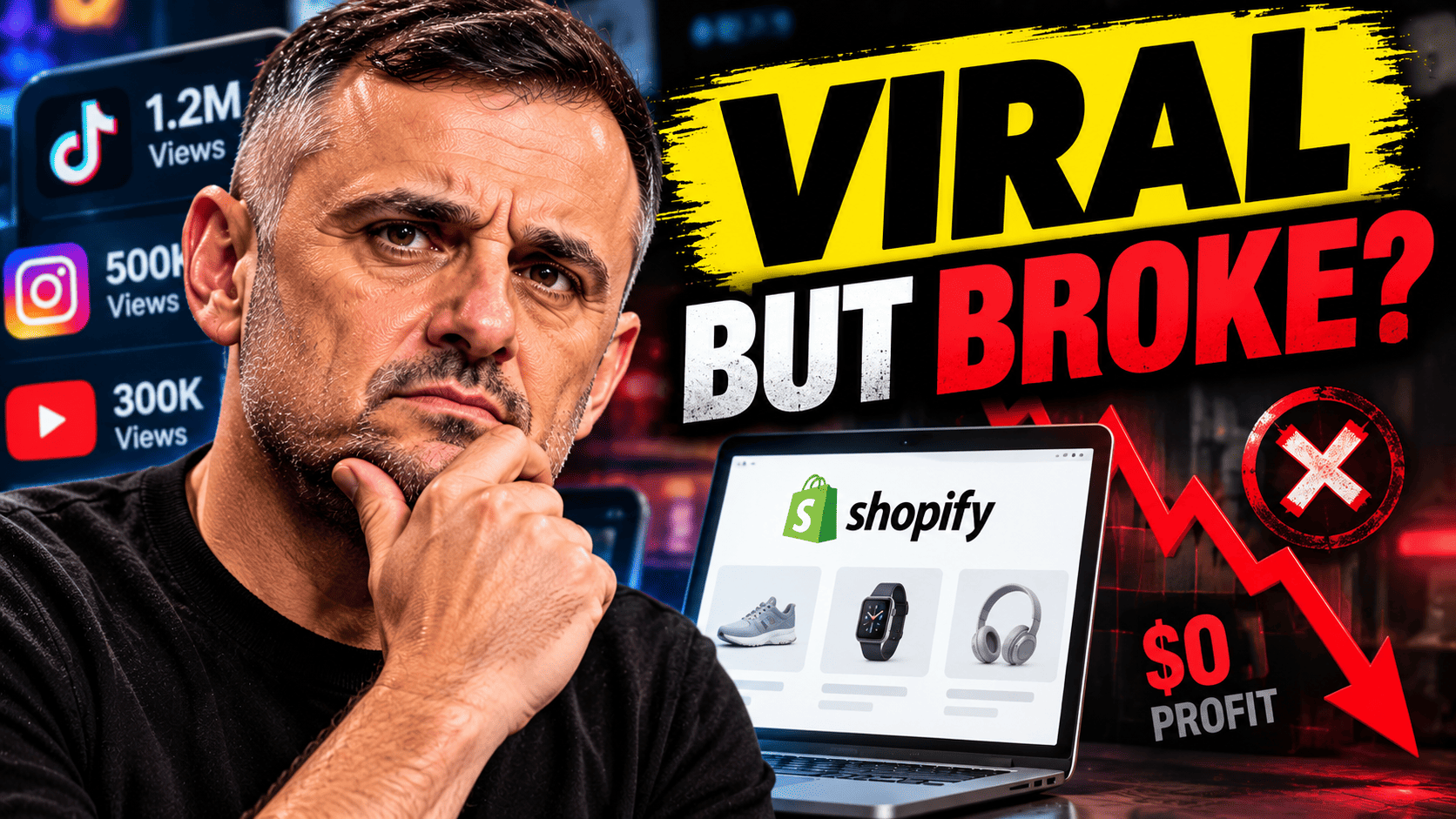
Gary Vaynerchuk has built an empire around one powerful idea: attention is one of the most valuable assets in business. But there’s a dangerous misunderstanding spreading among e-commerce entrepreneurs. They believe that getting attention automatically means making money. It doesn’t.
Every day, thousands of Shopify store owners publish TikTok videos, Instagram Reels, Facebook posts, and YouTube Shorts, hoping their products will go viral.
They follow trending sounds. They copy successful creators. They experiment with AI-generated content. Some even spend thousands of dollars hiring influencers.
And when a video finally reaches 100,000 views, they celebrate.
But there’s one problem.
Their Shopify store still isn’t making money.
This raises a controversial question:
What if the biggest mistake e-commerce entrepreneurs make isn’t ignoring Gary Vee’s advice, but misunderstanding it?
Gary Vaynerchuk, better known as Gary Vee, has spent years explaining the importance of storytelling, organic content, brand relevance, and consumer attention.
His marketing philosophy has influenced entrepreneurs around the world.
However, running a successful e-commerce business requires more than mastering social media algorithms.
It requires profitable products, customer trust, conversion optimization, operational efficiency, and a long-term acquisition strategy.
And that’s where many Shopify entrepreneurs get things wrong.
1. Gary Vee Is Right About Attention — But Attention Isn’t Revenue
Gary Vee’s marketing philosophy centers on identifying where consumers spend their time and creating relevant content for those environments.
His 2024 book, Day Trading Attention, explores how businesses can build brands and generate sales through modern media channels.
The principle is simple: instead of relying exclusively on traditional advertising, businesses should recognize emerging opportunities to reach consumers.
It’s a powerful concept.
But here’s what many entrepreneurs overlook.
Attention and revenue are two completely different metrics.
Imagine two Shopify stores selling fitness accessories.
Store A publishes a viral TikTok video that generates 500,000 views but produces only 20 orders.
Store B publishes an educational YouTube video that receives 5,000 views but generates 50 orders.
Assuming the orders have similar value and profitability, Store B has generated more revenue despite receiving 99% fewer views.
Why?
Because its audience may have stronger purchasing intent.
People watching entertaining fitness videos aren’t necessarily interested in buying resistance bands.
But someone searching for “best resistance bands for home workouts” may already be considering a purchase.
This is the difference between attracting attention and attracting qualified customers.
A million views can make you famous. They cannot guarantee a profitable Shopify store.
2. The Viral Content Trap That Destroys E-commerce Expectations
Social media platforms reward content that generates engagement.
That engagement might include comments, shares, watch time, or repeat views.
However, content that performs well on social media doesn’t always produce commercial results.
A controversial post about entrepreneurship might attract thousands of comments.
A funny product demonstration might generate millions of impressions.
But neither guarantees that viewers will trust the seller enough to make a purchase.
The problem becomes more serious when entrepreneurs start optimizing exclusively for engagement.
They ask:
“How can I make this video go viral?”
Instead, they should also ask:
“How will this content help the right customer understand my product?”
These questions lead to different marketing strategies.
One focuses on maximizing reach.
The other focuses on attracting and converting potential buyers.
The most effective e-commerce content often accomplishes both.
But when those objectives conflict, business owners need to understand the trade-off.
Gary Vee himself emphasizes the relationship between brand building and sales. His philosophy should not be reduced to the idea that views automatically equal money.
3. Why Copying Gary Vee’s Content Strategy Can Backfire
Gary Vee has built an extensive personal brand through years of publishing content, operating businesses, and developing an audience.
His company, VaynerMedia, works with major brands on advertising and marketing strategy.
He also operates VeeFriends, a business built around characters, intellectual property, collectibles, and experiences.
These ventures provide a level of brand recognition and infrastructure that a new Shopify merchant typically doesn’t possess.
This matters because strategies must be adapted to the resources available.
A large organization might have dedicated teams for content creation, editing, analytics, community management, and advertising.
A small Shopify store owner may be responsible for everything.
Product sourcing.
Customer service.
Website maintenance.
Advertising.
Shipping problems.
Refund requests.
And content creation.
Trying to imitate the publishing output of a major media organization can quickly become unsustainable.
For smaller businesses, the solution isn’t necessarily to produce hundreds of videos.
It’s to develop a realistic content strategy that supports business objectives.
For example, a Shopify merchant might start with three educational short-form videos per week, one detailed product demonstration, and one SEO-focused blog article.
The important part is measuring what each activity contributes to the business.
Consistency matters. But consistency without direction can become an expensive distraction.
4. Your Shopify Store Has a Conversion Problem, Not Just a Traffic Problem
Here’s an uncomfortable reality.
Many online stores don’t need more visitors immediately.
They need to convert more of the visitors they already receive.
Imagine a Shopify store attracting 20,000 monthly visitors with a conversion rate of 0.8%.
That’s 160 orders.
If the average order value is $60, monthly revenue equals $9,600.
Now imagine the store improves its conversion rate to 1.6%, without increasing traffic.
The result becomes:
| Metric | Before | After |
|---|---|---|
| Monthly visitors | 20,000 | 20,000 |
| Conversion rate | 0.8% | 1.6% |
| Orders | 160 | 320 |
| Average order value | $60 | $60 |
| Monthly revenue | $9,600 | $19,200 |
Illustrative example, not a guaranteed result or industry benchmark.
Revenue doubles without generating a single additional visitor.
Of course, improving conversion rates requires identifying actual problems.
A store might suffer from slow loading times, unclear product descriptions, confusing navigation, weak trust signals, or unexpected shipping costs.
Other problems include complicated checkout experiences and poorly optimized mobile layouts.
These issues cannot be solved simply by posting more Instagram Reels.
They require attention to the shopping experience itself.
This is why Shopify conversion rate optimization deserves as much consideration as social media marketing.
Traffic brings potential customers to your store.
Your website must give them convincing reasons to buy.
5. Gary Vee’s Philosophy Reveals Why Brand Building Matters
One of the strongest elements of Gary Vee’s approach is his emphasis on brand relevance.
In his July 2026 article The New Rules of Social Media, he discussed the transition from traditional social networks toward interest-driven content discovery.
His argument is that algorithms increasingly distribute content based on relevance rather than simply showing posts to existing followers.
For e-commerce businesses, this creates opportunities.
A small Shopify brand can potentially reach customers without already possessing a massive following.
However, visibility is only the beginning.
A brand needs to develop recognition, credibility, and a clear identity.
Consider two online stores selling identical coffee accessories.
The first publishes generic product advertisements.
The second creates educational content about brewing techniques, compares different accessories, answers customer questions, and develops a recognizable personality.
Over time, the second business may establish stronger customer relationships.
Customers aren’t simply buying a coffee accessory.
They’re buying from a business they recognize and trust.
This is where Gary Vee’s philosophy becomes especially valuable.
The goal shouldn’t be to collect views.
The goal should be to transform attention into lasting brand value.
Read also : Jeff Bezos Built Amazon, But His Strategy Could Destroy Your Shopify Store
6. SEO Is the Missing Piece in Many Social-First E-commerce Strategies
Social media is powerful for discovery.
But search engines serve a different purpose.
On TikTok or Instagram, consumers often encounter products while browsing.
On Google, consumers frequently search because they have a specific question, problem, or purchasing intention.
These behaviors create different marketing opportunities.
Imagine someone watching a viral video about ergonomic office chairs.
They might enjoy the content without planning to purchase anything.
Now imagine someone searching Google for “best ergonomic office chair for back support.”
That search suggests a more specific interest.
Neither visitor is guaranteed to buy, but their intent may differ substantially.
This is why Shopify SEO remains an important acquisition channel.
A well-optimized e-commerce website can attract relevant organic traffic through product pages, collection pages, buying guides, and educational content.
Unlike a social post that may receive most of its exposure shortly after publication, useful search content can continue attracting visitors over an extended period.
However, rankings aren’t guaranteed, and SEO requires ongoing investment.
How Shopify Stores Can Combine SEO With Social Media
The strongest strategy isn’t necessarily choosing between Gary Vee’s social media approach and traditional search optimization.
It’s combining them.
For example, a Shopify store selling skincare products could create a detailed article explaining how to choose a moisturizer for dry skin.
That article could support organic search visibility.
The business could then turn the article into short educational videos, Instagram carousels, and YouTube Shorts.
Social content creates awareness.
SEO captures relevant search demand.
Product pages help convert interested visitors.
Email marketing encourages customers to return.
Each channel plays a different role in the customer journey.
At Scrowp, we emphasize the importance of combining Shopify website optimization, SEO, and user experience rather than depending on one marketing channel.
A sustainable e-commerce strategy should make customer acquisition more resilient.
7. Why Dropshippers Misunderstand Gary Vee’s Advice
Dropshipping entrepreneurs are particularly vulnerable to the viral content trap.
Many beginners launch Shopify stores with limited budgets.
They search for trending products, import them from suppliers, and begin publishing short-form videos.
The hope is that one viral post will generate enough sales to transform the business.
Sometimes viral content can produce meaningful demand.
But relying on virality as a complete business strategy creates substantial risk.
What happens if the supplier runs out of stock?
What happens if shipping takes three weeks?
What happens when customers discover competitors selling the same product for less?
What happens when advertising costs increase?
Gary Vee’s emphasis on attention doesn’t eliminate these operational challenges.
A business still needs reliable fulfillment, competitive pricing, customer support, and healthy margins.
For dropshippers, this means developing value beyond the product itself.
That value might come from specialization, educational content, superior support, or a carefully curated product selection.
A dropshipping store with a recognizable brand and loyal customers is fundamentally different from a generic website selling whatever happens to be trending.
The first has the potential to develop lasting business value.
The second may depend entirely on temporary opportunities.
8. AI Content Is Making the Attention Game More Competitive
Artificial intelligence has dramatically lowered the barriers to content creation.
Shopify entrepreneurs can use AI tools to draft product descriptions, generate advertising concepts, analyze keywords, summarize reviews, and plan social media campaigns.
This creates opportunities for small businesses.
But it also creates a problem.
If every store can generate similar content with similar tools, differentiation becomes harder.
Imagine hundreds of Shopify stores publishing AI-generated articles about the same products.
Many of those articles may repeat identical information without providing original expertise.
The result is more content, but not necessarily more value.
The same problem applies to short-form video.
Generating dozens of videos doesn’t guarantee that customers will find them useful.
Businesses need to combine automation with genuine product knowledge and customer insights.
For example, AI can help analyze common customer questions.
But merchants should use those findings to create accurate, original explanations based on their products and customer experiences.
Specialized AI agents, including tools available through Accio Work, can also support research and SEO workflows.
However, AI should improve decision-making rather than replace strategic thinking.
When everyone can create content, the competitive advantage shifts toward who creates content worth trusting.
9. Gary Vee Is Betting on Live Commerce — Should Shopify Merchants Follow?
In 2026, Gary Vee has increasingly emphasized live shopping and social commerce.
At NRF 2026, he discussed the importance of relevant creative content and live shopping experiences.
He also argued in a June 2026 article that live commerce represents a major opportunity for consumer brands.
This is an interesting development because live shopping connects entertainment, product demonstration, customer interaction, and purchasing.
For certain businesses, it can shorten the distance between discovering a product and buying it.
But does that mean every Shopify merchant should immediately invest in livestream selling?
Not necessarily.
Live commerce may work particularly well for products that benefit from demonstrations, visual comparisons, or real-time customer questions.
Fashion, beauty, collectibles, and certain consumer accessories are potential examples.
Other products may require a different approach.
A merchant selling specialized industrial equipment might generate better results from technical documentation, search optimization, and direct sales relationships.
The lesson isn’t to ignore live commerce.
It’s to evaluate whether it matches the product, customer behavior, and available resources.
A marketing trend becomes valuable only when it contributes to business results.
10. My Perspective: E-commerce Entrepreneurs Need More Than Attention
As a Shopify and SEO specialist, I believe Gary Vee’s work contains valuable lessons for online entrepreneurs.
His emphasis on consumer attention, storytelling, consistency, and adapting to changing platforms is relevant.
But I also believe that many e-commerce entrepreneurs focus too heavily on visibility while neglecting the fundamentals of running a business.
A Shopify store isn’t successful because its founder becomes popular.
It’s successful when it consistently creates value for customers while generating sustainable financial results.
That requires understanding product demand, conversion rates, customer acquisition costs, average order value, fulfillment expenses, and repeat purchasing behavior.
It also requires developing marketing channels that complement one another.
Social media can introduce customers to a brand.
SEO can help capture search demand.
Email marketing can support retention.
A well-designed Shopify store can make purchasing easier.
Customer service can build trust.
None of these elements operates in isolation.
The strongest businesses understand how they work together.
My concern isn’t that entrepreneurs are listening to Gary Vee.
It’s that some are turning a sophisticated marketing philosophy into a simplistic formula:
Post more content, get more views, become successful.
That formula ignores the complexity of e-commerce.
And it can encourage founders to spend more time chasing engagement than improving their businesses.
Conclusion: Gary Vee Can Help You Win Attention, But You Still Need to Win Customers
Gary Vaynerchuk has helped popularize an important business principle: consumer attention creates opportunities.
His work has encouraged entrepreneurs to take content creation seriously and recognize shifts in how people discover brands.
Those lessons remain valuable.
But attention is not a substitute for product quality, customer trust, operational reliability, or profitability.
A viral video cannot compensate indefinitely for poor fulfillment.
A massive social media following cannot guarantee healthy margins.
And thousands of likes cannot automatically turn an uncompetitive product into a successful business.
For Shopify entrepreneurs, the objective should be bigger than becoming popular online.
Build a brand customers remember.
Create content that attracts the right audience.
Invest in SEO and long-term organic visibility.
Improve the shopping experience.
Understand your numbers.
And develop products and services that solve real problems.
Because Gary Vee can teach you how to capture attention. But building an e-commerce business requires knowing what to do with that attention once you’ve earned it.
About the author: Marouane RHAFLI is the founder of Scrowp, a Shopify and SEO specialist, and an e-commerce consultant helping online businesses improve search visibility, customer experience, and sustainable growth.