
 By
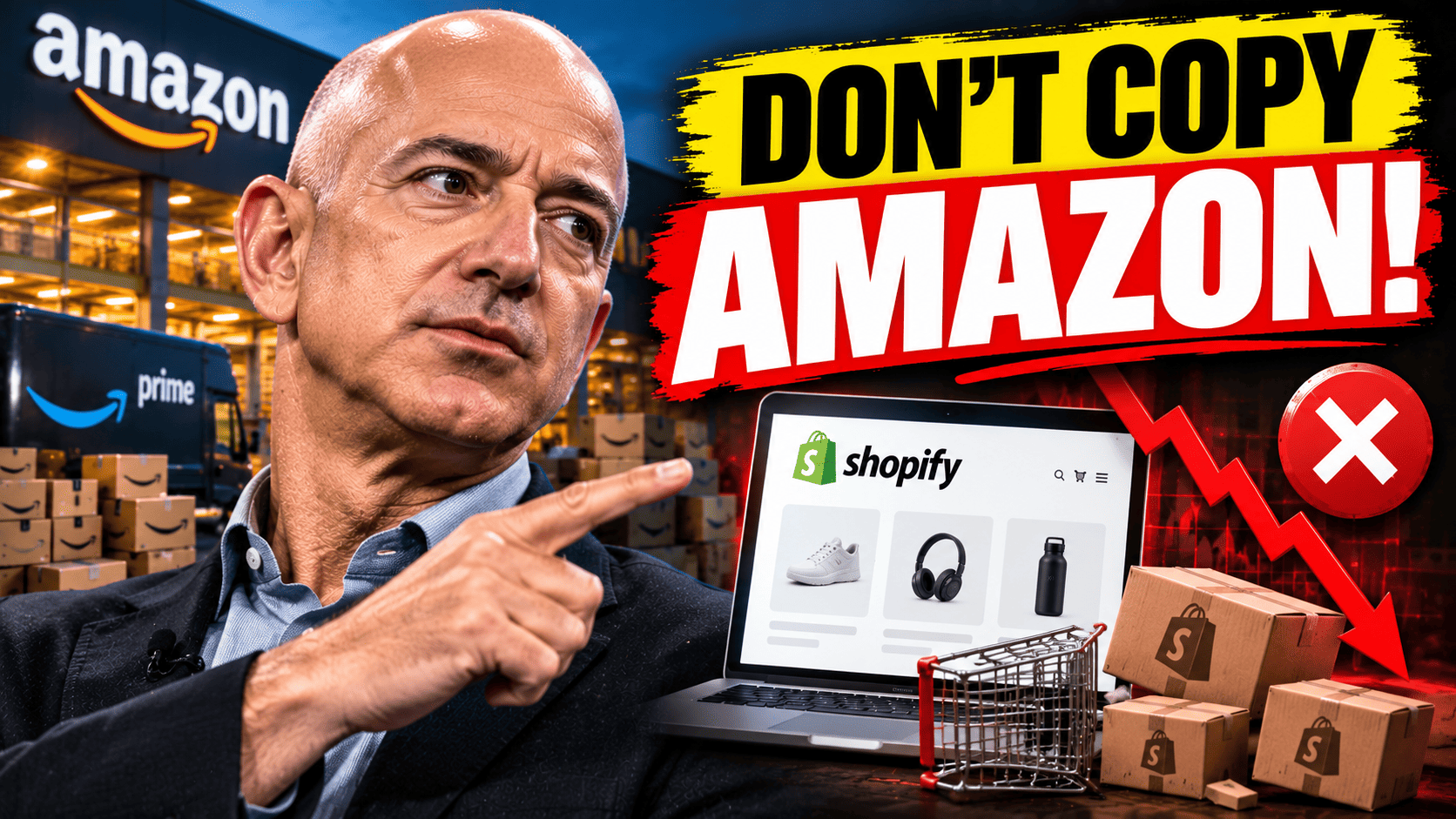
Jeff Bezos transformed Amazon from an online bookstore into one of the world’s most influential e-commerce companies. But here’s an uncomfortable truth: the same strategies that helped Amazon become a global giant could bankrupt a small Shopify business.
Every aspiring e-commerce entrepreneur knows the story.
In 1994, Jeff Bezos founded Amazon. What started as an online bookstore grew into a company that transformed retail, logistics, cloud computing, and consumer expectations.
Today, Amazon is synonymous with fast delivery, competitive pricing, convenience, and enormous product selection.
Naturally, Shopify entrepreneurs want to replicate that success.
They lower their prices to compete with Amazon.
They offer free shipping on almost everything.
They expand their product catalogs.
They invest heavily in advertising to capture market share.
And they assume that if these strategies worked for Jeff Bezos, they should work for their businesses too.
But there’s a serious problem with this thinking.
Amazon’s strategy was built around advantages that most independent e-commerce businesses simply don’t possess.
And trying to imitate those advantages without the necessary capital, infrastructure, or scale can turn a promising Shopify store into an unprofitable operation.
1. The Biggest Misunderstanding About Jeff Bezos
One of the most important aspects of Jeff Bezos’s business philosophy is his obsession with customers.
In Amazon’s famous 1997 shareholder letter, Bezos emphasized long-term thinking, customer relationships, and market leadership over short-term financial results.
He believed that prioritizing customers and investing in long-term opportunities could create substantial value over time.
This philosophy helped shape Amazon’s development.
But many entrepreneurs misunderstand what it means.
They assume that customer obsession means offering the lowest prices, fastest shipping, and most generous return policies regardless of cost.
That’s not necessarily what customer obsession requires.
Customer obsession means understanding what your customers value and building a business capable of delivering it sustainably.
For Amazon, competitive pricing, convenience, and selection became central parts of its value proposition.
For a specialized Shopify store, customers might value something completely different.
They might prefer expert advice, personalized service, exclusive products, or carefully selected merchandise.
The mistake is assuming that Amazon’s interpretation of customer obsession is the only possible one.
You don’t need to become a smaller Amazon to build a successful e-commerce business.
You need to become the best option for a specific group of customers.
2. Amazon Can Compete on Price. Your Shopify Store Probably Shouldn’t.
One of the most dangerous mistakes independent e-commerce businesses make is trying to compete with Amazon primarily on price.
Imagine a Shopify store selling a product for $40.
The product costs $18 from the supplier.
Shipping and packaging cost $5.
Payment processing costs $1.50.
Customer acquisition costs $10.
That leaves $5.50 before other operating expenses, refunds, taxes, and overhead.
Now imagine a competitor reduces its price to $35.
To remain competitive, the Shopify owner matches that price.
Suddenly, the contribution per order drops to just $0.50.
One refund, chargeback, or unexpected shipping expense could eliminate the profit from several successful orders.
This is the danger of competing on price without a structural cost advantage.
Amazon has built an extensive logistics network and operates multiple businesses at enormous scale.
It also has access to financial resources that most independent merchants cannot match.
A small Shopify store doesn’t possess the same advantages.
That doesn’t mean small businesses cannot compete.
It means they need a different strategy.
Instead of asking, “How can I sell this product cheaper than Amazon?”
Ask, “Why would someone choose to buy this product from my store instead of Amazon?”
The answer might involve specialization, superior support, product customization, or a more trustworthy shopping experience.
If your only competitive advantage is being cheaper, your business becomes extremely vulnerable.
3. Jeff Bezos’s Long-Term Thinking Can Become a Dangerous Excuse
Bezos famously emphasized long-term decision-making.
His approach encouraged Amazon to invest in infrastructure, technology, and customer relationships rather than focusing exclusively on immediate profits.
This strategy helped Amazon develop major competitive advantages.
But here’s where Shopify entrepreneurs can get into trouble.
Some founders use long-term thinking as an excuse to ignore financial reality.
They spend heavily on advertising.
They accept negative margins.
They offer unsustainable discounts.
And they tell themselves that profitability will come later.
Sometimes businesses deliberately invest ahead of profits to establish market position.
But that strategy requires a credible path to profitability and sufficient capital to survive.
For a small Shopify merchant, cash flow is often a much more immediate concern.
Consider a store generating $30,000 in monthly revenue while losing $3,000 every month.
The founder might celebrate revenue growth.
But if the business has only $12,000 in available cash, those losses could exhaust its reserves in approximately four months, assuming nothing else changes.
Growth without financial discipline can destroy a business.
The lesson from Bezos isn’t that profits don’t matter.
It’s that long-term investment must be supported by a sustainable economic model.
Thinking long term doesn’t mean you can afford to lose money indefinitely.
4. Amazon’s Free Shipping Strategy Could Destroy Your Margins
Fast and convenient delivery is one of Amazon’s most recognizable competitive advantages.
Through its logistics network and Prime ecosystem, Amazon has conditioned many consumers to expect convenient shipping.
This creates pressure on independent retailers.
Shopify merchants often feel compelled to offer free shipping on every order.
But free shipping isn’t actually free.
Someone must pay for transportation, packaging, handling, and fulfillment.
And if the merchant absorbs those costs without adjusting prices or order economics, margins shrink.
Imagine a store selling products with a 35% gross margin before shipping.
If an order generates $50 in revenue, that leaves $17.50 before fulfillment, marketing, and other expenses.
Now subtract $8 in shipping costs.
Only $9.50 remains before additional costs.
If customer acquisition costs another $10, the order becomes unprofitable before overhead.
This doesn’t mean free shipping is always a mistake.
It can improve conversion rates and encourage larger purchases.
But it must be designed around actual business economics.
A Shopify merchant could offer free shipping above a minimum order value, incorporate shipping costs into pricing, or create product bundles that increase average order value.
The objective is to offer a compelling customer experience without sacrificing the financial health of the business.
5. Why Amazon’s Massive Product Catalog Is the Wrong Model for Many Shopify Stores
Amazon became famous for its enormous product selection.
Its marketplace connects customers with products across countless categories.
But trying to replicate that breadth can be a serious mistake for independent e-commerce businesses.
Many beginners launch Shopify stores selling everything from phone accessories to kitchen gadgets, fitness products, pet supplies, and home decorations.
They believe that more products automatically mean more opportunities to generate sales.
In reality, an unfocused catalog can create several problems.
It makes branding more difficult.
It complicates navigation.
It increases the workload required to maintain accurate product information.
And it can make the business appear less specialized or trustworthy.
Consider two Shopify stores.
The first sells 2,000 unrelated products.
The second sells 40 carefully selected products for professional home-office setups.
The specialized store may be better positioned to develop expertise, create relevant educational content, and establish a recognizable brand.
It can build product comparisons, buying guides, and customer support around a clearly defined audience.
This doesn’t guarantee success.
But it creates a clearer positioning strategy.
Amazon wins through scale and convenience. Small Shopify businesses can compete through focus and expertise.
6. Jeff Bezos’s Customer Obsession Is Worth Copying — But Not Blindly
There is one part of Bezos’s philosophy that nearly every Shopify entrepreneur should take seriously: understanding customers.
Amazon has consistently emphasized removing friction from the purchasing experience.
For independent merchants, this principle can be extremely valuable.
But customer obsession doesn’t require copying every Amazon feature.
It requires identifying what matters most to your particular audience.
For example, a Shopify store selling high-end skincare products might discover that customers care more about ingredient transparency and product guidance than next-day delivery.
A business selling specialized automotive accessories might find that compatibility information and technical support matter more than discounts.
A store selling custom furniture might compete through craftsmanship and personalization rather than speed.
The key is listening to customers.
Analyze support requests.
Review product feedback.
Investigate abandoned carts.
Study frequently asked questions.
Look for recurring objections that prevent customers from purchasing.
These insights can reveal opportunities to improve the shopping experience.
Sometimes the most effective conversion optimization strategy isn’t adding another Shopify app.
It’s answering a question that customers are afraid to ask.
7. Amazon’s Advertising Strategy Is Not Your Advertising Strategy
Amazon operates one of the world’s largest digital advertising businesses.
It benefits from substantial shopping activity, product search behavior, and marketplace data.
Independent Shopify merchants operate under very different conditions.
Many depend heavily on Meta Ads, Google Ads, TikTok Ads, or influencer partnerships to attract customers.
Paid advertising can be highly effective.
But it also creates financial risk when customer acquisition costs increase.
Imagine a Shopify store spending $5,000 per month on advertising and generating $15,000 in attributed revenue.
That represents a 3:1 return on ad spend.
At first glance, it looks impressive.
But if product costs, shipping, transaction fees, and operating expenses exceed the remaining $10,000, the store may still be unprofitable.
This is why return on ad spend alone isn’t enough.
Merchants should also understand contribution margins, customer lifetime value, repeat purchase rates, and cash flow.
And they should avoid becoming completely dependent on one advertising platform.
This is where search engine optimization becomes particularly valuable.
8. SEO Is One of the Biggest Opportunities Amazon Leaves for Shopify Stores
Amazon dominates many commercial product searches.
But independent Shopify stores can still compete by focusing on specialized customer needs.
A large marketplace may offer thousands of products.
A specialized retailer can provide deeper explanations, original comparisons, and expert guidance.
For example, imagine a Shopify store selling ergonomic office furniture.
Instead of trying to rank for the extremely competitive keyword “office chair,” it could target more specific searches such as:
- Best ergonomic chair for a small home office
- How to choose an office chair for tall people
- Mesh vs. leather office chairs
- How to adjust an ergonomic chair correctly
- Best office chair features for remote workers
These topics can attract customers at different stages of the buying journey.
Educational articles can support product and collection pages through internal linking.
Well-structured product information can also help search engines understand the store’s offerings.
However, SEO requires ongoing investment, and rankings are never guaranteed.
The opportunity is to build a body of useful content that differentiates the store from generic marketplace listings.
Shopify SEO and AI Search Visibility
The growth of AI-powered search experiences creates additional reasons to invest in clear, trustworthy product information.
Businesses should provide accurate descriptions, relevant structured data, transparent policies, and useful educational resources.
These improvements can help search systems interpret product information, although they do not guarantee inclusion in AI-generated answers.
At Scrowp, we focus on helping Shopify merchants improve their websites through SEO, user experience, and conversion-oriented design.
The goal isn’t to defeat Amazon at its own game.
It’s to help independent stores compete where their specialization creates meaningful value.
9. AI Won’t Turn Your Shopify Store Into Amazon
Artificial intelligence is transforming e-commerce.
Merchants can now use AI tools to research keywords, generate content drafts, analyze customer feedback, improve product descriptions, and automate repetitive workflows.
But there’s a dangerous misconception.
Some entrepreneurs believe AI will allow them to replicate Amazon’s capabilities without Amazon’s resources.
It won’t.
AI can improve productivity, but it cannot automatically create supplier relationships, logistics infrastructure, customer loyalty, or sustainable unit economics.
A Shopify store with poor products and unreliable shipping will not become successful simply because it uses AI-generated marketing content.
The real opportunity is to use technology to strengthen an already viable business model.
For example, AI agents can help merchants organize SEO research, identify content opportunities, and prioritize technical improvements.
Platforms such as Accio Work provide tools for exploring AI-assisted business workflows.
But technology should support strategic decisions rather than replace them.
The question isn’t whether AI can help you operate more like Amazon.
It’s whether AI can help you serve your specific customers better.
10. What Shopify Entrepreneurs Should Actually Learn From Jeff Bezos
Jeff Bezos’s success offers valuable lessons for independent merchants.
But those lessons need to be adapted to the realities of smaller businesses.
First, prioritize customers. Understand what your audience values and build your shopping experience around those needs.
Second, think long term. Invest in branding, customer relationships, useful content, and operational improvements.
Third, protect your margins. Growth means little if every additional sale increases your losses.
Fourth, create differentiation. Compete through expertise, product selection, personalization, or service rather than relying exclusively on price.
Fifth, build efficient systems. Automation and technology can reduce unnecessary work, but they must solve real business problems.
Sixth, diversify customer acquisition. Combine paid advertising with SEO, email marketing, and other appropriate channels.
And finally, understand your scale.
A strategy designed for a multinational corporation may be completely inappropriate for a business generating its first $10,000 in monthly revenue.
The principles behind Amazon’s success are worth studying.
But copying its tactics without understanding the economics can be disastrous.
11. My Perspective: Stop Trying to Build the Next Amazon
As a Shopify and SEO specialist, I believe one of the biggest mistakes aspiring e-commerce entrepreneurs make is choosing the wrong role model.
They look at Amazon and imagine building a smaller version of it.
They assume that offering more products, lower prices, and faster delivery will eventually produce similar success.
But the internet doesn’t need another generic Amazon clone.
It needs businesses that solve specific problems better than existing alternatives.
A Shopify store specializing in premium pet accessories doesn’t need to compete with every product available on Amazon.
It needs to become a trusted destination for a clearly defined audience.
A store selling handmade furniture doesn’t need to offer the fastest delivery in the world.
It needs to demonstrate quality, craftsmanship, and reliability.
A business selling specialized electronics doesn’t need millions of products.
It needs accurate information, dependable support, and products customers can trust.
This is why I believe independent e-commerce businesses should prioritize specialization over imitation.
The most valuable lesson from Bezos isn’t to copy Amazon.
It’s to understand the strategic thinking that made Amazon successful and apply the relevant principles to your own circumstances.
Conclusion: Jeff Bezos Built Amazon. You Need to Build Something Different.
Jeff Bezos helped transform the global e-commerce industry.
His focus on customers, long-term investment, operational efficiency, and innovation provides valuable lessons for entrepreneurs.
But Amazon’s business model is not a universal blueprint.
Its enormous scale, logistics infrastructure, financial resources, and diversified operations create advantages that small Shopify businesses cannot easily reproduce.
Trying to compete directly on price, shipping speed, and product selection can expose independent merchants to unsustainable costs.
The better strategy is to focus on what large marketplaces cannot always provide as effectively.
Specialized expertise.
Personalized customer experiences.
Distinctive branding.
Carefully selected products.
And genuine relationships with customers.
Don’t try to become the next Amazon. Build the kind of e-commerce business that gives customers a reason not to shop on Amazon.
That’s how independent Shopify businesses can develop meaningful competitive advantages in a market shaped by Jeff Bezos’s legacy.
About the author: Marouane RHAFLI is the founder of Scrowp, a Shopify and SEO specialist, and an e-commerce consultant focused on helping online merchants improve organic visibility, conversion rates, and long-term business performance.