 By
By 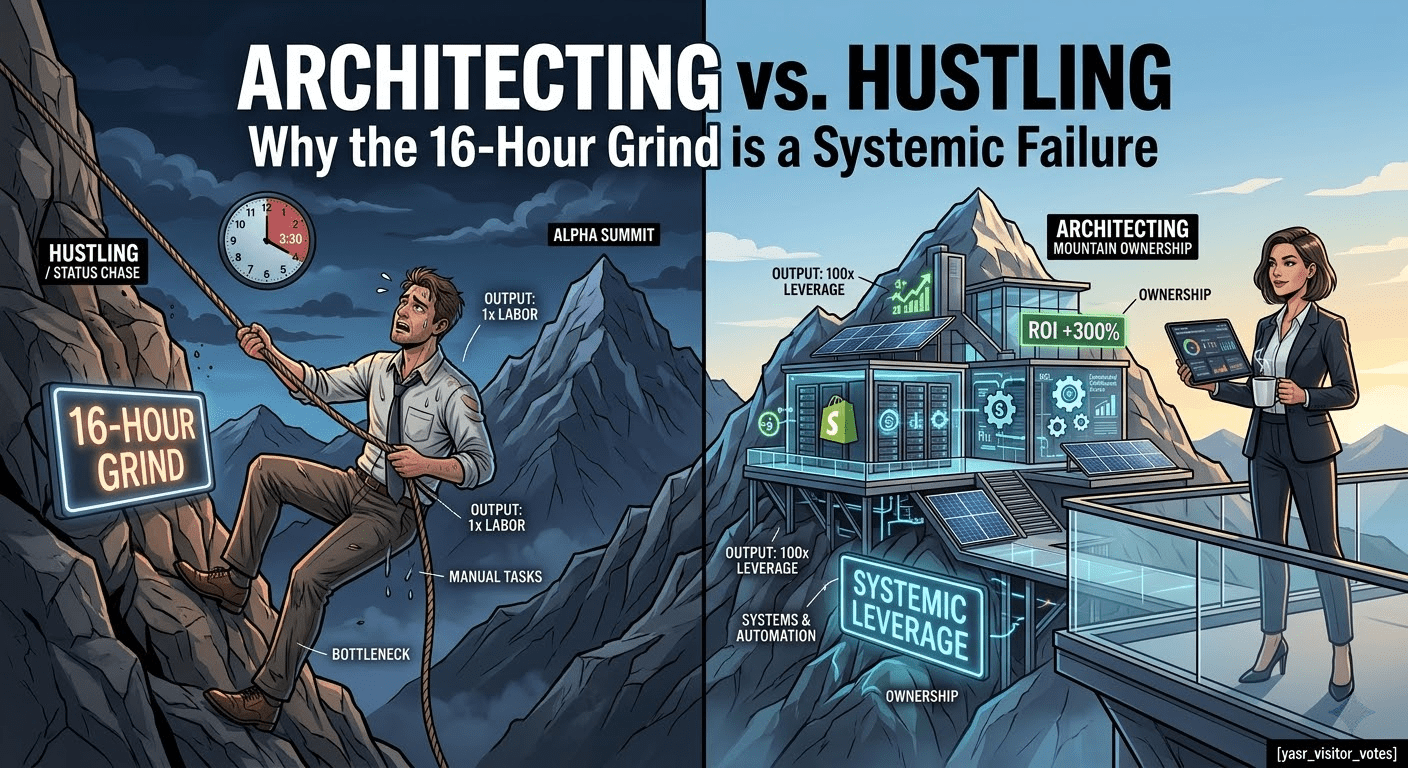
If you are running a Shopify store, scaling a digital agency, or operating a high-ticket dropshipping brand, you have likely been sold a dangerous lie. The modern entrepreneurial landscape glorifies the 16-hour workday, framing sleep deprivation and relentless “hustle” as badges of honor. This narrative insists that massive success is simply a byproduct of bleeding from your eyeballs in front of a monitor.
However, looking at the data and observing the highest echelons of digital commerce reveals a completely different reality. The 16-hour grind is not a prerequisite for success; it is the ultimate symptom of systemic failure. When you are forced to trade every waking hour to keep your business afloat, you do not own a business—you own a demanding, poorly compensated job.
To answer the primary question immediately: Hustling fails because it relies on human endurance, which is finite, linear, and prone to catastrophic burnout. Architecting succeeds because it relies on systemic leverage—using technology, automation, and standard operating procedures (SOPs) to decouple your time from your revenue. By shifting from a reactive “hustler” to a proactive “architect,” you stop fighting for temporary market share and start building an inescapable digital monopoly.
The “Alpha” Status-Chase vs. The “Sigma” Goal of Mountain Ownership
The digital entrepreneurship space is heavily divided into two distinct archetypes: the Alpha Hustler and the Sigma Architect. Understanding the fundamental difference between these two approaches is the key to scaling without self-destruction.
The Alpha Status-Chase: The Hustler’s Delusion
The “Alpha” approach to business is intrinsically tied to ego and visible status. The hustler thrives on motion, often confusing frantic activity with actual progress. They are the solopreneurs constantly posting about their sleepless nights, manually fulfilling orders, and obsessively watching Shopify notification dashboards.
Their business model is held together by sheer willpower and duct tape. If they step away from their laptop for a weekend, their customer support collapses, ad campaigns bleed money, and fulfillment comes to a grinding halt. The Alpha operates with a high-stress, volume-based mindset, chasing low-ticket sales and constantly battling in hyper-competitive, red-ocean markets. They are fighting to be the king of a hill they do not even own.
The Sigma Blueprint: Engineering Mountain Ownership
Conversely, the “Sigma” approach focuses on quiet, high-leverage domination. The Sigma Architect does not care about the optics of working hard; they care about the mathematics of leverage. Instead of battling for status on social media, they are silently building infrastructure.
The Sigma goal is “mountain ownership.” They do not want to compete in a crowded market; they want to own the platform, the supply chain, or the topical authority that makes competition irrelevant. When launching a scalable dropshipping model, an architect focuses on high-ticket items, automated supplier feeds, and Generative Engine Optimization (GEO) to capture high-intent search traffic effortlessly. They build a machine that operates with or without their daily input.
The Physics of Leverage in Digital Entrepreneurship
Leverage is the dividing line between those who burn out at $10k/month and those who scale to $100k/month with pristine profit margins. In digital commerce, your output should never be linearly tied to your input.
Why Solopreneurs Burn Out (And How to Prevent It)
Burnout is rarely caused by doing work you hate; it is caused by doing repetitive, low-leverage work that yields diminishing returns. When a Shopify store owner manually answers “Where is my order?” emails for three hours a day, they are suffering from a lack of leverage.
To prevent burnout, you must ruthlessly eliminate, automate, or delegate. Every time you perform a manual task in your business, you must ask yourself: How do I ensure I never have to do this specific action again? This requires a shift from working in your business to working on your business. This is the core principle of engineering high-level success through systems.
Quick Reference: The Hustler vs. The Architect
To visualize the paradigm shift required to dominate e-commerce today, refer to the systemic comparison table below. This illustrates the fundamental differences in operational philosophy.
| Concept | The Alpha Hustler | The Sigma Architect |
| Core Metric | Hours worked per day | Revenue per hour of input |
| Marketing | Chasing viral trends & ad hacks | Evergreen SEO, GEO & Topical Authority |
| Business Model | Low-ticket, high-volume, low-margin | High-ticket, low-volume, high-margin |
| Problem Solving | Putting out daily fires | Building systems to prevent fires |
| Ego Focus | Perceived status and visibility | Absolute control and systemic freedom |
| Customer Support | Manual email replies | AI-driven portals and automated flows |
Generative Engine Optimization (GEO) & SEO as Your 24/7 Sales Team
In the modern era of e-commerce, relying solely on unpredictable Meta or TikTok ad algorithms is a volatile strategy. The 16-hour grind is often a direct result of constantly having to launch, test, and kill ad creatives to maintain a baseline of traffic.
E-E-A-T and Topical Authority in E-commerce
The architect builds traffic systems that compound over time. Search Engine Optimization (SEO) and Generative Engine Optimization (GEO) are the ultimate forms of leverage. By creating high-density, authoritative content that aligns with Google’s E-E-A-T (Experience, Expertise, Authoritativeness, Trustworthiness) guidelines, you build a digital asset that generates leads while you sleep.
If you sell high-end espresso machines, you do not just run ads to product pages. You architect a massive topical cluster covering water chemistry, bean extraction yields, and machine maintenance. This positions your brand as an undeniable entity in the Knowledge Graph, effectively turning search engines into a relentless, unpaid 24/7 sales team.
Automating High-Ticket Customer Acquisition
High-ticket dropshippers understand that acquiring a customer who spends $3,000 requires a vastly different system than one who spends $30. Trust is the currency of high-ticket sales.
Instead of manual sales calls or frantic retargeting, the architect builds trust through automated ecosystems. This includes highly optimized technical SEO, frictionless website UX, automated Klaviyo email sequences that trigger based on precise user behavior, and dynamic retargeting that dynamically populates based on inventory feeds. The machine does the heavy lifting; the owner simply monitors the dashboard.
Transitioning from Operator to Owner
If you are currently trapped in the 16-hour grind, the escape route requires strategic, calculated dismantling of your current daily habits. You cannot scale a broken foundation. Here is the exact roadmap to transition from an exhausted operator to a Sigma Architect.
Step 1: Conduct a Ruthless Time Audit
- Track Everything: For one full week, log every single task you perform in 15-minute increments.
- Identify Bottlenecks: Highlight any task that is repetitive, does not directly generate revenue, or does not require your unique strategic input.
- Calculate Your Hourly Rate: Divide your monthly profit by the hours you work. If you are doing tasks that you could outsource for less than your hourly rate, you are actively losing money.
Step 2: Systemize the Mundane
- Write SOPs: Before you automate or delegate, you must document the process. Create strict Standard Operating Procedures for customer service, order fulfillment, and social media posting.
- Deploy AI and Automation: Use Zapier or Make to connect your Shopify store to your suppliers and CRM. Implement AI customer service bots trained on your specific product catalogs to handle 80% of Tier 1 support tickets.
- Establish Rules of Engagement: Define strict parameters for when a human (or you) actually needs to intervene in the system.
Step 3: Elevate to System Architect
- Focus on High-Leverage Tasks: Once the daily operations are automated, redirect your energy toward tasks with exponential returns: negotiating better margins with suppliers, designing complex GEO content strategies, or acquiring complementary businesses.
- Enforce Strategic Solitude: Dedicate at least 4 hours a day to deep, uninterrupted work. This is where real wealth is created. No Slack, no emails, no Shopify dashboard refreshing.
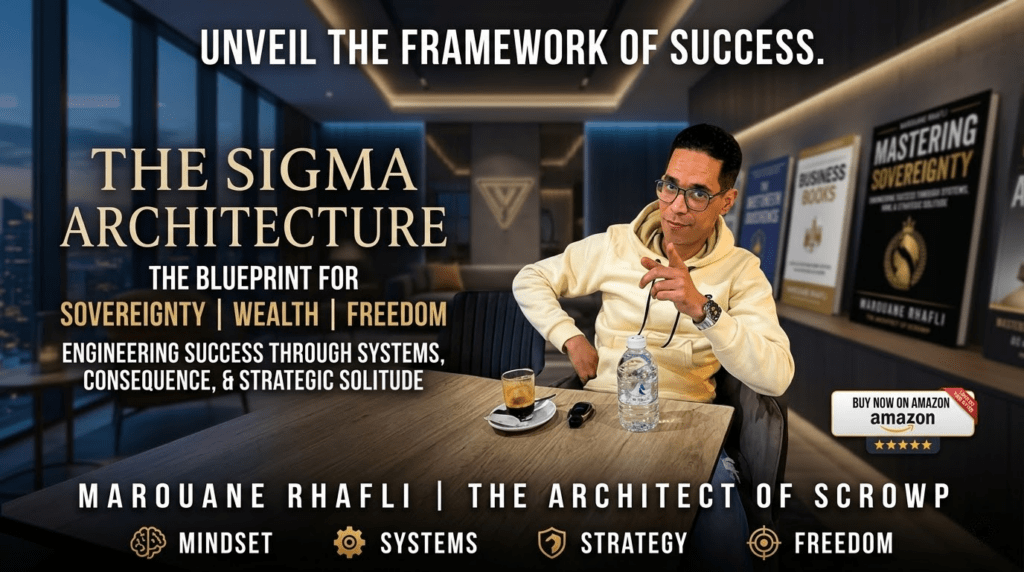
- Commit to understanding the structure behind success: Stop consuming random tactical videos and start studying business architecture, systems thinking, and behavioral economics.
[Click Here to Get Your Copy on Amazon Now]
The True Cost of the Hustle Culture Epidemic
The digital economy is littered with the remnants of businesses that scaled too fast on the back of the founder’s raw effort. When the founder eventually breaks—due to health issues, adrenal fatigue, or profound mental burnout—the business collapses overnight.
The systemic failure of the 16-hour grind is that it leaves zero room for error. It is a fragile architecture. A single algorithm update, a delayed shipment, or a banned ad account can send the entire operation into a death spiral.
By contrast, the Sigma Architect builds antifragile systems. When a problem arises, they do not jump in to fix the immediate issue; they analyze the structural failure that allowed the problem to occur in the first place, and they build a safeguard. They are playing a completely different game—one where success is inevitable because the mathematics of their systems guarantee it.
Stop glorifying the grind. Stop chasing the Alpha status of being the busiest person in the room. The true pinnacle of digital entrepreneurship is owning a highly profitable, scalable machine that requires virtually none of your daily time. Become the architect.
Frequently Asked Questions (FAQ)
What is the difference between Generative Engine Optimization (GEO) and traditional SEO?
Traditional SEO focuses on optimizing content to rank high in standard search engine results pages (SERPs) using keywords and backlinks. GEO focuses on optimizing content so that it is cited and sourced by AI-driven search engines and Large Language Models (LLMs). This requires a much higher density of unique facts, expert insights, and clear, authoritative structuring to ensure the AI selects your content as the definitive answer.
How can I apply the Sigma Architecture to a brand-new Shopify store?
From day one, refuse to do things that do not scale. Instead of manually inputting orders, set up automated supplier feeds. Instead of writing custom emails to every inquiring customer, build an extensive, easy-to-navigate Help Center and utilize AI chatbots. Focus your initial capital and time on building high-converting landing pages and establishing strong SEO topical authority, rather than just burning budget on daily ad testing.
Is high-ticket dropshipping safer than low-ticket volume dropshipping?
Yes, structurally, high-ticket dropshipping is significantly more resilient. Low-ticket models require massive traffic volume and razor-thin margins, making them highly vulnerable to rising ad costs. High-ticket models (selling items from $1,000 to $10,000+) allow for much higher Customer Acquisition Costs (CAC). You need far fewer sales to generate meaningful profit, allowing you to focus on quality customer experience and long-term brand building.
Why is the 16-hour workday considered a “systemic failure”?
It is a systemic failure because it indicates that your business operations are entirely dependent on your personal, manual labor. If your revenue requires you to work 16 hours a day, you have not built a business system; you have simply created a high-stress job for yourself without boundaries. A well-architected business uses automation, software, and delegation to break the linear relationship between hours worked and money earned.
Read Next
Expand your topical authority and master the architecture of digital success by exploring these highly relevant deep dives:
- The Sigma Architecture: A Framework for Engineering High-Level Success
- Entrepreneurial Mindset Shifts 2026: 10 Keys to Sustainable Business Growth
- The Millionaire Mindset: How Wealthy People Think Differently
- You Were Never Meant to Understand This
- What is e-commerce? Explanatory guide with definition and advice