
 By
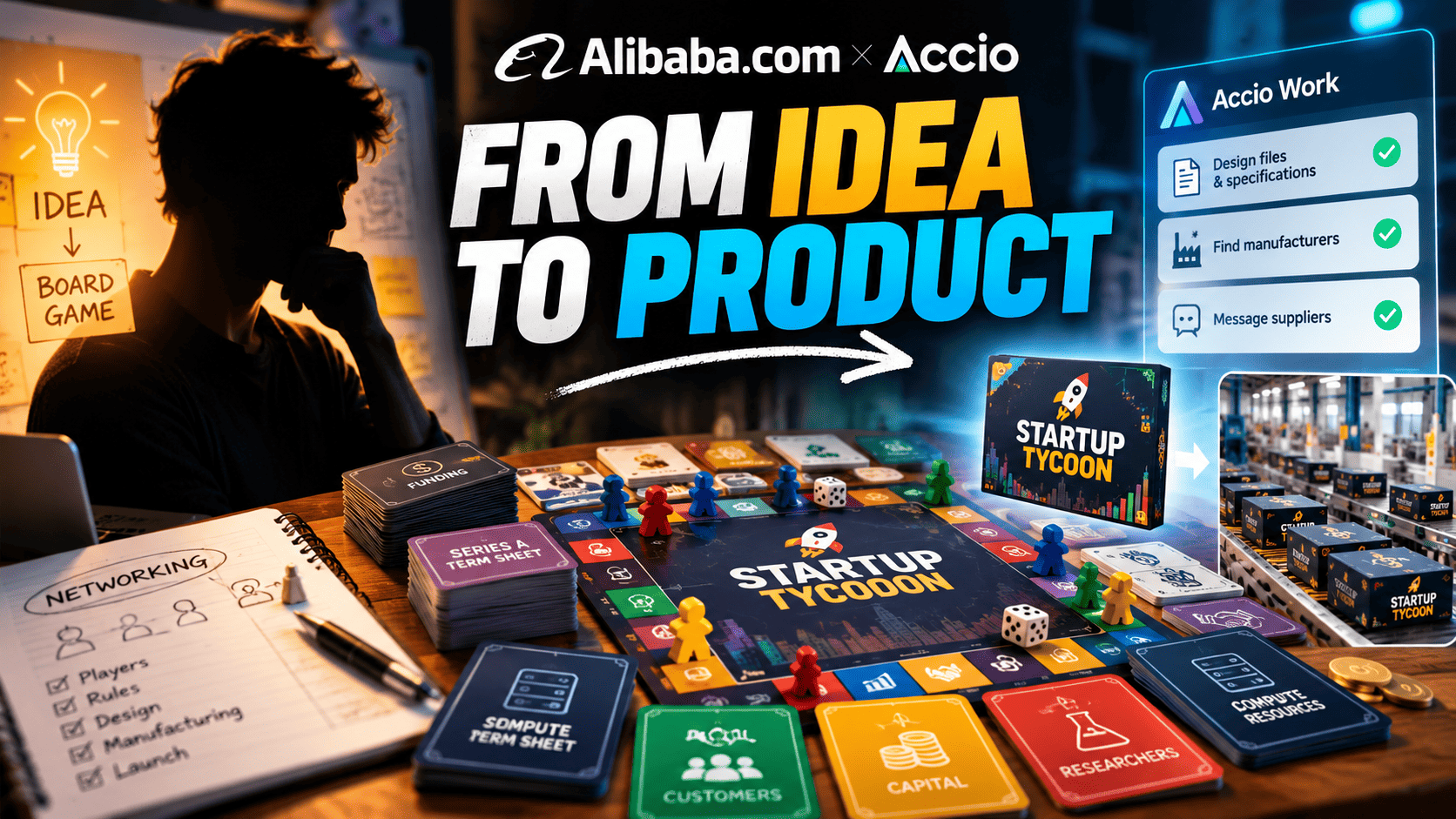
Discover how one entrepreneur turned a networking challenge into an innovative board game concept—and how Alibaba.com’s Accio Work helped him navigate product development, manufacturing requirements, and supplier sourcing.
Entrepreneurship often begins with a simple observation: something isn’t working as well as it should.
For Andrew Young, that observation came from hosting networking events for technology founders, CEOs, and ambitious entrepreneurs. Although he could bring interesting people together, he noticed that creating meaningful conversations was a completely different challenge.
His solution wasn’t another networking app, online community, or business conference.
It was a board game.
But transforming that creative idea into a physical product presented an entirely new set of obstacles. Andrew had experience bringing entrepreneurs together, but he didn’t know how to manufacture a board game, prepare production specifications, or communicate with factories.
That’s where Accio Work, Alibaba.com’s AI-powered business workspace, entered the story.
Featured in the Accio Launchpad video, Andrew’s experience illustrates how artificial intelligence can help entrepreneurs move beyond brainstorming and begin tackling the practical work involved in launching a product.
The Networking Problem That Inspired a Business Idea
Andrew Young introduces himself as someone who hosts tech parties that everyone wants to attend.
At first glance, that sounds like the perfect business networking environment. Gather successful founders, investors, and CEOs in one place, and valuable relationships should naturally develop.
But reality is often more complicated.
Even at exclusive events, people can struggle to initiate conversations. Some stay close to people they already know, while others repeat familiar introductions without developing deeper connections.
Andrew realized that bringing people into the same room was only half the challenge.
The other half was giving them a reason to interact.
Think about a typical networking event. You approach someone, introduce yourself, ask about their company, and exchange contact details. The conversation might last a few minutes before both participants move on.
Now imagine replacing that predictable interaction with a game where participants must negotiate, compete, cooperate, and make strategic decisions.
Suddenly, conversation has a purpose.
Instead of awkward introductions, people have shared challenges. Instead of discussing hypothetical business scenarios, they participate in simulated ones.
Andrew saw an opportunity to make networking feel less like an obligation and more like an enjoyable experience.
That observation became the foundation of his board game concept.
A Board Game Built Around the Startup World
Andrew didn’t want to create a generic party game.
He wanted something specifically designed for entrepreneurs who understand the excitement, pressure, and unpredictability of building startups.
His game incorporates concepts familiar to the technology industry, including startup funding, customers, capital, researchers, and computing resources.
These elements become assets that players can negotiate and exchange.
During the gameplay shown in the video, participants discuss deals involving researchers, customers, money, and compute resources.
🚀 Get 500 FREE Accio Work AI credits when you sign up (valid for 7 days) + 100 FREE credits weekly this month!
The conversations resemble exaggerated versions of actual startup negotiations.
Players compete for resources, negotiate trades, and react to their changing positions.
The result is an experience that combines entertainment with the language of entrepreneurship.
This is an important product development lesson.
Andrew didn’t simply invent a game and then search for an audience.
He started with an audience, identified its problem, and designed a product around its interests.
For entrepreneurs, that approach can be more effective than chasing random product trends.
When you understand a specific audience, you can develop features, experiences, and marketing messages that resonate with its needs.
Andrew’s concept also has potential applications beyond casual entertainment, such as founder gatherings, startup communities, and entrepreneurial workshops.
Those are possible use cases rather than confirmed commercial applications, but they demonstrate how a narrowly targeted idea can have multiple opportunities.
The Difficult Part: Turning an Idea Into a Physical Product
Coming up with an innovative concept is one thing.
Manufacturing it is another.
Andrew quickly discovered that creating a board game involves far more than printing a few cards and placing them inside a box.
A physical board game may require:
- Clear rules and balanced gameplay mechanics.
- Professionally designed cards, boards, and packaging.
- Accurate dimensions, materials, and print specifications.
- Prototype testing and revisions.
- Reliable manufacturers capable of producing the components.
- Quality checks before large-scale production.
Each stage introduces unfamiliar decisions.
For example, choosing the wrong card material could affect durability. Incorrect artwork dimensions could create printing problems. Unclear specifications could lead to misunderstandings with suppliers.
Even something as straightforward as packaging requires decisions about box dimensions, inserts, printing finishes, and shipping.
For an experienced board game manufacturer, these requirements are routine.
For someone developing their first physical game, they can become overwhelming.
🚀 Get 500 FREE Accio Work AI credits when you sign up (valid for 7 days) + 100 FREE credits weekly this month!
Andrew openly acknowledges that he lacks the technical knowledge required to handle everything himself.
And this is precisely where many aspiring entrepreneurs get stuck.
They understand the problem they want to solve. They have a promising idea. They may even have potential customers.
But the operational complexity prevents them from moving forward.
Andrew decided to explore whether AI could help him overcome that barrier.
How Andrew Discovered Accio Work
While trying to figure out how to manufacture his board game, Andrew remembered an example from someone in his professional network.
His friend Tane, associated with WhisperFlow, had previously used Accio for a customized betting set.
That experience gave Andrew an idea.
Rather than learning every manufacturing process from scratch, perhaps he could use an AI-powered business tool to organize the work and find suitable suppliers.
Developed by Alibaba’s international commerce business, Accio Work is designed to support business activities including market research, product development, sourcing, and operational workflows. Unlike a traditional chatbot focused mainly on generating answers, the platform is built around AI agents that can help execute tasks.
For Andrew, this was particularly relevant because he didn’t need another collection of product ideas.
He already had the concept.
What he needed was a practical path toward manufacturing it.
Step 1: Organizing the Board Game’s Design Specifications
One of the first things Andrew encounters is an organized spreadsheet containing information about the game’s design files and specifications.
This might not sound particularly exciting, but anyone who has developed a physical product understands its importance.
Manufacturers need accurate instructions.
They cannot simply receive a creative idea and be expected to produce exactly what the entrepreneur imagined.
They need details about components, materials, dimensions, artwork, quantities, and packaging.
Organizing this information manually can take considerable time, particularly when the entrepreneur is unfamiliar with manufacturing terminology.
Andrew recognizes the value immediately.
The information that might have taken hours to prepare and organize is now presented in a structured format.
This demonstrates one of the most practical applications of AI in business: turning scattered information into usable working documents.
For a first-time product creator, that can make the next steps considerably easier.
Step 2: Moving From Product Specifications to Supplier Sourcing
Once the design requirements are organized, another major challenge appears.
Andrew needs manufacturers.
Finding the right factory is not simply about locating the cheapest supplier.
A manufacturer must understand the product, have the appropriate production capabilities, and be able to meet the project’s requirements.
For customized products, entrepreneurs often need to discuss minimum order quantities, prototypes, materials, packaging, and production timelines.
Andrew admits that manufacturing involves an unfamiliar professional language.
But as he explores Accio Work, he notices that the platform has prepared an inquiry based on his product requirements and is helping initiate supplier communication.
This is a significant moment in the story.
The process moves beyond research and toward action.
Rather than merely explaining how to find manufacturers, the AI helps prepare the information needed to approach them.
Accio Work’s broader capabilities include product and supplier research, file organization, and business workflow automation, according to Alibaba’s product documentation
However, AI assistance does not eliminate the need to verify suppliers, review quotations, inspect prototypes, and confirm manufacturing agreements.
The video demonstrates progress in the sourcing process, not proof that the final board game has already been mass-produced.
Why This Story Matters for Entrepreneurs
Andrew’s experience highlights a challenge faced by thousands of aspiring entrepreneurs.
Many people have business ideas but hesitate because they lack specialized knowledge.
Someone might want to create a custom fitness accessory but know nothing about materials.
Another entrepreneur might envision an educational toy but have no experience designing products.
A Shopify merchant might identify demand for a unique product but struggle to find a suitable manufacturer.
In each situation, the problem is similar.
The entrepreneur understands the opportunity but doesn’t know how to execute every stage.
AI-powered tools can help reduce that initial knowledge barrier.
Instead of spending weeks figuring out where to begin, founders can use AI to research requirements, organize documentation, explore potential suppliers, and prepare the next steps.
That doesn’t guarantee business success.
But it can make the early stages of entrepreneurship more accessible.
Five Lessons Entrepreneurs Can Learn From Andrew Young
Andrew’s board game story offers several practical lessons for anyone considering launching a business.
1. Start with a problem, not a product. Andrew noticed that founders struggled to connect at networking events. His board game emerged as a potential solution to that specific problem.
2. Understand your target audience. The game incorporates startup funding, customers, researchers, and computing resources because those concepts are familiar to its intended players.
3. Don’t let missing technical skills stop your progress. Andrew had no manufacturing experience, but he explored tools that could help him navigate unfamiliar tasks.
4. Use AI for execution, not just inspiration. AI becomes more valuable when it helps organize specifications, prepare inquiries, and support operational decisions.
5. Test before investing in large-scale production. A promising concept still requires customer feedback, manufacturing validation, cost analysis, and product testing before significant investment.
Together, these lessons reinforce an important entrepreneurial principle: success requires combining creativity with disciplined execution.
What Shopify Store Owners Can Learn From This Example
Andrew’s experience is particularly relevant to Shopify entrepreneurs.
Many online sellers begin by offering products already available from existing suppliers.
While this approach can simplify launching a store, it often creates intense competition.
Multiple merchants may sell nearly identical products, making differentiation difficult.
Developing a customized product offers another possibility.
Imagine creating an educational card game, specialized desk accessory, branded fitness product, or unique home decoration.
A Shopify entrepreneur could begin by researching customer needs, identifying gaps in the market, and developing a product concept.
AI tools could then assist with preparing product requirements and exploring manufacturing options.
Once the product is validated and sourcing arrangements are established, Shopify can serve as the storefront for reaching customers.
This approach also creates opportunities for SEO.
Unique products provide original stories, educational content, and distinctive features that merchants can highlight through search-optimized product pages and blog articles.
As a Shopify SEO consultant, I see AI as particularly useful when it supports the entire business workflow, rather than treating product development, sourcing, marketing, and SEO as unrelated activities.
That’s also why I developed my Shopify SEO Advisor AI agent on Accio Work, designed to help merchants approach their store’s search optimization more systematically.
The Future of AI-Powered Entrepreneurship
Andrew’s story reflects a broader change in the relationship between entrepreneurs and technology.
For years, AI tools were primarily associated with generating text, answering questions, and producing creative ideas.
Now, business-focused AI agents are increasingly designed to assist with workflows that involve multiple steps and different tools.
Alibaba positions Accio Work as a platform for helping businesses research opportunities, develop products, find suppliers, and operate online stores.
This matters because launching a business requires more than a good idea.
It requires execution.
Entrepreneurs must transform concepts into specifications, specifications into prototypes, prototypes into products, and products into something customers are willing to purchase.
AI can assist with parts of that process, particularly repetitive research, documentation, and communication tasks.
The entrepreneur remains responsible for the vision, financial decisions, product quality, and customer experience.
Andrew’s experience demonstrates how those two roles can complement each other.
Final Thoughts: Your Next Business Idea Might Be Closer Than You Think
Andrew Young didn’t begin with a revolutionary technological invention.
He noticed a familiar problem at networking events and imagined a more engaging way to solve it.
His idea was a board game that could bring technology founders together through competition, negotiation, and shared experiences.
When manufacturing became complicated, he explored Accio Work to help organize product specifications and connect the concept with potential suppliers.
The story is a reminder that entrepreneurs don’t need to master every discipline before exploring a business opportunity.
They need a clear understanding of the problem, a willingness to experiment, and the ability to use appropriate resources.
The most valuable business ideas often begin with problems everyone experiences but few people attempt to solve.
If you have a product idea and want to explore how AI can help with research, development, and supplier sourcing, try Accio Work here.
You can also watch Andrew Young’s original Accio Launchpad video on YouTube.
🚀 Get 500 FREE Accio Work AI credits when you sign up (valid for 7 days) + 100 FREE credits weekly this month!