
 By
By 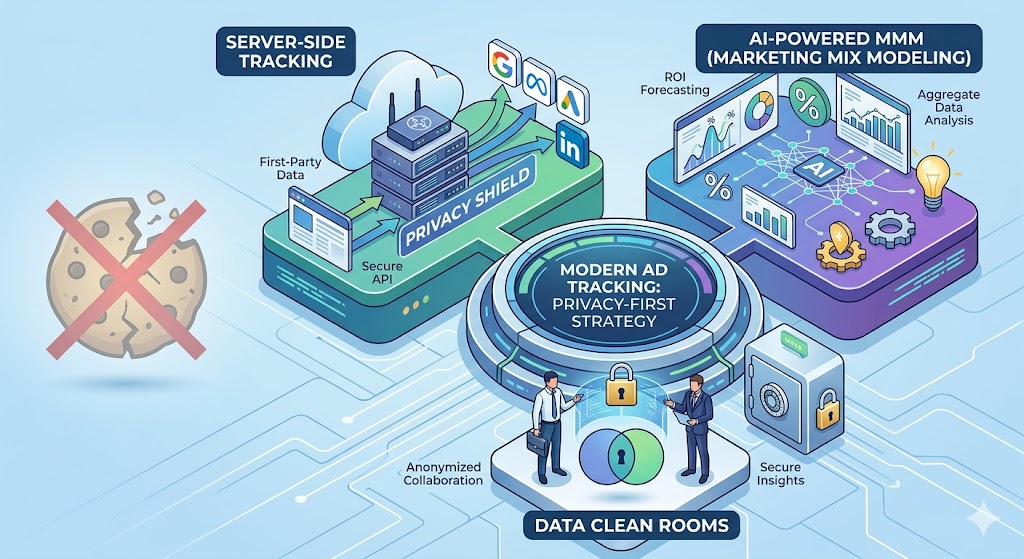
Welcome to 2026. The long-anticipated “cookie apocalypse” is no longer a looming threat; it is our current reality. With global privacy regulations tightening, consumer awareness at an all-time high, and major tech ecosystems having fully deprecated third-party cookies and restricted mobile identifiers, the digital marketing landscape has undergone a seismic shift.
For years, marketers relied on deterministic, user-level tracking—following an individual from an ad click to a website visit and finally to a purchase. That era is over. Today, capturing Return on Ad Spend (ROAS) and understanding the customer journey requires a completely new playbook. We have definitively moved from an era of precise, individual tracking to an era of aggregated, probabilistic, and privacy-compliant measurement.
However, the death of third-party tracking does not mean the death of ad performance measurement. It simply demands evolution. Brands that adapt to privacy-first ad tracking are already outperforming their competitors by building deeper trust with consumers and leveraging advanced, future-proof analytics.
If you are struggling to prove the ROI of your digital campaigns or feeling blinded by signal loss, this guide is for you. Below, we explore three robust, highly effective ways to track your ads in the privacy-first world of 2026.
The Paradigm Shift: From Deterministic to Probabilistic Tracking
Before diving into the specific tracking methods, it is crucial to understand the fundamental shift in how data is collected and analyzed today.
In the past, multi-touch attribution (MTA) models attempted to assign fractional credit to every touchpoint in a user’s journey. This relied heavily on deterministic data—knowing for a fact that User A clicked an ad on Facebook and later bought a product on your website.
In 2026, privacy laws like the updated General Data Protection Regulation (GDPR), the California Privacy Rights Act (CPRA), and strict tracking prevention mechanisms in browsers (like Apple’s ITP and Google’s Privacy Sandbox) make this impossible on a large scale. Instead, marketers must rely on probabilistic tracking and aggregated data. This means using statistical models, artificial intelligence, and broad data sets to predict behavior and attribute conversions without ever compromising an individual’s personally identifiable information (PII).
To survive and thrive, your marketing technology stack must pivot. Here are the three core strategies you must implement.
Method 1: Harnessing Server-Side Tracking and First-Party Data
The most immediate and essential fix for signal loss in 2026 is migrating from traditional client-side tracking to server-side tracking, fueled by a robust first-party data strategy.
What is Server-Side Tracking?
Historically, ad tracking relied on client-side tags (pixels) placed on your website. When a user loaded a page, their browser (the “client”) would send data directly to third-party platforms like Meta, Google, or TikTok. Because this data flow happened in the user’s browser, it was highly vulnerable to ad blockers, browser privacy restrictions, and cookie expiration limits.
Server-side tracking fundamentally changes this data pipeline. Instead of the user’s browser sending data to advertising platforms, the browser sends data to a secure server owned and controlled by your business (a cloud environment). Your server then processes, filters, and anonymizes this data before passing it strictly to the ad platforms via APIs (Application Programming Interfaces).
Why Server-Side Tracking Wins in 2026
Server-side tracking is not a loophole around privacy laws; it is a mechanism for better data governance and compliance. Here is why it is non-negotiable today:
- Total Data Control: You decide exactly what data is sent to advertising networks. You can hash (anonymize) email addresses and strip out sensitive PII before it ever reaches Meta or Google.
- Bypassing Browser Restrictions: Because the data is routed through your own domain (e.g., https://www.google.com/search?q=tracking.yourdomain.com), it is treated as first-party data. This bypasses the stringent restrictions browsers place on third-party tracking scripts.
- Improved Website Speed: Removing multiple heavy third-party pixels from your website’s code drastically improves page load times, which directly boosts conversion rates and your organic SEO rankings.
- Enriched Data Quality: Server-side setups allow you to enrich the data payload with information from your CRM (Customer Relationship Management) system, sending high-quality, offline conversion signals back to ad platforms to train their bidding algorithms.
Building a First-Party Data Fortress
Server-side tracking is only as good as the data you feed it. In a world without third-party data brokers, your proprietary, first-party data is your most valuable asset.
First-party data is the information your customers intentionally and proactively share with you. This includes email addresses gathered from newsletter signups, purchase history, website behavior patterns, and customer feedback.
To maximize this:
- Implement Robust Value Exchanges: Consumers in 2026 are highly protective of their data. They will only provide an email address or phone number if they receive tangible value in return. Offer exclusive discounts, premium content, or loyalty program benefits in exchange for sign-ups.
- Focus on Zero-Party Data: Go a step further by collecting zero-party data—information a customer freely gives you about their preferences. Use interactive quizzes, preference centers, and conversational AI chatbots to gather direct insights about what your customers want.
Actionable Steps to Implement Server-Side Tracking
If you haven’t made the switch yet, here is how to start:
- Audit Your Existing Tags: Identify every pixel and tracking script currently running on your website.
- Set Up a Cloud Server: Utilize Google Cloud Platform (GCP), Amazon Web Services (AWS), or specialized hosting providers to set up your server container.
- Deploy Conversion APIs: Implement tools like the Meta Conversions API (CAPI), Google Ads API, and TikTok Events API. These are designed specifically to receive server-side data securely.
- Ensure Compliance: Work with your legal team to ensure your privacy policy clearly states that data is being processed server-side and that you are obtaining explicit user consent (via a robust Cookie Management Platform) before routing data to your server.
Method 2: AI-Powered Marketing Mix Modeling (MMM)
While server-side tracking helps you capture direct conversions, it cannot give you the full picture of a complex, multi-channel marketing strategy. For macro-level ad tracking and budget allocation, the industry has experienced a massive renaissance in Marketing Mix Modeling (MMM).
The Renaissance of MMM in 2026
Marketing Mix Modeling is not a new concept; it originated in the 1960s to measure the impact of traditional media like television, radio, and print. Historically, MMM was slow, incredibly expensive, and required months of manual data science work to produce a single report.
However, in 2026, MMM has been completely revolutionized by Artificial Intelligence and machine learning. Modern MMM platforms can ingest millions of data points in real-time, providing actionable insights in days rather than months.
More importantly, MMM is inherently privacy-compliant. It does not use user-level data. Instead, it looks at aggregate, macro-level data to find correlations between marketing activities and sales.
How Modern MMM Replaces Granular Attribution
Imagine you are running ads on connected TV (CTV), Google Search, Meta, and a popular podcast. A user might see the CTV ad, hear the podcast read, and finally search for your brand on Google to buy. Granular tracking will likely credit Google Search with the sale, ignoring the crucial demand generation from CTV and audio.
MMM solves this by analyzing historical aggregate data. It looks at:
- Marketing Inputs: Daily spend on Meta, Google, TikTok, TV, radio, PR campaigns, etc.
- External Factors: Seasonality, economic indicators, competitor pricing, weather, and even global events.
- Business Outcomes: Total daily revenue, total units sold, or total leads generated.
The AI algorithms analyze how changes in your marketing inputs (e.g., increasing Meta spend by 20%) correlate with changes in your business outcomes, factoring out external noise. This reveals the true incremental value of each ad channel.
Benefits of MMM in a Privacy-First World
- Zero Privacy Liability: Because MMM only uses aggregate spend and revenue data, there is absolutely no risk of violating GDPR or CPRA. No cookies, no pixels, no individual user IDs are required.
- Holistic View of Omnichannel Marketing: It measures the unmeasurable. MMM can accurately quantify the impact of offline channels (billboards, print) alongside digital channels, providing a unified view of your marketing ecosystem.
- Diminishing Returns Analysis: Advanced MMM tools in 2026 will tell you exactly when a specific ad channel has hit the point of diminishing returns. It answers the critical question: “If I spend an extra $10,000 on Google Ads tomorrow, how much revenue will it generate compared to spending it on TikTok?”
- Future Forecasting: By understanding historical correlations, MMM allows marketers to run scenario planning. You can simulate budget shifts and predict future revenue outcomes before spending a single dollar.
How to Get Started with MMM Today
You no longer need an in-house team of Ph.D. econometricians to run MMM.
- Adopt SaaS MMM Platforms: Look into modern, agile SaaS MMM providers (e.g., Recast, Robyn by Meta, Lightweight MMM by Google). These platforms integrate directly with your ad accounts and Shopify/CRM via APIs to automate data ingestion.
- Clean Your Aggregate Data: The accuracy of MMM depends entirely on the cleanliness of your aggregate data. Ensure your spend data is accurately categorized by channel, campaign type (brand vs. non-brand), and date.
- Run Incrementality Testing: To calibrate your MMM model, run regular geographic holdout tests (e.g., turning off Meta ads in Texas for two weeks) to establish a baseline of organic sales. Feed this incrementality data back into the MMM to make the AI smarter.
Method 3: Data Clean Rooms and Privacy-Enhancing Technologies (PETs)
The third pillar of ad tracking in 2026 bridges the gap between massive datasets and strict privacy requirements. Data Clean Rooms (DCRs) and Privacy-Enhancing Technologies (PETs) have become the standard for collaborative analytics and advanced audience targeting.
What are Data Clean Rooms (DCRs)?
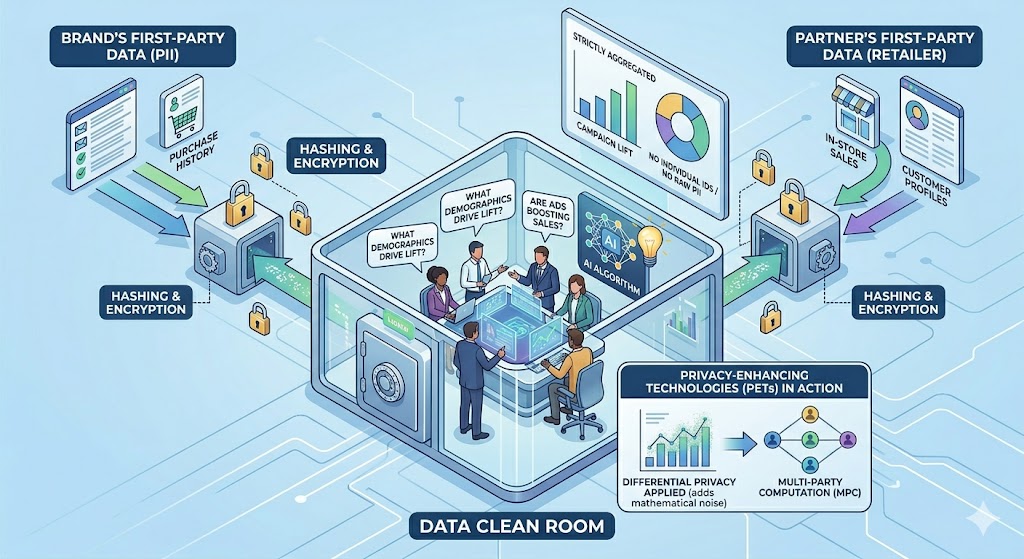
Think of a Data Clean Room as a secure, digital Switzerland. It is a highly controlled, neutral cloud environment where two or more parties can safely bring their data together for joint analysis, without ever exposing the underlying, raw PII to one another.
For example, suppose a global FMCG (Fast-Moving Consumer Goods) brand wants to know how its digital ad campaigns are driving in-store sales at a major retail chain. Due to privacy laws, the retailer cannot simply hand over a list of customer emails and purchase histories to the brand.
Instead, both parties upload their encrypted, hashed data into a Data Clean Room.
Collaborative Analytics Without Exposing PII
Once the data is inside the clean room, advanced cryptographic techniques are applied. The clean room matches the encrypted datasets—finding the overlap between the people who saw the FMCG brand’s ad and the people who bought the product at the retailer.
The output is strictly aggregated and anonymized. The FMCG brand receives a report stating, “Your recent campaign drove a 15% lift in sales for this demographic,” but they never learn who specifically made those purchases.
Major platforms have fully integrated clean rooms into their ecosystems in 2026:
- Cloud Providers: Snowflake, Amazon Web Services (AWS Clean Rooms), and Google Cloud have democratized access to independent data clean rooms.
- Walled Gardens: Google’s Ads Data Hub (ADH) and Amazon Marketing Cloud (AMC) allow advertisers to match their first-party data against the platform’s massive user bases in a privacy-safe environment.
The Role of Privacy-Enhancing Technologies (PETs)
Data Clean Rooms are powered by highly sophisticated Privacy-Enhancing Technologies. Understanding these terms is vital for modern marketing operations:
- Differential Privacy: This technique intentionally injects “mathematical noise” into a dataset. It preserves the statistical accuracy of the aggregate data (e.g., the overall conversion rate) while making it mathematically impossible to reverse-engineer the data to identify a specific individual.
- Multi-Party Computation (MPC): This allows multiple organizations to compute a function over their inputs while keeping those inputs private. It’s a way for brands and publishers to calculate joint ROI without ever seeing each other’s raw data.
- On-Device Processing: Part of the broader PET ecosystem involves shifting tracking away from servers and entirely onto the user’s device. Browsers now calculate ad interests locally, sending only generalized, anonymous signals back to ad networks (the core concept behind Google’s Privacy Sandbox APIs like the Topics API).
Is a Data Clean Room Right for Your Brand?
DCRs are incredibly powerful but require a certain level of maturity:
- Data Volume: You need a substantial amount of first-party data to make clean room matching statistically significant and worthwhile.
- Strategic Partnerships: Clean rooms are most effective when you have second-party data partnerships—such as a travel agency partnering with an airline, or a CPG brand partnering with a supermarket.
- Technical Investment: While software makes it easier, utilizing a DCR still requires data engineering resources to format, hash, and structure data correctly before ingestion.
Integrating the Three Methods: The “Triangulation” Strategy
Relying on a single method for tracking in 2026 is a recipe for blind spots. The most sophisticated marketing teams employ a strategy known as Triangulation. This involves blending all three methods to create a single source of truth.
- Server-Side Tracking (The Micro View): Use this for real-time optimization. Server-side tracking feeds high-quality, consented first-party data directly into ad platform algorithms, ensuring your campaigns learn efficiently and bid accurately on a day-to-day basis.
- Marketing Mix Modeling (The Macro View): Use MMM for strategic budget allocation. Review your MMM dashboards weekly or monthly to understand the overarching, incremental ROI of every channel, factoring in external market forces.
- Data Clean Rooms & Incrementality (The Validation): Use DCRs and localized incrementality tests to validate the assumptions made by your server-side data and your MMM. If your MMM suggests Meta ads are driving a 3x ROI, run a clean room analysis with a retail partner or a geo-holdout test to prove that assumption with hard data.
By triangulating these three data sources, you eliminate the biases inherent in any single measurement tool, resulting in highly confident, privacy-compliant business decisions.
Conclusion: Embracing the Privacy-First Future
The transition to a privacy-first marketing landscape in 2026 was never about killing measurement; it was about elevating it. The deprecation of third-party cookies forced the digital advertising industry to mature, moving away from lazy, invasive tracking methods toward sophisticated, data-driven strategies built on mutual trust with consumers.
To track ads successfully today, you must respect the user’s right to privacy while leveraging cutting-edge technology. By implementing server-side tracking to secure your first-party data, utilizing AI-powered Marketing Mix Modeling for holistic budget optimization, and exploring Data Clean Rooms for secure, collaborative analytics, you can achieve unprecedented clarity into your marketing ROI.
The brands that view privacy not as a hurdle, but as a competitive advantage, are the ones dominating the market. The tools are available, the methodologies are proven, and the privacy-first era is here. It is time to stop mourning the loss of the cookie and start building a resilient, future-proof measurement infrastructure.
Related articles :
- Email Marketing: Strategies, Features, & Examples for Your E-commerce Business
- How to Source Winning Products in Morocco
- 16 ESSENTIAL TOOLS FOR GOOD MANAGEMENT OF YOUR BUSINESS
- The importance of branding for businesses