 By
By 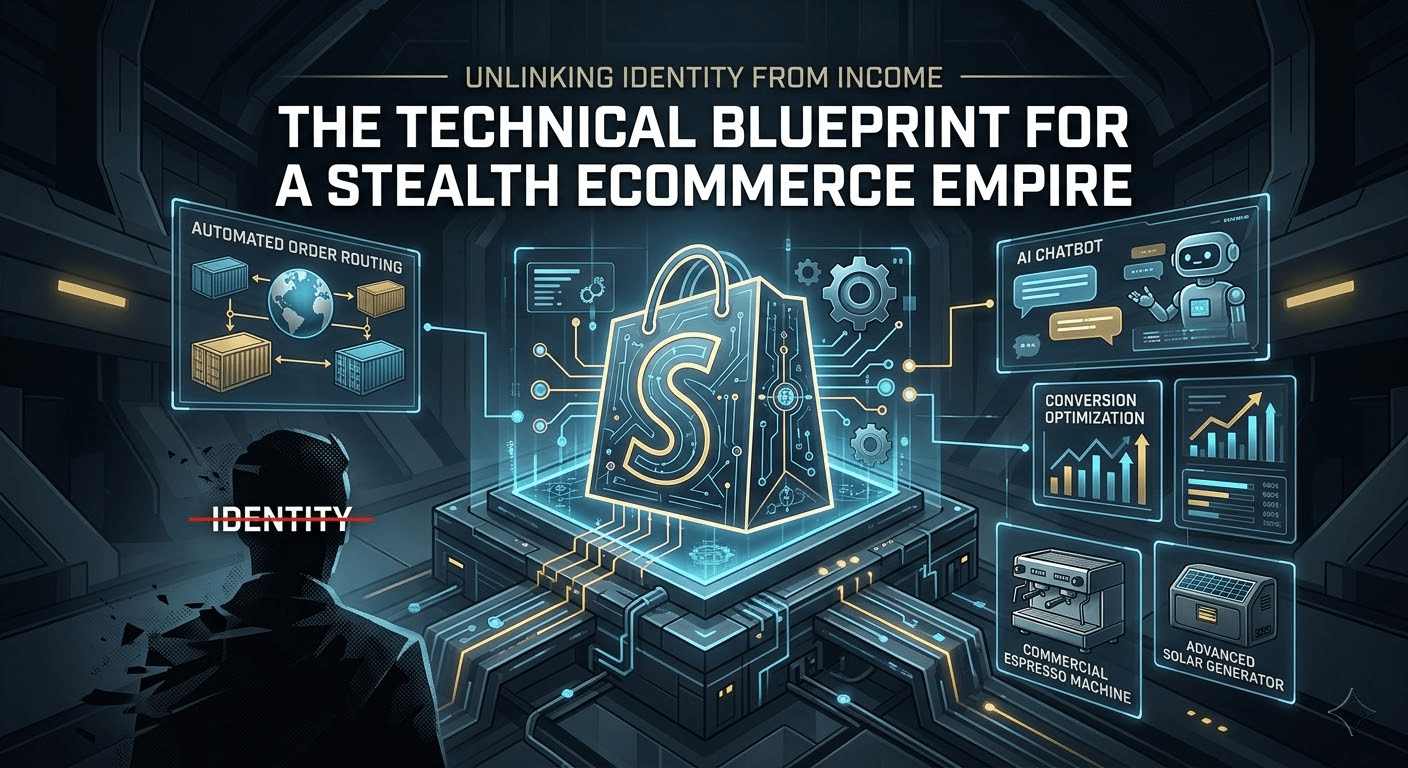
The digital economy has sold entrepreneurs a dangerous lie: that to achieve financial freedom, you must first become a public figure. You are told to document your life, build a personal brand, and leverage your identity for clicks. But for the technically minded solopreneur, being the face of a brand is a critical vulnerability.
When your face is tied to your revenue, you suffer from key-person risk. If you step away, burn out, or face a PR crisis, the entire revenue engine stalls. True digital wealth lies in the exact opposite approach. It relies on building unlinked digital assets—stealth operations that generate massive cash flow entirely independent of your personal identity or presence.
Welcome to the zero-employee paradigm. This guide provides the complete, technical blueprint for building an unlinked asset strategy using automation, high-ticket e-commerce, and conversion-optimized Shopify ecosystems.
You do not need to be an influencer. You need to be an architect.
The Solopreneur’s Dilemma: Why Founder-Led Brands Trap You
Many e-commerce founders begin with high hopes, only to realize they have engineered a high-stress job rather than a scalable business. Founder-led brands require constant content creation, personal storytelling, and active engagement. This creates a severe bottleneck.
If you are a high-ticket dropshipper or a Shopify store owner, your time should be spent optimizing conversion rates and automating supply chains, not filming short-form video content. Personal branding caps your scalability. You can only be the face of one, perhaps two, brands before your audience gets confused or fatigued.
Furthermore, investors and private equity firms apply steep discount multipliers to personality-driven businesses. An asset that relies on your daily presence is nearly impossible to sell. A faceless, systemized Shopify store, however, is a highly liquid digital asset.
By prioritizing systems over personality, you achieve what we call “systemic independence.” Your store continues to convert, rank on Google, and fulfill orders whether you are asleep, traveling, or focusing on launching your next niche site.
The Anatomy of a Stealth eCommerce Empire
To unlink your identity from your income, you must restructure your business model from the ground up. This involves stripping away personality-driven marketing and replacing it with high-intent data, superior user experience, and seamless technical execution.
Brand Architecture: Faceless by Design
A stealth brand establishes trust through professional design, secure payment gateways, and highly informative product pages, rather than founder charisma. Your brand voice must be authoritative, objective, and deeply knowledgeable about the specific niche.
Instead of a “My Story” page, you develop a robust “Our Methodology” or “Quality Assurance” page. Trust signals are generated via verified third-party reviews, comprehensive warranties, and transparent shipping policies. The goal is to make the customer feel they are buying from a massive, established retail entity rather than a one-person operation.
High-Ticket Dropshipping vs. Low-Ticket Churn
The stealth model pairs perfectly with high-ticket e-commerce. Selling $20 gadgets requires going viral on TikTok, which often demands a face, high energy, and constant trend-chasing. It is a volume game with razor-thin margins.
Conversely, selling a $3,500 commercial espresso machine or an $8,000 outdoor solar generator relies on search intent. High-ticket buyers are not making impulse purchases on social media. They are typing specific, long-tail queries into Google. By mastering faceless inbound e-commerce SEO strategies, you intercept these buyers at the exact moment of high commercial intent.
The Technical Blueprint: Shopify Setup & Automation
To execute a stealth operation, your infrastructure must be flawless. Your Shopify store is not just a digital catalog; it is an automated conversion engine designed to replace the need for human sales representatives.
Selecting High-Converting, Faceless Shopify Themes
Your theme is the digital storefront of your stealth empire. Because you lack a personal brand to generate goodwill, your site’s user experience (UX) must be immaculate to convert cold traffic. Relying on slow, bloated themes will instantly kill buyer trust, especially for high-ticket items.
You must prioritize themes built for Generative Engine Optimization (GEO) and core web vitals. Clean code, fast loading times, and built-in conversion features (like sticky add-to-carts and advanced filtering) are non-negotiable.
When analyzing the best free vs. paid themes for dropshipping, serious operators lean toward premium options like the Scrowp theme. Premium themes natively integrate trust badges, optimized mobile hierarchies, and semantic HTML structures that search engines—and AI overviews—favor.
Operational Automation: The Tech Stack
A true digital shadow requires zero manual intervention. If you are manually routing orders to suppliers or writing individual email replies, you are failing the automation test.
1. Order Routing and Supplier Sync:
Connect your Shopify store via API directly to your high-ticket suppliers. When a customer pays, the order data should instantly populate in your supplier’s ERP system. Tools like TeemDrop or custom Zapier webhooks can automate tracking number synchronization back to the customer.
2. Algorithmic Pricing:
High-ticket e-commerce often involves MAP (Minimum Advertised Price) enforcement. Utilize automated pricing apps that monitor supplier feeds to adjust your pricing dynamically, protecting your margins while remaining competitive in Google Shopping.
3. AI-Driven Customer Deflection:
High-ticket buyers have technical questions before they spend $5,000. Deploy advanced, trained LLM chatbots natively on your Shopify store. Train these AI agents on your supplier catalogs, product manuals, and PDF spec sheets. The AI can confidently answer 85% of complex B2B inquiries without human input.
Founder-Led vs. Stealth eCommerce Models
To clearly illustrate the distinct advantages of unlinking your identity from your income, review the technical comparison below:
| Metric / Attribute | Founder-Led E-Commerce | Stealth E-Commerce Empire |
| Primary Traffic Engine | Social media, viral content, influencer ads | SEO, Google Shopping, Programmatic Content |
| Customer Acquisition Cost | Highly volatile; relies on algorithmic favor | Stable, compounding ROI through organic search |
| Operational Bottleneck | Founder’s energy, daily content creation | API rate limits, supplier inventory levels |
| Trust Generation | Parasocial relationships and personality | UX, secure gateways, technical product data |
| Exit Valuation (Multiples) | Low (Key-person dependency discount) | High (Easily transferable, systemized asset) |
| Average Order Value (AOV) | Typically Low-Ticket ($20 – $75) | Typically High-Ticket ($1,000 – $10,000+) |
Traffic & Acquisition Without a Personal Brand
If you refuse to dance on TikTok, how do you generate traffic? The answer lies in owning the digital infrastructure. You must build proprietary traffic engines utilizing search engines and data-driven advertising.
SEO & Programmatic Content
A stealth empire thrives on informational dominance. You must engineer massive SEO pillar sites around your niche. Instead of writing generic blog posts, deploy Generative Engine Optimization (GEO) principles.
Write in definitive statements. Use Markdown tables to compare product specs, as AI engines love structured data. Place the direct answer to a user’s search query in the first 50 words of your article.
Furthermore, you can utilize programmatic SEO to generate hundreds of localized or specific landing pages based on dynamic databases. By combining supplier data feeds with templated, high-quality copywriting, you cast a massive net for long-tail search traffic that competitors ignore.
Performance Marketing (Google Ads & Meta)
Without a face, your ad creatives must rely on product utility and direct-response psychology. For high-ticket items, Google Search and Google Shopping are your primary weapons. You are capturing existing demand.
For Meta (Facebook/Instagram), utilize faceless User Generated Content (UGC). Hire creators strictly to demonstrate the product—only showing their hands or focusing entirely on the item’s functionality. Combine this with text-heavy, benefit-driven image ads. A well-optimized Shopify store combined with clinical, data-driven media buying will consistently outperform a chaotic, personality-driven brand.
Future-Proofing Your Faceless Asset
The ultimate goal of building a stealth e-commerce empire is the exit. Buyers acquire systems, not jobs. To prepare your faceless asset for a lucrative acquisition, you must enforce strict financial hygiene.
Keep your accounting perfectly separated for each niche store. Document every Standard Operating Procedure (SOP) meticulously. Whether it is how you format an SEO article, how your AI chatbot is updated, or how supplier disputes are handled, it must live in a centralized knowledge base.
When you decouple your identity from the revenue, you achieve true professional sovereignty. You own a cash-flowing machine that scales infinitely, shielded from the exhaustion of public visibility.

[Click Here to Get Your Copy on Amazon Now]
Summary
Unlinking your identity from your income is the highest form of digital leverage. By avoiding the trap of the founder-led personal brand, you remove the ultimate bottleneck to scaling: yourself.
A stealth e-commerce empire relies on high-ticket dropshipping, premium conversion-focused Shopify themes, and ruthless operational automation via APIs and AI agents. Traffic is driven systematically through programmatic SEO, definitive pillar content, and intent-based performance marketing.
Ultimately, building a faceless digital asset isn’t just about preserving your privacy—it’s about engineering a highly liquid, highly valuable business that can be operated, scaled, and eventually sold with zero key-person risk.
Frequently Asked Questions
How long does it take to see traction with a stealth SEO e-commerce store?
Unlike viral social media tactics, inbound SEO requires patience. Typically, a well-structured domain will begin ranking for long-tail keywords within 3 to 6 months. However, once topical authority is established, the traffic is highly stable and requires minimal daily maintenance compared to paid ads.
Can I run multiple faceless Shopify stores at once?
Yes, this is the core advantage of the stealth model. Because your face is not required for content or branding, your only limitations are capital for initial setups and the efficiency of your automated systems. Many operators run “portfolios” of 3 to 5 niche stores simultaneously.
What is the best way to handle customer service for high-ticket items without a massive team?
Deploy custom AI chatbots trained specifically on your product manuals and supplier data. Supplement this with highly detailed FAQ pages, robust product descriptions, and automated email workflows. Only escalate highly complex or specific warranty issues to a remote, part-time human contractor.
Does a stealth e-commerce brand have a lower conversion rate than a personal brand?
Not necessarily. While a personal brand builds trust through emotion, a stealth brand builds trust through authority. By utilizing premium site design, fast loading speeds, comprehensive product data, and transparent policies, stealth high-ticket stores often boast highly competitive conversion rates.
Read Next
- Beginner’s Guide to Dropshipping in 2026
- The Sigma Architecture: A Framework for Engineering High-Level Success
- Fullcart: AI-Powered Ecommerce Analytics & Automation Guide
- Engineering the Digital Shadow: Faceless Inbound SEO & eCommerce
- Best Free vs Paid Themes for Dropshipping