 By
By 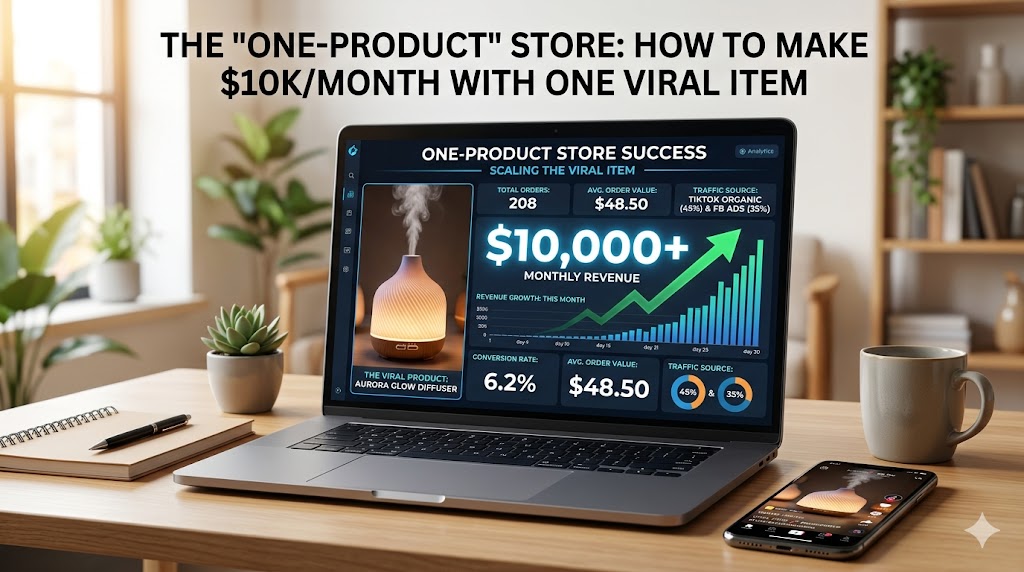
The landscape of e-commerce has fundamentally shifted. Gone are the days when you needed a sprawling digital catalog of thousands of items to run a profitable online business. Today, the most agile and scalable business model relies on intense focus: the one-product store.
By identifying a single viral item, building a brand around it, and driving highly targeted traffic, reaching $10,000 per month in revenue is not just possible—it is a mathematical formula. This comprehensive guide will walk you through the exact blueprint for launching a one-product store, finding a winning item, optimizing for conversions, and scaling your marketing to hit that $10k/month milestone.
Why the One-Product Store Model Wins
When you open a general store with hundreds of products, you are competing with retail giants like Amazon and Walmart. You spread your marketing budget thin, and your branding becomes diluted. A one-product store flips this dynamic on its head.
Laser-Focused Marketing and Branding
With a single product, your entire website, social media presence, and ad copy are dedicated to solving one specific problem for one specific target audience. This creates immediate trust. When a customer lands on your site, they don’t see a chaotic flea market; they see a specialized boutique that is the absolute authority on that particular item.
Simplified Operations and Logistics
Managing inventory, communicating with suppliers, and handling customer service for 50 different items is an operational nightmare for a one-person business. A single-product focus allows you to streamline your supply chain. You deal with one supplier, one set of shipping dimensions, and a predictable set of customer inquiries, freeing up your time to focus on high-leverage activities like marketing and conversion rate optimization.
Higher Conversion Rates
Because your site is highly optimized around a single narrative, the user journey is frictionless. There are no distracting categories to browse through. The funnel is simple: land on the page, understand the value proposition, and check out. This streamlined process naturally leads to higher conversion rates compared to general e-commerce stores.
Step 1: Finding Your Viral $10k/Month Product
Your product is the engine of your business. If the product is weak, no amount of brilliant marketing will save it. Finding a “winning product” requires balancing emotional appeal with practical utility.
The Criteria for a Winning Product
To hit $10k a month, your item needs to meet three strict criteria: It solves a pain point, has a “wow” factor, and maintains healthy profit margins. Do not guess what people want to buy; look at the data. Many successful entrepreneurs automate this research phase by using a dedicated winning products finding tool to uncover profitable items before they saturate the market.
Research Methods for Uncovering Viral Items
Do not guess what people want to buy; look at the data.
- TikTok Organic Research: Search terms like “TikTok made me buy it,” “Amazon finds,” or “Problem solved.” Filter videos by “Most Liked” in the last month. Look for products that are generating massive engagement but haven’t been saturated by established brands.
- The Facebook Ad Library: This is a goldmine for competitive intelligence. Search for keywords related to your niche and look for ads that have been running for weeks or months. Advertisers do not spend money on losing ads. If an ad has been active for a long time, the product is selling.
- Amazon Movers & Shakers: This list shows the biggest gainers in sales rank over the past 24 hours. It is an excellent way to spot emerging trends before they hit peak virality.
Validating Demand Before Sourcing

Before committing to a product or buying inventory in bulk, validate the idea. You can set up a basic storefront and run a low-budget ad campaign. If people click through and attempt to add to cart, you have validated demand. (You can simply refund them and state the item is on backorder while you set up the actual supply chain).
Step 2: Building a High-Converting E-commerce Store
Once you have your product, you need a digital storefront designed to convert traffic into cash. A high-converting one-product store needs to look premium, load instantly, and build immediate trust.
Choosing the Right Architecture
Platforms like Shopify are the industry standard for a reason. When selecting a theme, prioritize speed, mobile responsiveness, and clean aesthetics. Avoid cluttered, overly complex themes. Using a highly optimized, fast-loading Shopify theme designed specifically for conversions will dramatically decrease your bounce rate and replace the need for dozens of clunky third-party apps.
Crafting the Perfect Product Page
Your product page is your sales pitch. It must flawlessly answer the customer’s internal monologue.
- High-Quality Visuals: Do not use the generic, low-resolution images provided by the supplier. Order the product yourself and take high-quality photos. More importantly, create GIFs demonstrating the product in action and embed them directly into the product description.
- Benefit-Driven Copywriting: Customers do not buy features; they buy better versions of themselves. Instead of saying “Made with polyurethane,” say “Ultra-durable material that lasts a lifetime.” Break up text with bold headers, bullet points, and ample white space.
- Social Proof is Non-Negotiable: Human beings are herd animals. We look to others to dictate our purchasing decisions. Include a dedicated review section with photo reviews. Displaying user-generated content (UGC) of real people using the product builds immense trust.
Seamless Checkout and Upsells
The checkout process must be completely frictionless. Offer multiple payment gateways, including express options like Apple Pay and Google Pay.
Furthermore, to maximize your Average Order Value (AOV), implement post-purchase upsells. If someone just bought your viral posture corrector, offer them a massage ball at a 20% discount immediately after they complete their purchase. This pure profit goes straight to your bottom line.
Step 3: Creating Viral Content and Advertisements
You have a winning product and a beautiful store. Now you need eyeballs. In the modern e-commerce landscape, organic short-form video and strategic paid advertising are the fastest routes to $10k/month.
The Power of Organic Short-Form Video
Platforms like TikTok, Instagram Reels, and YouTube Shorts offer unprecedented organic reach. You can get millions of views without spending a dime on ads. If you are camera-shy or want to scale production, you can use AI video creation tools to generate lifelike product demonstrations and highly engaging faceless content that drives traffic natively.
Structuring a Winning Video Ad
If you are running paid ads, your video creative is the most important variable. Follow this proven framework:
- The Hook (0-3 seconds): You must stop the scroll. Use a bold statement, a visually shocking visual, or ask a question directly related to the pain point.
- The Problem/Solution Setup (3-10 seconds): Agitate the problem the viewer is facing, then introduce your product as the ultimate solution.
- The Demonstration (10-20 seconds): Show the product working seamlessly. Use text overlays to highlight key benefits.
- The Call to Action (20-30 seconds): Tell them exactly what to do next. “Click the link below to get 50% off today.”
User-Generated Content (UGC) as Your Secret Weapon
Consumers are increasingly blind to polished, brand-created advertisements. They want authenticity. Reach out to micro-influencers or content creators and send them your product for free in exchange for a short review video. Using UGC as your primary advertising creative will almost always yield a higher Return on Ad Spend (ROAS) than traditional studio-shot commercials.
Step 4: Launching and Scaling Paid Traffic
While organic content is fantastic, paid advertising provides predictability and scale. When you put $1 in and get $3 back, scaling to $10k/month becomes a matter of math.
Testing with Precision
Start by testing your video creatives on Facebook, Instagram, or TikTok. Create a campaign with multiple ad sets targeting different interests related to your niche. Keep your daily budget relatively low during the testing phase—around $20 to $50 per day.
Reading the Data: KPIs to Watch
Do not let your emotions dictate your ad strategy; look at the key performance indicators (KPIs).
- Click-Through Rate (CTR): If your CTR is below 1%, your ad creative (your hook or video) is not engaging enough.
- Cost Per Click (CPC): If your CPC is too high, you are targeting the wrong audience or your ad isn’t relevant.
- Cost Per Acquisition (CPA): This is the holy grail. How much does it cost to acquire a customer? If your product sells for $50, your product cost is $15, and your CPA is $15, you are making a $20 net profit per sale.
Scaling the Winners
Once you find an ad creative and target audience that consistently generates a profitable ROAS, it is time to scale. Do not increase your budget too aggressively, as this can break the algorithm’s learning phase. Increase the budget of your winning ad sets by 15-20% every two to three days. Simultaneously, duplicate your winning ads and test them against new, broader audiences.
Step 5: Backend Operations: Fulfillment and Customer Service
As your order volume increases, the backend operations of your business become critical. A single viral video can bring in hundreds of orders, and if your supply chain cracks, your brand reputation will tank.
Automating the Supply Chain
As your order volume increases, the backend operations of your business become critical. When starting out, an AI-powered dropshipping model—where advanced algorithms handle global sourcing, automatic order syncing, and rapid fulfillment directly to the customer—is the most efficient way to maintain cash flow while keeping delivery times competitive.
Retaining Customers for LTV
The easiest money to make is from a customer who has already bought from you. Do not ignore your email list. Set up automated flows for abandoned carts, welcome sequences, and post-purchase follow-ups. Once you have a customer’s trust with your initial viral product, you can introduce complementary products to your store, dramatically increasing their Lifetime Value (LTV).
The $10k/Month Math Breakdown
Scaling to $10,000 per month can feel daunting, but breaking it down into daily numbers makes it highly actionable.
Let’s assume you find a product with a compelling value proposition:
- Product Sale Price: $50
- Product Sourcing & Shipping Cost: $15
- Gross Margin: $35
To reach $10,000 in monthly revenue:
- $10,000 / $50 per sale = 200 sales per month.
- 200 sales / 30 days = 6.6 sales per day.
Getting just 7 sales a day is highly achievable with a solid product page and targeted traffic.
Now, let’s look at the profit side. If your target CPA (Cost Per Acquisition on ads) is $15:
- Revenue per sale: $50
- Product Cost: -$15
- Ad Cost (CPA): -$15
- Net Profit per sale: $20
At 200 sales a month, that yields $4,000 in pure monthly net profit from a single product that only requires you to facilitate 7 transactions a day. Optimize your ads to lower your CPA, or implement post-purchase upsells to increase your AOV, and those profit margins widen even further.
Conclusion: Focus is the Ultimate Growth Hack
Building a general store with hundreds of products is an exercise in distraction. The one-product store model forces you to become an expert in the fundamentals of e-commerce: identifying market desires, crafting compelling sales copy, and mastering digital traffic generation.
By finding a single, emotionally resonant product, building a high-converting, trust-building storefront, and systematically testing and scaling your marketing efforts, the path to a $10k/month business becomes clear. It requires deep work, optimization, and an unwavering commitment to the data, but the blueprint is proven. Master the single product, and you master the art of online business.
Related articles :
- Shopify: E-commerce Dropshipping Platform
- How to Add FAQ Schema to Shopify Without Any App
- Why Successful Shopify Stores Live and Breathe SEO
- TeemDrop | World-Class AI Dropshipping: The Ultimate Guide to Scaling Your E-commerce Business