
 By
By 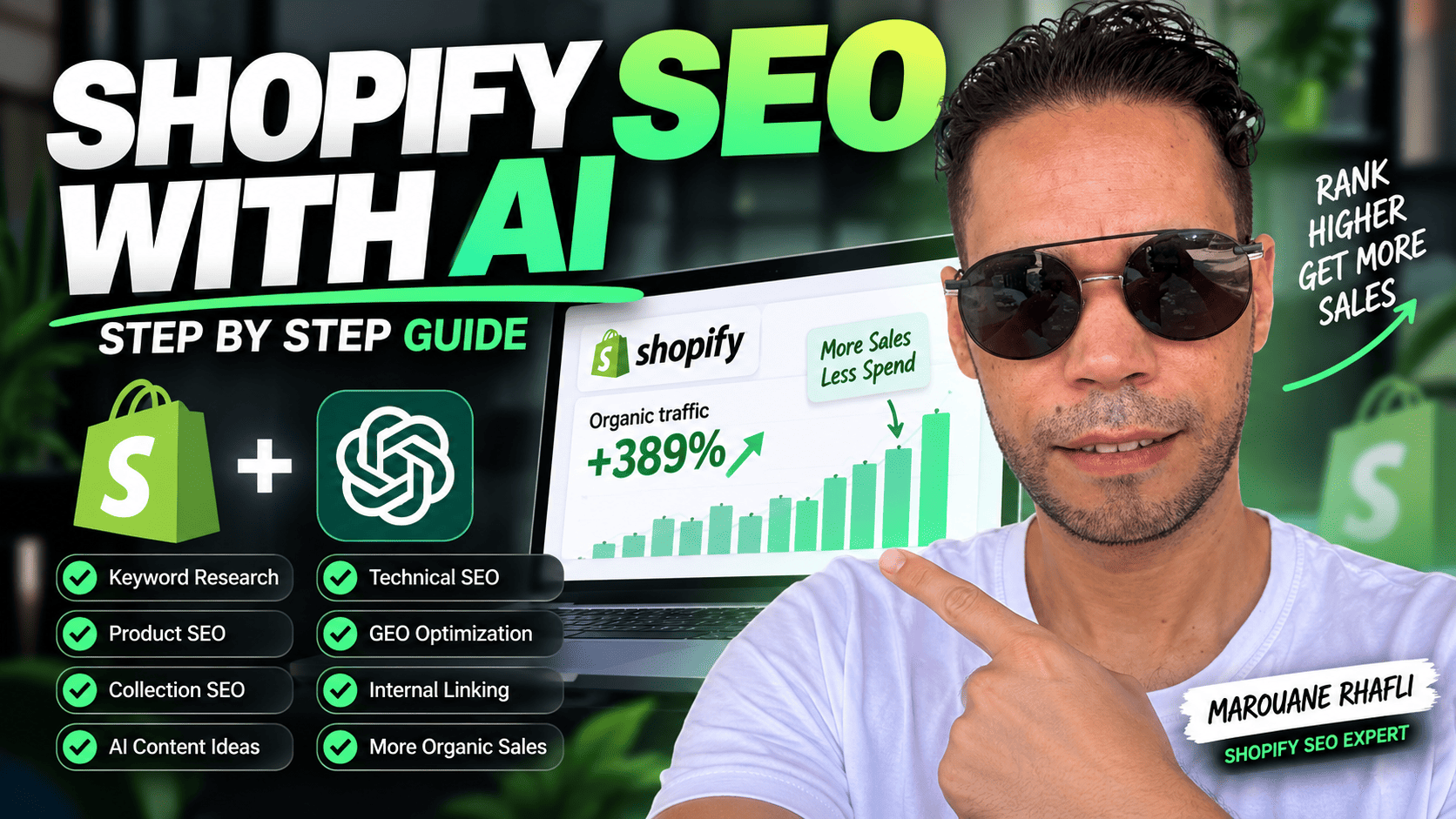
AI is changing the way Shopify SEO is done.
For years, optimizing a Shopify store meant spending hours researching keywords, analyzing competitors, writing product descriptions, optimizing collections, creating blog content, fixing technical issues, and monitoring rankings.
Today, AI can accelerate a large part of that work.
But there is an important distinction: using AI for SEO does not mean asking ChatGPT to generate hundreds of articles and publishing them blindly.
The real opportunity is using AI as an SEO assistant—helping you research faster, identify opportunities, improve existing pages, and make better decisions.
In this guide, I’ll show you how to use AI for Shopify SEO and how you can build a more efficient SEO workflow for your store.
1. Start With AI-Powered Keyword Research
Every successful SEO strategy starts with understanding what people are searching for.
Instead of starting with random keywords such as:
“men’s shoes”
you need to understand the actual search intent behind potential customers.
AI can help you expand a broad product category into dozens of potential search topics.
For example, if you sell running shoes, you could ask an AI tool to categorize keywords according to intent:
- Informational
- Commercial
- Transactional
- Comparison
- Problem-based searches
You may discover opportunities such as:
best running shoes for beginners
lightweight running shoes for men
running shoes for flat feet
best shoes for long-distance running
The objective isn’t simply to find keywords with large search volumes.
You want to find searches that match the products you actually sell and the problems your customers are trying to solve.
Use AI to accelerate the brainstorming and classification process, then validate important keywords using real search data.
Try out the Shopify AI advisor for FREE
2. Optimize Shopify Product Pages With AI
Your product pages shouldn’t contain only a title, price, image, and generic description.
They are potential SEO landing pages.
AI can help you analyze and improve elements such as:
Product titles
Include the terminology customers actually use without turning the title into keyword spam.
Product descriptions
Explain what the product is, who it is designed for, its important benefits, specifications, and use cases.
Meta titles and descriptions
Create search-friendly metadata designed to improve relevance and encourage clicks.
Image alt text
Describe product images accurately while naturally providing useful context to search engines.
FAQs
Identify questions customers may have before purchasing and answer them directly on the product page.
The key is giving AI detailed information about the product.
The less information you provide, the more generic the output becomes.
3. Optimize Your Shopify Collection Pages
One of the biggest SEO mistakes I see on Shopify stores is ignoring collection pages.
Collections can be extremely valuable because they often target commercial searches.
For example:
/collections/running-shoes
may have significantly more SEO potential than an individual shoe product because someone searching for “running shoes” usually wants to compare several options.
AI can help analyze a collection and suggest:
- Better collection titles
- Introductory copy
- Supporting content
- Frequently asked questions
- Internal links
- Related subcategories
- Relevant search topics
Your goal should be to make the collection genuinely useful rather than adding 1,000 words simply because you think Google wants more content.
4. Find Content Ideas That Can Generate Sales
Blogging for Shopify shouldn’t be about publishing random articles to increase your page count.
Every article should have a purpose.
AI can help connect informational searches with your products.
Imagine that your Shopify store sells coffee equipment.
Instead of publishing generic articles about coffee, you could build content around questions such as:
How to make espresso at home
French press vs espresso machine
Best coffee grinder for espresso
Why does my espresso taste bitter?
These searches happen before the purchase.
A useful article can answer the question and then naturally direct the reader toward the appropriate product or collection.
This is where content becomes part of your sales funnel rather than just another source of traffic.
5. Use AI to Improve Existing Shopify Content
You don’t always need more content.
Sometimes the biggest opportunity is improving what you already have.
Give AI an existing product page, collection page, or blog article and ask it to identify:
- Missing topics
- Weak headings
- Unanswered questions
- Poor search intent alignment
- Internal linking opportunities
- Duplicate information
- Sections that don’t provide enough value
This can be especially powerful on pages that already receive impressions from Google but aren’t ranking near the top.
Improving an existing page can sometimes produce results faster than creating an entirely new one.
6. Build Smarter Internal Links
Internal linking is one of the simplest Shopify SEO techniques, yet many stores barely use it.
AI can help identify relationships between your content.
For example:
Blog article → Collection
“How to Choose Running Shoes” → Running Shoes Collection
Blog article → Product
“Best Shoes for Marathon Training” → Relevant marathon shoe
Product → Collection
Individual shoe → Running Shoes Collection
Collection → Supporting guide
Running Shoes → “How to Choose the Right Running Shoe”
This creates a logical structure that helps customers navigate your store while helping search engines understand how your pages relate to each other.
7. Optimize for SEO and GEO
Search is evolving beyond traditional Google results.
People increasingly discover products and information through AI-powered search and answer engines.
This is why I believe Shopify merchants should think about both SEO and GEO (Generative Engine Optimization).
Your content should be easy for both traditional search engines and AI systems to understand.
That means creating clear page structures, answering specific questions, providing useful factual information, using descriptive headings, demonstrating expertise, and avoiding unnecessary filler.
Don’t write content for algorithms.
Create information that makes it easy for a search engine—or an AI system—to understand exactly what your page is about and why it is useful.
8. Automate the Process With My Shopify SEO Advisor AI Agent
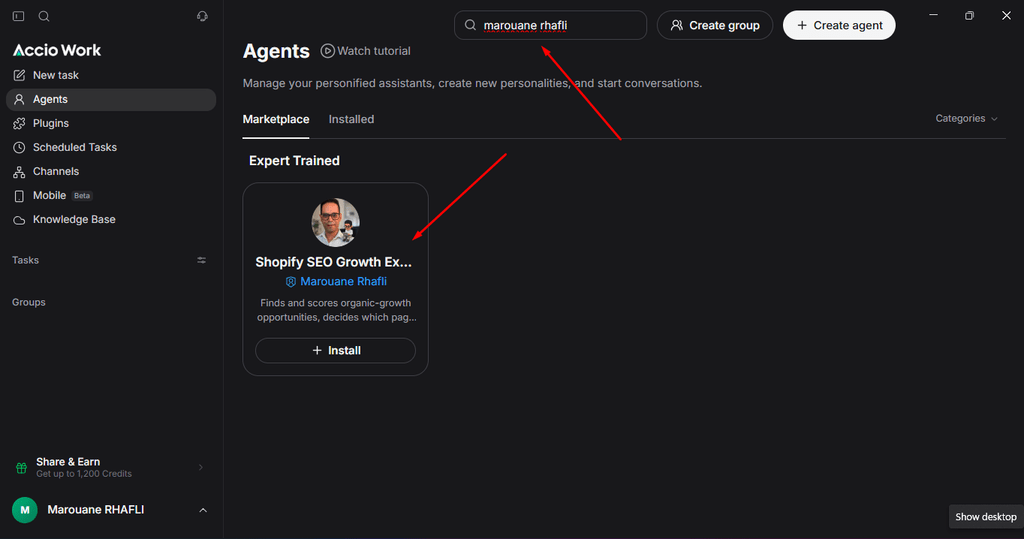
If you’re thinking, “This sounds useful, but I don’t want to perform every step manually,” that’s exactly the problem AI agents can help solve.
I’ve collaborated with Accio Work, a product of Alibaba.com, to bring my Shopify SEO expertise into a dedicated Shopify SEO Advisor AI Agent.
I was selected by Alibaba.com for my expertise in Shopify and SEO, and the goal of the agent is simple: make professional Shopify SEO guidance much more accessible to merchants.
Instead of figuring out every SEO step on your own, you can use my AI agent inside Accio Work to help you analyze your Shopify SEO situation and work through optimization tasks using an AI-powered workflow.
Think of it as having a Shopify SEO advisor available when you’re working on your store.
It brings together AI + Shopify + SEO/GEO in a workflow designed around the type of optimization strategies I’ve used and developed through my own experience working with e-commerce businesses.
If you want to use AI for Shopify SEO but don’t know where to begin, my Shopify SEO Advisor on Accio Work is a great place to start.
→ Try Marouane Rhafli’s Shopify SEO Advisor on Accio Work
[Insert screenshot/image of the Shopify SEO Advisor agent here]
9. Don’t Let AI Put Your SEO on Autopilot
AI can make SEO dramatically faster.
But it shouldn’t replace judgment.
You should still review what AI generates, verify facts, understand your customers, monitor performance, and make decisions based on actual data.
The winning approach isn’t:
AI replaces SEO experts.
It’s:
AI makes good SEO execution faster and more accessible.
A merchant who understands their customers and knows how to use AI effectively can now accomplish work that previously required multiple tools and many hours.
Final Thoughts
Shopify SEO is becoming less about manually completing hundreds of repetitive tasks and more about knowing what should be optimized, why it matters, and how AI can accelerate the process.
Start with search intent.
Optimize your products and collections.
Build content around real customer questions.
Create strong internal connections between pages.
Optimize for both traditional search engines and emerging AI discovery experiences.
Then use AI to make the entire workflow faster.
That’s also why I created my Shopify SEO Advisor with Accio Work: to turn my Shopify SEO knowledge into an AI-powered experience that merchants can actually use.
SEO isn’t disappearing because of AI.
SEO is evolving because of AI—and Shopify merchants who learn how to use it now will have an advantage.
Try out the Shopify AI advisor for FREE