 By
By 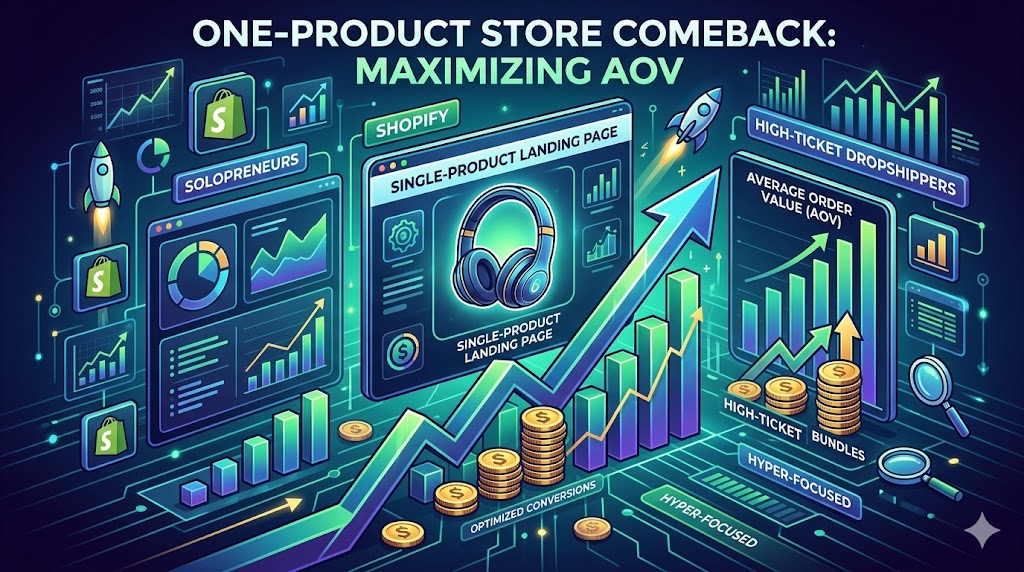
The digital landscape has shifted. If you are a solopreneur, a Shopify store owner, or a high-ticket dropshipper, you already know the harsh truth: the days of throwing broad Facebook Ads at a cluttered, 500-SKU general store are dead. Rising Customer Acquisition Costs (CAC), shrinking profit margins, and hyper-aware consumers have fundamentally altered the e-commerce playbook.
But out of this friction, a highly lucrative model has re-emerged from the ashes of 2018 dropshipping trends: the “One-Product” store.
However, this isn’t the amateur, copy-and-paste AliExpress model of the past. The 2026 iteration of the single-product brand is a sophisticated, highly optimized digital asset. It leverages Generative Engine Optimization (GEO), strict Google E-E-A-T principles, and psychological copywriting to create an inescapable buying environment. The singular goal? Maximizing Average Order Value (AOV) through a hyper-focused landing page.
In this comprehensive guide, we will dissect the exact framework top-tier digital entrepreneurs are using to scale single-SKU stores to 7 and 8 figures. You will learn how to architect high-converting landing pages, engineer irresistible upsells, and build a technically flawless store that dominates both paid social and organic search.
Why the One-Product Store Model is Dominating Again
To understand how to win, you must first understand why the old models are failing. The traditional “general store” dropshipping strategy relied on cheap traffic and impulse buys. Today, traffic is anything but cheap, and consumers are meticulously researching every purchase.
The Death of the “General Store”
General stores inherently suffer from high cognitive load. When a user lands on a site featuring dog toys, fitness bands, and kitchen gadgets all on the same homepage, trust plummets immediately. Modern consumers have been trained by giants like Apple and direct-to-consumer (DTC) unicorns to expect a seamless, branded narrative.
A scattered inventory dilutes your marketing message. It prevents you from speaking directly to the specific pain points of a highly targeted buyer persona. In contrast, a one-product store allows you to channel 100% of your creative energy, ad spend, and website real estate into a single, compelling value proposition.
Lower Cognitive Load Equals Higher Conversions
The paradox of choice is a well-documented psychological phenomenon: give consumers too many options, and they will choose nothing. A hyper-focused landing page eliminates this friction entirely.
When a prospect clicks your ad and lands on a single-product page, the journey is strictly linear. There are no distracting category menus, no sidebar widgets, and no unrelated “You May Also Like” carousels. The user is presented with a binary choice: buy the solution to their problem, or leave. This forced decision-making process naturally inflates conversion rates.
The Math Behind the Comeback (CAC vs. AOV)
The resurgence of the one-product store is ultimately a mathematical necessity. With ad platforms heavily relying on AI and machine learning, feeding the algorithm a single, high-quality data stream (purchases of one specific item) allows for faster pixel seasoning and better targeting.
More importantly, controlling a single funnel allows you to ruthlessly optimize the AOV-to-CAC ratio. If your Customer Acquisition Cost is $45, selling a single $50 item leaves you bankrupt. But if that same hyper-focused landing page utilizes intelligent bundling and post-purchase upsells to drive the AOV to $115, you have built a money-printing machine.
The Anatomy of a Hyper-Focused Landing Page
A product page on a standard Shopify theme is rarely enough to drive massive scale. You need a dedicated, long-form landing page that acts as a 24/7 digital salesperson. This page must systematically dismantle objections, build desire, and compel action.
The Hero Section: Selling the Transformation
Your hero section—the very top of the landing page—is responsible for 80% of your success. If it fails to hook the user within three seconds, they will bounce. Do not waste this prime real estate talking about technical specifications.
Instead, sell the transformation. Use a bold, benefit-driven headline that directly addresses the user’s primary pain point. Pair this with a high-definition lifestyle image or an engaging video loop demonstrating the product in action. The “Add to Cart” button (your primary Call to Action) must be prominently displayed above the fold, utilizing a contrasting color to draw the eye.
Frictionless Social Proof and UGC
Consumers do not trust brands; they trust other consumers. Injecting User-Generated Content (UGC) and authentic social proof throughout the landing page is non-negotiable.
Do not just dump a wall of text reviews at the bottom of the page. Integrate specific, problem-solving testimonials directly under key feature callouts. If your product solves back pain, place a video review of a customer demonstrating their newfound mobility right next to the section detailing the product’s ergonomic design.
To ensure your layout supports this kind of rich media without destroying your site speed, you must prioritize Shopify Store Design for SEO & Conversions. Proper architectural planning ensures your heavy UGC assets do not tank your Core Web Vitals.
Strategic Feature Stacking
Avoid the trap of simply listing features. Every feature must be translated into a tangible benefit, a concept known as “Feature Stacking.”
- Bad: Made with aerospace-grade aluminum.
- Good: Ultra-lightweight and virtually indestructible, so you never have to replace it.
Break these benefits down into easily digestible sections. Use custom iconography, short paragraphs, and bold text to make the page highly scannable. Remember, mobile users are scrolling rapidly; your copy must stop their thumbs through striking visual hierarchy.
Strategies for Maximizing Average Order Value (AOV)
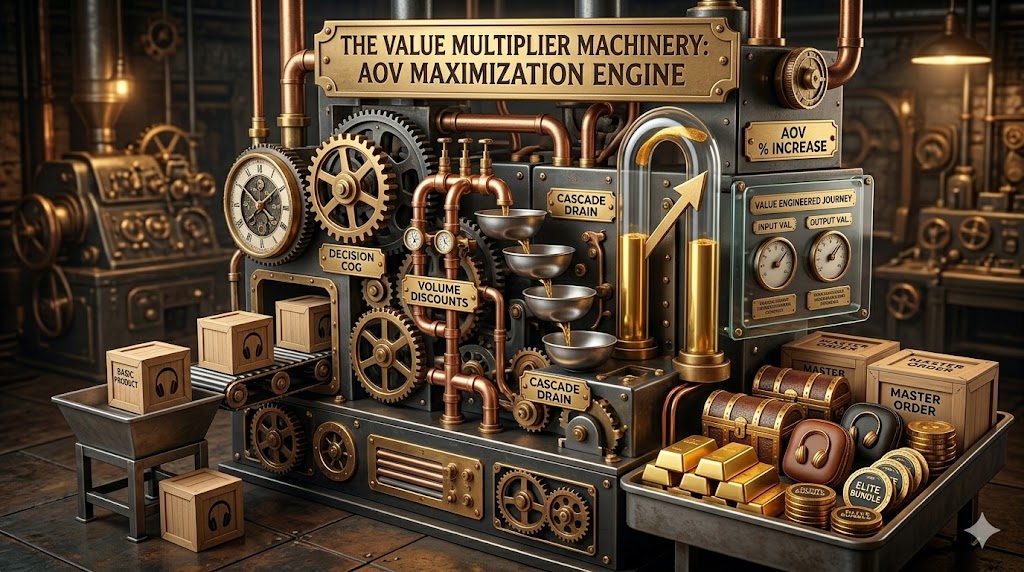
Driving traffic to a high-converting landing page is only step one. The true secret to scaling a one-product store lies in extracting maximum revenue from every single transaction. This is where advanced AOV strategies come into play.
The Power of Pre-Purchase Upsells and “The Decoy Effect”
You don’t need a massive catalog to offer upsells. The most effective upsells on a single-product store are often multiples of the same product, or highly complementary micro-accessories.
Leverage “The Decoy Effect” in your pricing strategy. Offer one unit at full price, but heavily incentivize buying two or three units. For example, if you sell a high-ticket skincare device, offer the base device for $149, a “Couples Pack” (two devices) for $249, and a “Family Pack” (three devices) for $299. The middle tier acts as an anchor, making the highest tier seem like an irresistible deal.
Tiered Pricing and Volume Breaks
Volume breaks are essential for consumable products or items that make good gifts. By implementing a sticky Add-to-Cart bar that updates pricing dynamically as the user selects higher quantities, you create a gamified shopping experience.
Use visual cues, such as “Most Popular” or “Best Value” badges, to guide the user toward your target AOV tier. Ensure these volume discounts are calculated and displayed clearly; confusing math will kill a conversion instantly.
Post-Purchase One-Click Upsells
The highest-converting moment in the entire customer journey is the exact second after they complete a purchase. Their credit card is already out, their dopamine is spiking, and their trust in your brand is cemented.
Implementing a post-purchase, one-click upsell funnel is mandatory. Because you only sell one core product, your post-purchase offer could be expedited VIP shipping, an extended warranty, or an exclusive digital product (like a premium video course related to the physical item). Because this requires zero additional data entry from the user, conversion rates on these offers often exceed 15%.
Tech Stack and Infrastructure for High-Ticket Dropshippers
A brilliant landing page built on a sluggish, bloated foundation is a recipe for wasted ad spend. The technical infrastructure of your Shopify store directly impacts both your organic search rankings and your paid conversion rates.
Speed, SEO, and Theme Architecture
Every additional second of load time drops your conversion rate by an average of 7%. When you are paying top dollar for clicks, you cannot afford to leak traffic due to a slow theme bogged down by 15 different third-party apps.
You need a lean, natively optimized environment. By utilizing an infrastructure like the Scrowp Shopify Theme, you can replace dozens of clunky apps—like upsell pop-ups, countdown timers, and sticky carts—with clean, built-in code. This radically improves your Google PageSpeed Insights score, which is a critical ranking factor for SEO and severely impacts your ad platform penalty rates.
Custom Design vs. Template Constraints
While out-of-the-box themes are great for beginners, scaling past the $50k/month mark often requires bespoke solutions. High-ticket dropshippers need landing pages that feel entirely proprietary.
If your current theme restricts your ability to craft dynamic, narrative-driven landing pages, it might be time to bring in the experts. Partnering with a specialized Shopify Design Agency allows you to hardcode custom sections, implement advanced predictive loading, and create a user interface that perfectly matches the high price point of your product.
Data Comparison: One-Product vs. General Store Models
To crystallize why top entrepreneurs are making this pivot, let’s examine the raw data and operational differences between the two primary e-commerce models in 2026.
| Metric / Attribute | One-Product Store Model | General Store (Multi-SKU) |
| Average Conversion Rate | 3.5% – 6.0% (Highly targeted) | 1.0% – 2.0% (Fragmented intent) |
| Average Order Value (AOV) | High (Driven by targeted bundles) | Low (Driven by random impulse) |
| Brand Perception & Trust | Premium, authoritative, niche expert | Cheap, commoditized, “flea market” feel |
| Ad Spend Efficiency (ROAS) | High (Fast pixel seasoning on 1 item) | Low (Algorithm struggles to find buyers) |
| Inventory / Supply Chain | Simplified, easy to private label | Complex, high risk of quality control issues |
| SEO & Topical Authority | Deep, highly specific, easy to rank | Broad, nearly impossible to build authority |
Notice how the One-Product model intrinsically supports higher efficiency across every major Key Performance Indicator (KPI).
Mastering E-E-A-T on a Single Product Page
Google’s E-E-A-T guidelines (Experience, Expertise, Authoritativeness, Trustworthiness) are not just for bloggers; they are aggressively applied to e-commerce sites, particularly in the “Your Money or Your Life” (YMYL) categories like health, wellness, and finance.
When you only have one product, your entire domain must scream authority. You cannot hide behind a massive catalog.
Demonstrating Real-World Experience
To satisfy the “Experience” metric, your landing page must feature original, high-quality photography and video. Avoid stock images at all costs. Show the product being unboxed, handled, and used in real-world scenarios. This proves to both users and search engine evaluators that you actually possess the inventory you are selling.
Building Niche Expertise and Authority
Create a robust “About Us” page that details the origin story of the product. Why was it created? What specific problem does it solve better than anything else on the market?
Additionally, support your single product with a high-density, SEO-optimized blog. If you sell a high-ticket ergonomic office chair, publish deeply researched pillar pages on posture correction, workspace ergonomics, and spinal health. This builds semantic relevance and establishes your domain as an authoritative Topical Entity in the eyes of Google’s Knowledge Graph.
Actionable Summary (The Zero-Click Takeaway)
To successfully capitalize on the one-product store comeback and maximize your AOV, you must execute flawlessly on multiple fronts. Cut the fluff and focus on these core pillars:
- Kill the Clutter: Abandon the general store model. Channel 100% of your resources into crafting a single, high-converting, linear funnel.
- Sell the Transformation: Your landing page hero section must immediately address the user’s pain point and present your single product as the ultimate solution.
- Engineer Higher AOV: Implement strategic volume breaks, decoy pricing, and frictionless post-purchase one-click upsells. Never settle for a single-unit sale.
- Consolidate Your Tech Stack: Ditch the bloated third-party apps. Use an ultra-fast, natively optimized Shopify theme to secure high PageSpeed scores and lower your bounce rate.
- Dominate E-E-A-T: Use authentic UGC, original media, and deep topical content to prove to Google and your customers that you are a legitimate, authoritative brand.
Frequently Asked Questions
Can I run a one-product store if I don’t manufacture my own product?
Yes, high-ticket dropshippers use this model extensively. The key is to heavily brand the store, use custom photography (even if you order a sample from your supplier to shoot yourself), and build a landing page that feels like a premium, proprietary brand rather than a cheap resale site.
How do I test products without building a whole new site every time?
You can use a “hybrid” approach during the testing phase. Build a main brand domain, but use isolated, hyper-focused landing pages (often hidden from the main navigation) to run paid traffic to specific items. Once a product shows a highly profitable AOV and conversion rate, you can pivot the entire domain to focus solely on that winning SKU.
What is a healthy AOV to aim for in a single-product dropshipping store?
While it varies wildly by niche, a standard baseline for profitability in 2026 is an AOV of at least $75 to $100. If your base product costs $40, you must rely on strategic bundles, expedited shipping offers, and post-purchase upsells to push the cart value over that $75 threshold to offset rising ad costs.
Do one-product stores rank well for SEO?
They can rank exceptionally well if executed correctly. Because the entire domain is dedicated to a single topic, search engines easily understand your site’s semantic relevance. By wrapping your product page in a cluster of deeply informative blog posts addressing the surrounding niche, you build massive topical authority faster than a fragmented general store.
Read Next
- Scrowp Shopify Theme
- Shopify Store Design for SEO & Conversions
- Shopify Design Agency
- How to Grow Any Business Faster: 10 Proven Scaling Strategies