
 By
By 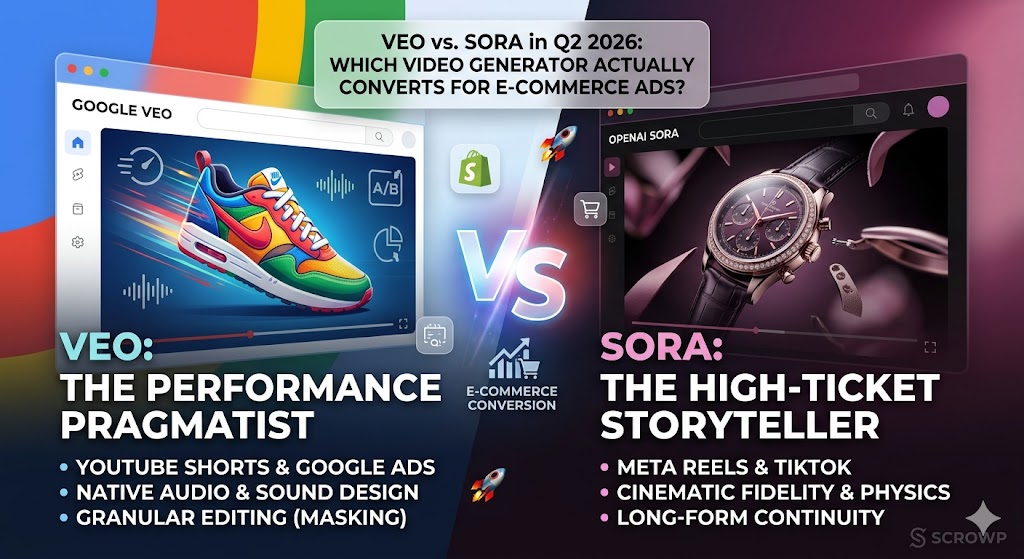
In Q2 2026, the e-commerce landscape is entirely video-first. Consumers no longer read static product descriptions; they expect dynamic, hyper-personalized video content before making a purchasing decision. For Shopify store owners, high-ticket dropshippers, and digital solopreneurs, the barrier to entry for high-quality video production has been obliterated by Generative AI.
But a critical divide has emerged. The debate is no longer about whether to use AI-generated video for marketing; it is about which model actually drives Return on Ad Spend (ROAS).
Currently, the market is dominated by two titans: Google’s Veo and OpenAI’s Sora. Both generate breathtakingly realistic video from text prompts, but they are fundamentally engineered for different use cases. If you are burning ad budget on the wrong model, you are actively losing conversions.
Here is the definitive, data-backed breakdown of Veo vs. Sora in 2026, and exactly which tool you should deploy to scale your e-commerce ads.
The 2026 AI Video Landscape: Moving Past the Hype
We are past the novelty phase. In 2024, generating a somewhat realistic video of a cat riding a skateboard was enough to go viral. Today, Generative Engine Optimization (GEO) and direct-response marketing require intent-driven realism, brand consistency, and native audio.
To survive in this ecosystem, digital entrepreneurs must leverage video generators that offer high information density and immediate visual hooks. The integration of generative AI into search and discovery means your video ads aren’t just competing on social feeds; they are appearing in multimodal search results.
Google Veo: The Performance Marketer’s Pragmatist
Google Veo has rapidly become the darling of performance marketers. Why? Because it is deeply integrated into the Google Ads and YouTube Shorts ecosystem. Veo isn’t just about making pretty videos; it is about making videos that prompt users to click.
Core Conversion Strengths
- Native Audio & Sound Design: Veo natively generates synchronized audio alongside the video. For e-commerce, this means product sounds (e.g., the snap of a luxury watch clasp, the sizzle of cookware) are perfectly timed, increasing perceived product quality and viewer retention.
- YouTube Shorts Synergy: Veo is heavily optimized for vertical formats and fast-paced editing, making it the superior choice for YouTube Shorts campaigns.
- Granular Editing (Masking): Veo allows advertisers to use prompt-based masking to change specific elements of a video (e.g., changing the color of a sneaker without altering the background). This is invaluable for rapid A/B testing of product variants.
The Verdict on Veo
If you are running high-volume, low-to-mid ticket dropshipping, Veo’s fast generation times and seamless Google Ads integration make it a ruthless conversion machine. It prioritizes direct response over cinematic flair.
OpenAI Sora: The High-Ticket Storyteller
Sora burst onto the scene with unparalleled cinematic quality. By Q2 2026, OpenAI has refined Sora into a powerhouse for brand building, complex visual storytelling, and high-ticket e-commerce where trust and perceived value are paramount.
Core Conversion Strengths
- Cinematic Fidelity & Physics: Sora understands real-world physics better than any other model. If you are selling high-ticket items (e.g., modular furniture, complex tech gadgets), Sora can generate hyper-realistic use-case scenarios that look like they were shot on a RED camera.
- Long-Form Continuity: Sora excels at maintaining object permanence and character consistency over longer durations. This is crucial for top-of-funnel (ToFu) educational ads or brand manifesto videos.
- Creative Flexibility: Sora allows for wildly imaginative transitions and environments, making it ideal for scroll-stopping “pattern interrupt” ads on TikTok and Meta.
The Verdict on Sora
If you are selling high-ticket products or building a long-term brand where aesthetic perfection is required to justify the price tag, Sora is your uncontested champion.
Data Deep Dive: Veo vs. Sora for E-Commerce Ad Performance
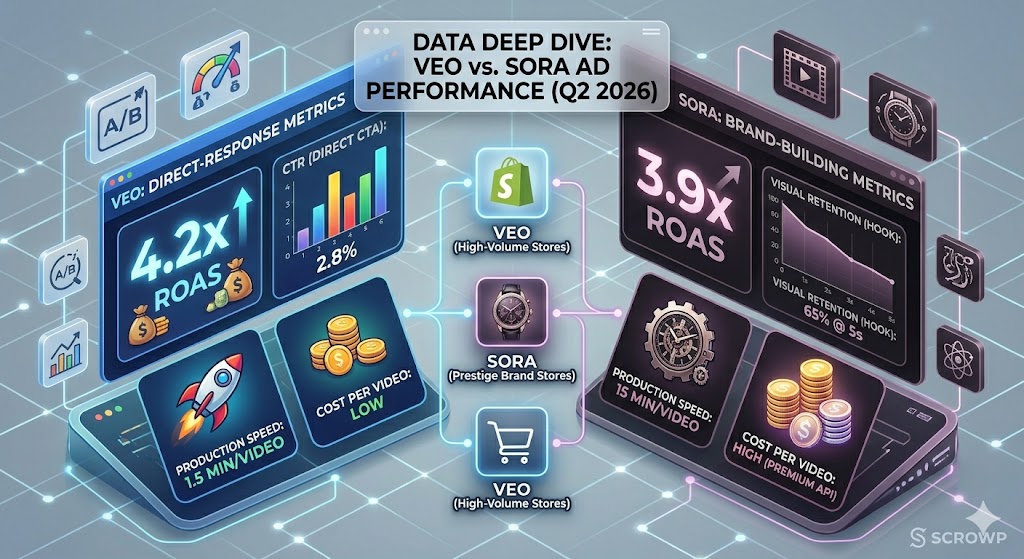
To understand the practical application, let’s look at the baseline performance metrics observed by media buyers in Q2 2026.
| Metric / Feature | Google Veo | OpenAI Sora | E-Commerce Implication |
| Primary Strength | Speed, Native Audio, A/B Testing | Cinematic Realism, Physics, Continuity | Veo wins for scaling variants; Sora wins for brand prestige. |
| Ideal Ad Format | YouTube Shorts, Direct Response | Meta Reels, TikTok, Top-of-Funnel | Match the tool to your primary traffic source. |
| Audio Generation | Native & Synchronized | Requires secondary tooling/post-production | Veo significantly reduces post-production time. |
| Average Production Cost | Lower (integrated into Workspace/Ads) | Higher (Premium API/Subscription tiers) | Sora requires a higher AOV to justify production scaling. |
| Product Consistency | High (via specific image prompting) | Very High (maintains physics across angles) | Both are excellent, but Sora handles complex 3D rotation better. |
| Typical CTR Impact | +15% on direct CTA prompts | +22% on visual hook retention | Sora stops the scroll better; Veo drives the click faster. |
Strategic Implementation: Matching the Tool to the Offer
Stop treating AI as a one-size-fits-all solution. Your strategy must dictate your tool. Knowing how to use AI videos to make money online requires matching the medium to the message.
Strategy 1: The Volume Game (Low-Ticket Shopify Stores)
If you are selling impulse-buy products under $50, your priority is volume and testing.
- Use Veo to generate 20 variations of a product in use.
- Utilize Veo’s masking feature to swap background environments (e.g., beach vs. city) and product colors.
- Deploy these via Google Performance Max and YouTube Shorts. The native audio will save you hours of editing, allowing you to launch and kill campaigns quickly based on CPA data.
Strategy 2: The Prestige Game (High-Ticket E-commerce)
If your AOV (Average Order Value) is over $300, trust is your biggest bottleneck. Customers need to see the product interacting perfectly with the real world.
- Use Sora to create cinematic, lifestyle-oriented videos.
- Focus on complex camera movements (e.g., a drone shot pushing through a window to reveal your high-end furniture).
- Deploy these assets on Meta and TikTok to build a premium brand halo. The visual fidelity will justify your price point and increase your conversion rate on the landing page.
Conclusion: The Verdict on ROI
In Q2 2026, the question isn’t whether Veo is “better” than Sora. The question is which model aligns with your e-commerce funnel.
- Choose Google Veo if you prioritize speed, rapid A/B testing, native audio, and direct-response metrics on Google networks.
- Choose OpenAI Sora if you require cinematic perfection, complex physical interactions, and are building a premium, high-ticket brand on social platforms.
Mastering both tools—and knowing when to deploy each—is the ultimate competitive advantage for modern digital entrepreneurs.
Frequently Asked Questions
Can I use my own product images to generate videos in both Veo and Sora?
Yes, both models support image-to-video generation in 2026. You can upload a high-quality static image of your product and prompt the AI to animate it within a specific environment. However, Sora generally maintains stricter geometric consistency for complex, multi-angle product rotations.
Do these AI videos get flagged or penalized by ad networks?
As long as the content adheres to platform policies regarding deceptive practices, AI-generated videos are not inherently penalized. In fact, platforms like Google actively encourage the use of their native AI tools (like Veo) for ad creation. Transparency is key; ensure the video does not misrepresent the actual physical product’s capabilities.
Which tool is more cost-effective for a solo dropshipper just starting out?
Google Veo tends to be more cost-effective for solopreneurs due to its tighter integration with Google Workspace and Google Ads, often providing streamlined generation quotas tied to existing ad spend. Sora’s high-fidelity generations typically require premium API access or higher-tier OpenAI subscriptions, making it slightly more expensive at scale.
How do I handle voiceovers for these AI video ads?
While Veo offers impressive native audio and sound effects, standard practice for high-converting ads involves using dedicated AI voiceover tools (like ElevenLabs) and overlaying them in an editing software like CapCut or Premiere. This allows for precise timing of the script against the AI-generated visual hooks.
Read Next
- Free vs Premium Shopify Themes: Building Your Ecommerce Empire on a Budget
- AI-Generated Video for Marketing in 2026: Tools, Examples & Tips
- The Dawn of a New Era: The Future of Search with Generative AI
- The Visual Revolution: How to Use AI Videos to Make Money Online