 By
By 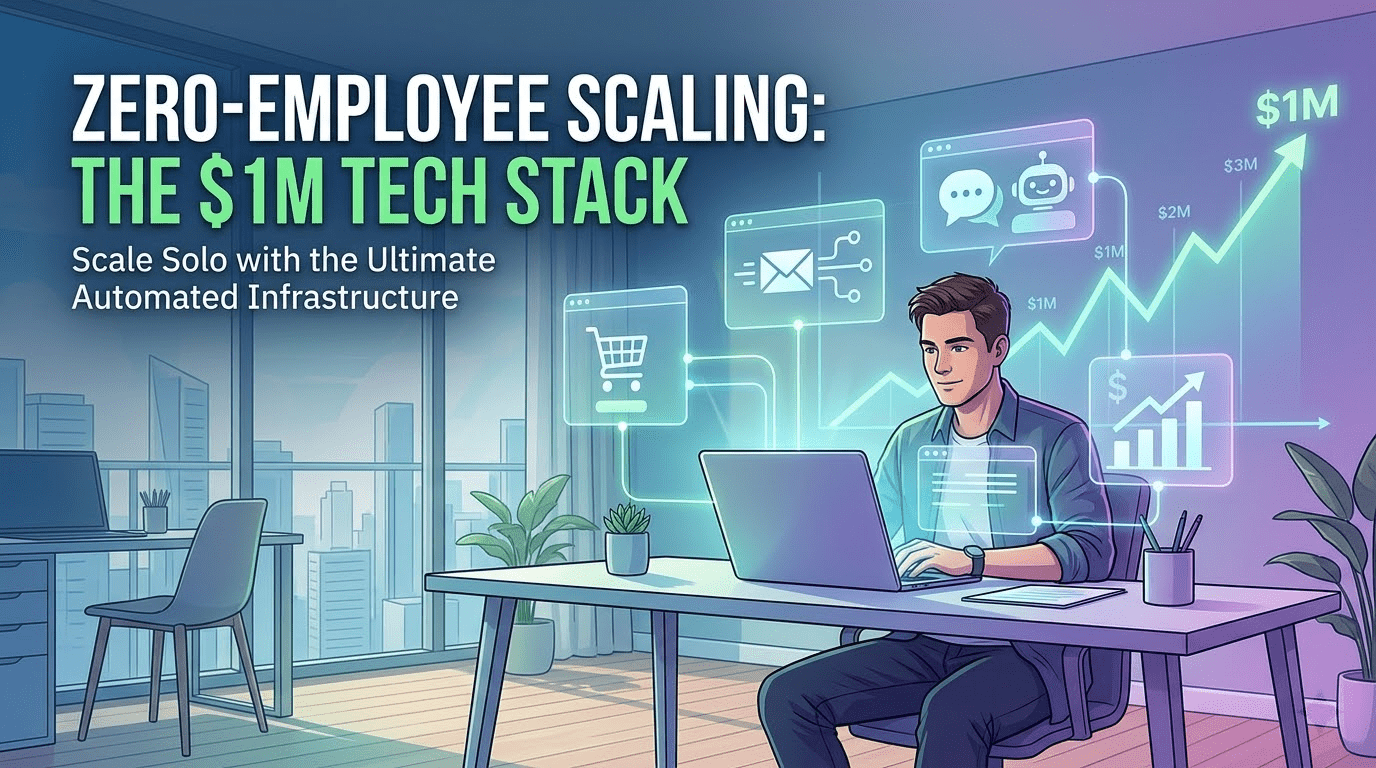
The era of scaling an e-commerce brand by simply throwing more human capital at the problem is over. For digital entrepreneurs, Shopify store owners, and high-ticket dropshippers, the new benchmark of operational excellence is zero-employee scaling.
Scaling to $1,000,000 in annual revenue—roughly $83,333 per month—used to require a bloated infrastructure. You needed a customer service team, a media buyer, a supply chain manager, and an in-house copywriter. Today, that entire organizational chart can be replaced by a meticulously architected tech stack.
By leveraging automation, artificial intelligence, and specialized software, solopreneurs are building lean, highly profitable, one-person micro-enterprises. This approach eliminates payroll tax, management overhead, and human error, allowing founders to maintain unprecedented profit margins.
If you are tired of managing freelancers and want to focus purely on high-leverage growth activities, you are in the right place. This guide breaks down the definitive zero-employee tech stack required to cross the $1M revenue threshold.
The Paradigm Shift: Why the “Zero-Employee” Model Wins
The internet has democratized distribution, but AI and advanced middleware have democratized execution. The concept of the “one-person unicorn” is no longer a myth; it is a mathematical reality driven by scalable infrastructure.
The Death of Traditional Agency Dependency
Historically, hitting seven figures required delegating complex tasks to expensive digital marketing agencies. These agencies often charged massive retainers while delivering generic, templated strategies. In 2026, the tech landscape has shifted the power back to the founder.
Through Generative Engine Optimization (GEO) and AI-assisted programmatic media buying, a solo operator can now out-execute a mid-sized agency. You do not need a team of writers when you can algorithmically generate optimized landing pages based on real-time search intent.
Profit Margin Over Gross Revenue
Revenue is a vanity metric if your payroll consumes 40% of your cash flow. The zero-employee model prioritizes EBITDA (Earnings Before Interest, Taxes, Depreciation, and Amortization) over sheer gross volume.
By keeping operational expenses restricted entirely to variable software costs and ad spend, solopreneurs protect their downside risk. When the market fluctuates, a zero-employee business does not have to worry about layoffs. You simply scale down your server loads and ad budgets with a single click.
The Foundation: Storefront and Infrastructure
Your digital storefront is your hardest-working employee. It operates 24/7, never calls in sick, and handles thousands of concurrent requests without complaining. However, the wrong infrastructure will quietly kill your conversion rates.
The Conversion-Obsessed Shopify Setup
Shopify remains the undisputed champion for solo e-commerce operators due to its unparalleled ecosystem and reliability. But an out-of-the-box Shopify store is not enough to hit $1M. You must optimize for ultra-fast load speeds and frictionless checkout experiences.
To achieve this without bloating your store with dozens of conflicting apps, you need a highly optimized foundation. Implementing a high-performance Shopify theme designed natively for mobile conversion is non-negotiable.
By utilizing built-in features like sticky add-to-carts, volume discounts, and mega menus within a single theme architecture, you reduce reliance on third-party scripts. This dramatically improves your Core Web Vitals, leading to higher organic rankings and cheaper ad costs.
High-Ticket Dropshipping and 3PL Automation
To operate solo, you cannot touch inventory. Picking, packing, and shipping are low-leverage tasks that will immediately cap your revenue potential. You have two highly scalable paths:
- High-Ticket Dropshipping: Partnering with domestic B2B suppliers who drop-ship high-value items (e.g., $1,500+ home saunas or industrial equipment). You process the payment, and their warehouse handles the freight.
- Automated 3PL (Third-Party Logistics): If you own your brand, forward all manufacturing directly to a tech-enabled 3PL like ShipBob or Flexport.
Integration is the key here. Your Shopify store must connect to your supplier’s inventory feed via API or EDI (Electronic Data Interchange). When a customer buys from you, the purchase order and shipping label must be generated at the warehouse automatically, requiring zero manual data entry.
The Marketing Tech Stack: Omnichannel Presence Solo
Marketing as a solopreneur requires you to act as a media company. You must generate omnipresence across search engines, social media platforms, and email inboxes without spending 80 hours a week creating content.
Programmatic SEO and Generative AI
Relying solely on paid ads is a fragile business model. You need a compounding layer of organic traffic. To execute this solo, you must master programmatic SEO—the automated creation of hundreds of search-optimized landing pages targeting long-tail commercial intent.
By combining massive keyword datasets with advanced AI frameworks, you can systematically dominate search engine results. Learning how to properly optimize your SEO with AI allows you to generate localized landing pages, dynamic product descriptions, and highly relevant blog clusters at scale.
The Solo SEO Workflow:
- Use Ahrefs or Semrush to extract thousands of low-competition, high-intent keywords.
- Route this data through an API integration with Claude 3.5 Sonnet or GPT-4o.
- Automatically push the optimized HTML directly into Shopify or WordPress using a webhook.
AI Video Production and Dynamic Ad Creative
Video is the undisputed king of top-of-funnel conversion. But traditionally, shooting and editing ad creatives required massive budgets and production crews. Today, you can automate this entire silo.
Leveraging platforms that generate AI-generated video for marketing allows you to turn static product URLs into dynamic, high-converting TikTok and Facebook ads in minutes.
- Midjourney / Gemini 3 Flash Image: Generate hyper-realistic lifestyle imagery of your products in various environments without a photographer.
- ElevenLabs: Create ultra-realistic voiceovers for your video ads based on high-converting copywriting frameworks.
- CapCut Pro / Opus Clip: Automate the editing process, applying dynamic captions and viral pacing with a single click.
Email and SMS Lifecycle Automation
Your backend marketing determines your ultimate profitability. If you are not automating your customer retention, you are leaving hundreds of thousands of dollars on the table. Klaviyo is the industry standard for automated lifecycle marketing.
A solo founder must build these four automated flows immediately:
- The Welcome Series: A 3-to-5 part sequence educating new subscribers on your brand value and incentivizing the first purchase.
- Site & Browse Abandonment: Triggering personalized emails displaying the exact product a user viewed but did not add to their cart.
- Abandoned Cart / Checkout: Multi-channel sequences (Email + SMS) designed to recover lost revenue using dynamic urgency and discount ladders.
- Post-Purchase Upsell & Replenishment: Automatically pitching complementary products or subscription refills based on the exact item purchased.
The Customer Experience Stack: 24/7 Support Without Payroll
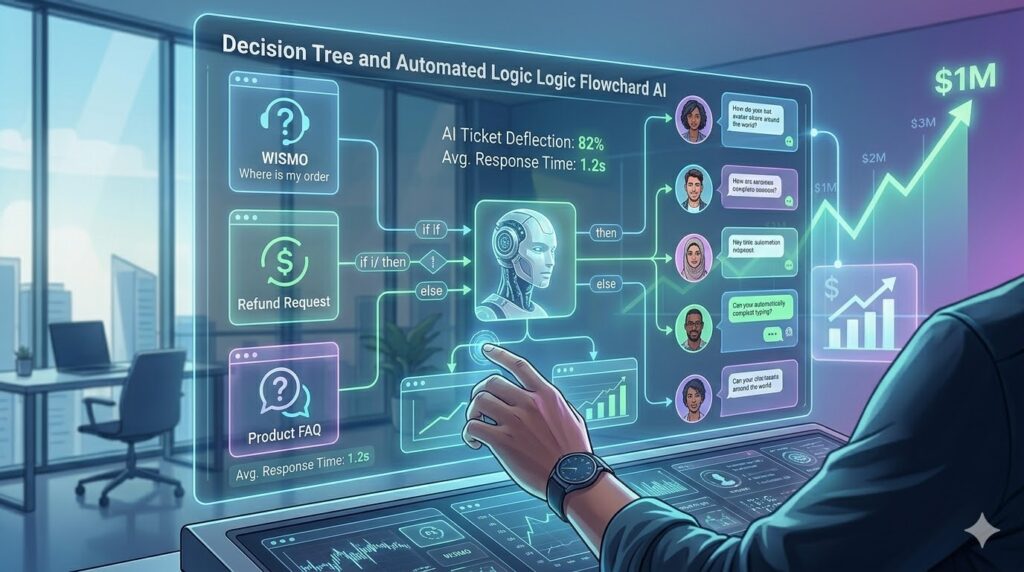
Customer support is typically the first bottleneck for a scaling e-commerce business. Answering “Where is my order?” (WISMO) tickets all day will drain your energy and halt your growth.
Conversational AI and Helpdesk Aggregation
To provide world-class support as a one-person team, you need a centralized, AI-powered helpdesk like Gorgias or Zendesk. These tools integrate deeply with Shopify, pulling in customer order data instantly.
How to automate 80% of your support tickets:
- Deploy an AI Chatbot: Train a generative AI agent on your store’s policies, shipping times, and product FAQs. It will instantly resolve standard queries without human intervention.
- Automate WISMO Inquiries: Set up logic rules that automatically detect tracking-related emails. The system instantly replies with the carrier link and current shipping status.
- Macro Templates: For the remaining 20% of complex queries, use pre-written macros to resolve tickets in two clicks rather than typing out manual responses.
The Operations and Finance Stack: Keeping the Machine Running
The invisible glue that holds a zero-employee business together is middleware and precise financial tracking. Without strict operational architecture, the system will collapse under the weight of its own scale.
Middleware: The Digital Nervous System
Middleware acts as the connective tissue between your disparate software tools. Make.com (formerly Integromat) or Zapier are essential for the solo operator. They allow you to create complex, conditional logic without writing a single line of code.
Crucial Solopreneur Automations:
- Fraud Detection: If Shopify flags an order as high-risk, a webhook instantly alerts you via Slack or SMS to verify the transaction before the supplier ships it.
- Review Aggregation: When a customer leaves a 5-star review on Loox or Yotpo, automatically push that text to a Google Sheet and generate a social media graphic via a Canva API.
- Inventory Syncing: Ensure your storefront never oversells by setting up hourly syncs between your supplier’s FTP server and your Shopify backend.
Financial Automation and Attribution
When you are scaling to $1M solo, you cannot afford to wait until the end of the month to understand your cash flow. You need real-time clarity on your unit economics and ad performance.
- TripleWhale or Northbeam: These platforms act as your fractional CFO and Chief Marketing Officer. They use first-party pixel data to track exactly which ads are driving revenue, bypassing iOS tracking limitations.
- QuickBooks Online + A2X: Automatically reconcile your Shopify payouts, Stripe fees, and PayPal transactions directly into your general ledger. This ensures you are always ready for tax season without hiring a full-time bookkeeper.
The Ultimate Solopreneur Tech Stack Comparison
To make immediate deployment easier, here is a quick-reference breakdown of the definitive zero-employee scaling stack.
| Business Function | Legacy Human Role | The Solopreneur Tech Solution | Core Benefit for Solo Founders |
| Storefront & UI | Front-End Developer | Shopify + Scrowp Theme | High-speed conversion without custom coding or bloated app stacks. |
| Fulfillment | Warehouse Manager | Automated 3PL / EDI Feeds | 100% hands-off inventory management and order routing. |
| Media Buying | Paid Ads Agency | Advantage+ (Meta) / PMax | Algorithmic budget allocation optimized by machine learning. |
| Copywriting & SEO | Content Team | ChatGPT-4o / Claude 3.5 | Instant programmatic SEO content and ad copy generation at scale. |
| Retention | Email Marketer | Klaviyo (Automated Flows) | Generates 20-30% of total store revenue while you sleep. |
| Customer Support | Support Agents | Gorgias + AI Agents | Deflects up to 80% of repetitive customer inquiries instantly. |
| Data Tracking | Data Analyst | TripleWhale | Pinpoint accurate ad attribution and real-time profit tracking. |
Step-by-Step Blueprint: Crossing the $1M Mark
Technology alone will not build a seven-figure business. You need a phased strategic approach to deploy this stack effectively.
Phase 1: 0 to $10k/month (Validation)
In the beginning, keep it brutally simple. Your only goal is validating the offer and the market.
- Launch a lean Shopify store using a high-conversion theme.
- Manually test ad creatives on Meta and TikTok using small budgets.
- Handle customer support yourself to intimately understand your buyers’ pain points and objections.
- Do not over-automate yet. Focus purely on generating consistent, profitable frontend sales.
Phase 2: $10k to $50k/month (Systematization)
Once you have product-market fit, the system will start breaking. This is where the tech stack takes over.
- Integrate Gorgias to handle the influx of support tickets.
- Build out your comprehensive Klaviyo email flows to maximize Customer Lifetime Value (LTV).
- Implement Make.com to automate order routing and inventory synchronization with your suppliers.
- Begin utilizing AI to generate programmatic SEO content, building your organic moat.
Phase 3: $50k to $83.3k+/month (Scaling)
At this stage, you are pushing towards the $1M annual run rate. Your focus shifts entirely to high-level strategy and capital allocation.
- Deploy TripleWhale to aggressively scale your winning ad campaigns with pinpoint attribution data.
- Use AI video generation tools to rapidly test hundreds of creative variations per week.
- Optimize your pricing and backend upsell funnels to increase Average Order Value (AOV).
- Maintain the zero-employee ethos by ruthlessly cutting out any task that can be replaced by an API call.
Actionable Summary: Your Next Steps to Solo Scaling
Crossing the $1M mark without hiring a single employee is the ultimate flex in modern digital entrepreneurship. It requires discipline, a willingness to adopt emerging technologies, and a ruthless focus on high-leverage activities.
Your immediate action items:
- Audit your current tech stack. Remove any app or software that does not directly contribute to revenue generation, conversion optimization, or time saving.
- Automate your biggest bottleneck today. If customer service is draining you, set up an AI helpdesk. If fulfillment takes hours, build a Make.com integration.
- Prioritize retention. Ensure your Klaviyo automated flows are active and optimized. The easiest way to hit seven figures is to sell to your existing buyers twice.
- Embrace AI execution. Stop typing out blog posts and manual ad copy. Build systems that generate high-quality assets algorithmically.
The technology exists. The blueprint is proven. Your ability to scale is now limited only by the quality of the systems you build.
Frequently Asked Questions (FAQ)
Can any e-commerce business model work with a zero-employee structure?
While most digital models can be highly automated, this structure works best for high-ticket dropshipping, digital products, and brands utilizing automated 3PLs. Businesses requiring custom manufacturing, bespoke packaging in-house, or complex physical quality control are harder to scale strictly solo.
How much does this exact tech stack cost per month?
Depending on your order volume, a robust zero-employee stack (Shopify, Klaviyo, Gorgias, Make.com, TripleWhale) typically ranges between $500 to $1,500 per month. Compared to a single entry-level employee’s salary ($3,000+ per month plus taxes and benefits), the ROI of this software suite is astronomical.
Will AI customer support ruin my brand’s reputation?
Not if configured correctly. Modern AI agents do not sound like robotic phone trees from 2010. They use natural language processing to answer standard queries conversationally. Crucially, they should always offer a clear escalation path, allowing the customer to leave a message for you (the human) if the issue is highly complex.
Is it really possible to manage $1M in ad spend solo?
Absolutely. Advertising platforms have shifted heavily toward algorithmic optimization (e.g., Meta Advantage+ and Google Performance Max). The platforms’ machine learning does the heavy lifting of bidding and audience targeting. Your only job as a solo media buyer is to continuously feed the algorithm high-converting creatives.
Read Next
Build a stronger, more profitable digital ecosystem by exploring these essential resources:
- Scrowp Shopify Theme
- Dropservicing: Outsource Services, Scale Your Business
- How to optimize your SEO with AI?
- AI-Generated Video for Marketing in 2026: Tools, Examples & Tips
- AI: The Digital Marketing Revolution