 By
By 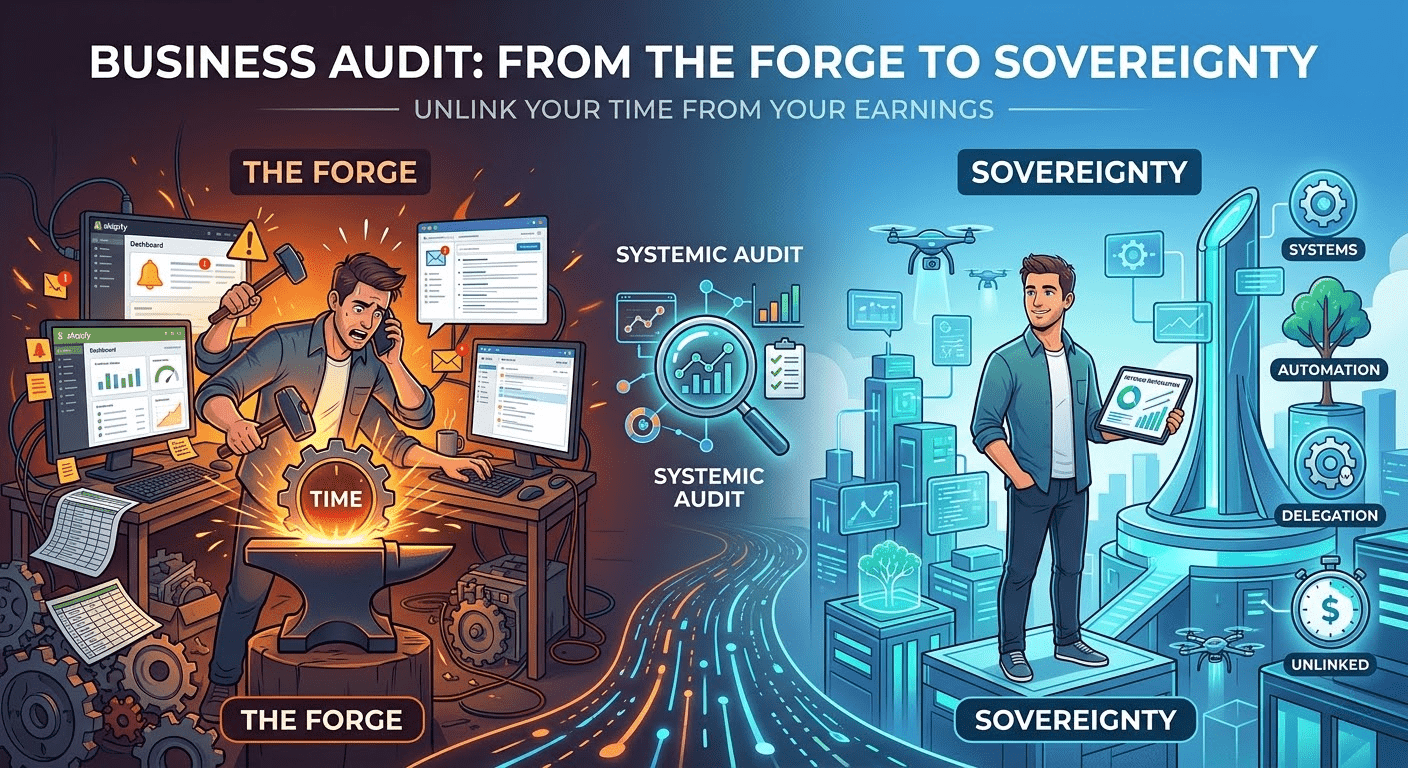
Every digital entrepreneur starts in “The Forge.” This is the gritty, high-friction environment where you hammer out your business model through sheer willpower. You wear every hat, manage every customer service ticket, optimize every ad campaign, and build every funnel.
For high-ticket e-commerce founders, agency owners, and digital solopreneurs, The Forge is a necessary rite of passage. But it is a terrible place to live.
If your revenue is entirely dependent on your daily active input, you do not own a business; you own a highly demanding, glorified job. The transition from operator to owner—from The Forge to Sovereignty—requires a radical, systemic audit of your current business reality.
This guide is your blueprint to identifying operational inefficiencies, delegating low-leverage tasks, and completely unlinking your time from your earnings. We will dissect your business layer by layer to build a machine that scales without your constant supervision.
The Core Problem: Why You Are the Biggest Bottleneck in Your Business
Entrepreneurs are naturally inclined to control every variable. In the early stages, this obsession with quality ensures survival. However, as your transaction volume increases, this exact trait becomes your greatest liability.
When you refuse to build systems, you create an artificial ceiling on your revenue. If you must personally approve every creative, check every order, or close every sales call, your income is mathematically capped by the 24 hours in a day.
To achieve sovereignty, you must adopt a systems-thinking paradigm. You need to view your business as an ecosystem of interlocking gears. Your role is no longer to turn the gears manually, but to engineer a better machine. For a deeper understanding of this mindset shift, you can read our guide on escaping the solopreneur trap and building resilient systems.
Phase 1: The Time and Energy Audit (Where Are You Bleeding Resources?)
Before you can optimize your business, you must face the reality of how you actually spend your time. Most founders believe they spend their days on high-level strategy, but a real audit usually reveals a different, far less flattering picture.
Tracking the “Shadow Tasks”
Shadow tasks are the tiny, repetitive actions that silently drain your day. Answering a quick Slack message, manually fulfilling an order, or fixing a minor website bug might only take five minutes, but they destroy your deep-work focus.
Action Step: For the next 72 hours, audit your time in 15-minute increments.
- Log Everything: Use a simple spreadsheet or a tool like Toggl.
- Be Brutally Honest: If you spent 30 minutes scrolling Twitter disguised as “competitor research,” write it down.
- Categorize by Value: Assign an hourly value to every task ($10/hr, $100/hr, $1,000/hr, $10,000/hr).
If you are a CEO spending four hours a day on $10/hr tasks, you are actively stealing from your own company’s potential.
The E-commerce and Agency Eisenhower Matrix
Once you have your time log, you must ruthlessly filter your tasks using a modified Eisenhower Matrix tailored for digital businesses.
- Eliminate: Tasks that do not drive revenue or customer satisfaction. (e.g., obsessive micro-management of ad copy that is already converting).
- Automate: Tasks that follow a strict logical rule. (e.g., onboarding emails, abandoned cart sequences, basic invoice generation).
- Delegate: Tasks that require human intelligence but not your specific intelligence. (e.g., tier-1 customer support, basic media buying, social media posting).
- Elevate: High-leverage, $10,000/hr tasks only you can do. (e.g., strategic partnerships, high-level brand positioning, negotiating supplier contracts).
Phase 2: The Financial Efficiency Audit (Are You Profitable or Just Busy?)
Revenue is a vanity metric; profit is sanity; cash flow is reality. Many e-commerce stores scale their front-end revenue while their back-end margins collapse under the weight of inefficient operations.
Analyzing True Cost Per Acquisition (CPA) and Lifetime Value (LTV)
You cannot automate a business that is fundamentally unprofitable. You must audit your unit economics to ensure your model is structurally sound before pouring fuel on the fire.
- Gross Margin Analysis: Are your suppliers eating into your profits? If you are a high-ticket dropshipper, a 5% increase in supplier costs can wipe out your net margin.
- True CPA: Factor in all costs to acquire a customer, including software subscriptions, agency retainers, and payment processor fees—not just your Facebook Ads ROAS.
- LTV Optimization: A sovereign business thrives on recurring revenue and repeat buyers. If your LTV to True CPA ratio is less than 3:1, you have a structural flaw that systems alone cannot fix.
Identifying and Cutting Margin Bleeders
Margin bleeders are the bloated expenses that accumulate unnoticed over time. These often include unused SaaS subscriptions, inefficient ad spend on low-performing demographic segments, and overpaying for underperforming contractors.
Perform a strict line-by-line audit of your last 90 days of bank and credit card statements. Cancel every software tool that hasn’t directly contributed to revenue or saved time in the last 30 days. Consolidate your tech stack. If you need a framework for streamlining your software costs, check out our insights on lean tech stacks for high-ticket e-commerce.
Phase 3: The Systems and SOP Breakdown
A business without Standard Operating Procedures (SOPs) relies entirely on tribal knowledge stored in the founder’s head. This makes delegation impossible and burnout inevitable.
Documenting the “Unwritten Rules”
Sovereignty requires transferring your internal logic into an external database. You must build an operational playbook that allows a competent stranger to step in and run 80% of your business tomorrow.
How to build SOPs without slowing down:
- Record Your Screen: Do not sit down to write a manual. Instead, use a tool like Loom. Every time you perform a routine task (e.g., launching a new ad campaign, responding to a refund request), record your screen and narrate your thought process.
- Transcribe and Format: Have an assistant or an AI tool transcribe the video and format it into a step-by-step checklist.
- Centralize in a Wiki: Store these documents in a searchable database like Notion or Slite.
Your goal is to build an asset that acts as the “brain” of your company.
Visualizing the Transformation: The Sovereign Operations Shift
To illustrate the difference between a founder stuck in The Forge and a Sovereign Founder, review this quick-reference breakdown of common e-commerce workflows.
| Business Function | “The Forge” (Manual & Bottlenecked) | “Sovereignty” (Systematized & Scalable) |
| Customer Support | Founder answers all emails via Gmail. | Offshore team uses Gorgias with macro-templates & AI triage. |
| Order Fulfillment | Manual spreadsheet exports to suppliers. | Automated API routing via Zapier/Make directly to 3PL. |
| Content Creation | Founder writes and schedules every post. | Content team repurposes core pillar content via SOPs. |
| Financial Tracking | End-of-month panic with messy receipts. | Bookkeeper reconciles weekly; automated KPI dashboards via Databox. |
| Growth Strategy | Randomly testing new hacks and trends. | 90-day disciplined sprints based on LTV data and market feedback. |
Phase 4: Unlinking Your Time from Earnings
With your time audited, finances secured, and operations documented, you are ready for the final transition. This is where you physically detach your personal hours from the revenue-generation engine.
Implementing High-Leverage Automations
Software is the ultimate employee. It never sleeps, never complains, and executes with 100% precision. You must audit the gaps between your current software tools and build bridges using automation platforms like Zapier or Make.
Core Automations to Implement Immediately:
- The Post-Purchase Flow: When a customer buys, trigger an automated sequence that sends a welcome email, updates the fulfillment spreadsheet, and adds them to a custom retargeting audience.
- Inventory Alerts: Automate Slack or email notifications when high-ticket inventory drops below a specific threshold, preventing stockouts and lost revenue.
- Lead Nurturing: If you run an agency, automate your calendar bookings to instantly trigger CRM updates, client onboarding forms, and contract generations.
Assembling a Lean, Autonomous Team
You do not need a massive corporate structure to achieve sovereignty. A lean, specialized team of A-players, guided by strict KPIs, will consistently outperform a large, bloated workforce.
- Hire for Ownership, Not Just Skills: When bringing on an operator, an ads manager, or a customer service lead, you want individuals who take ownership of the outcome, not just the task.
- The Operator / Integrator: The most critical hire you will ever make is a Chief Operating Officer (COO) or a high-level Project Manager. This person acts as the filter between you and the rest of the team. For tips on structuring this relationship, refer to our comprehensive breakdown on hiring your first e-commerce integrator.
The Sovereignty Action Plan: Your Next 90 Days
Knowledge without execution is merely entertainment. To transform your current reality, you must treat this systemic audit as a high-priority project. Here is your 90-day roadmap to unlinking your time from your earnings.
Month 1: Discovery and Documentation
- Week 1: Execute the 72-hour time audit. Identify your top three $10/hr tasks and eliminate or delegate them instantly.
- Week 2: Conduct the financial audit. Cancel redundant software and renegotiate with your top two suppliers.
- Week 3: Start the Loom recording process. Record yourself performing the 10 most frequent operational tasks in your business.
- Week 4: Build your company Wiki in Notion. Organize your first 10 SOPs into clear departments (Marketing, Fulfillment, Customer Service).
Month 2: Automation and Delegation
- Week 5: Audit your tech stack. Map out your data flows on a whiteboard. Where does information get stuck?
- Week 6: Build out your primary Zapier/Make automations to connect your storefront, your CRM, and your fulfillment center.
- Week 7: Draft a job description for your first (or next) key hire. Focus on the tasks you outlined in the “Delegate” quadrant of your Eisenhower Matrix.
- Week 8: Conduct interviews. Test candidates with paid, real-world mini-projects rather than just asking theoretical questions.
Month 3: Optimization and Withdrawal
- Week 9: Onboard your new hire using the SOPs you built in Month 1. Let them rely on the documentation rather than asking you directly.
- Week 10: Implement strict KPI tracking. Give your team a dashboard (e.g., Triple Whale, Databox) so they know if they are winning or losing without you having to tell them.
- Week 11: The “Disappearance Test.” Take two full days completely off grid. Do not check Slack, email, or your Shopify dashboard.
- Week 12: Review what broke during your absence. These are your final operational bottlenecks. Build a system or an SOP to fix them, and step firmly into your new role as an owner.
Summary: Reclaiming Your Time and Scaling with Intent
The ultimate luxury of digital entrepreneurship is not a sports car or a penthouse; it is absolute control over your calendar.
Transitioning from The Forge to Sovereignty is not an overnight event. It is a methodical, systemic audit of your flaws, your bottlenecks, and your ego. By rigorously auditing your time, optimizing your financial unit economics, documenting your brain into SOPs, and leveraging automation and specialized talent, you build a business that serves you—instead of you serving it.
Stop acting as the most expensive, overworked employee in your own company. Audit your reality today, build the machine, and take back your time.

[Click Here to Get Your Copy Now]
Frequently Asked Questions
How long does it realistically take to step out of the daily operations of an e-commerce business?
For an established business doing consistent revenue, a dedicated founder can systematize operations and step back from daily tasks within 3 to 6 months. This requires aggressive delegation, SOP creation, and hiring a competent operator or manager to oversee the daily workflows.
What is the best way to track my team’s performance without micromanaging?
The key is shifting from managing people to managing outcomes. Establish 1-3 core Key Performance Indicators (KPIs) for every role. Use automated dashboards to track these metrics. If the KPIs are green, you stay out of their way; if they turn red, you step in to diagnose the system, not to criticize the person.
Do I need to know how to code to implement these high-leverage automations?
No. No-code and low-code platforms like Zapier and Make (formerly Integromat) use visual, drag-and-drop interfaces that allow you to connect APIs and automate complex data routing without writing a single line of code.
What should I do with my time once the business is running on systems?
Once you achieve operational sovereignty, your time should be redirected to maximum-leverage activities: building strategic partnerships, negotiating better supplier terms, exploring new market expansions, acquiring competitors, or simply enjoying the freedom you built the business to achieve.
Read Next
- Escaping the Solopreneur Trap: Building Resilient Systems
- The Lean Tech Stack for High-Ticket E-Commerce Brands
- Hiring Your First E-Commerce Integrator: A Step-by-Step Guide
- Maximizing LTV: Retention Strategies for Digital Agencies
- The 4-Hour E-Commerce Workweek: Myth or Reality?