 By
By 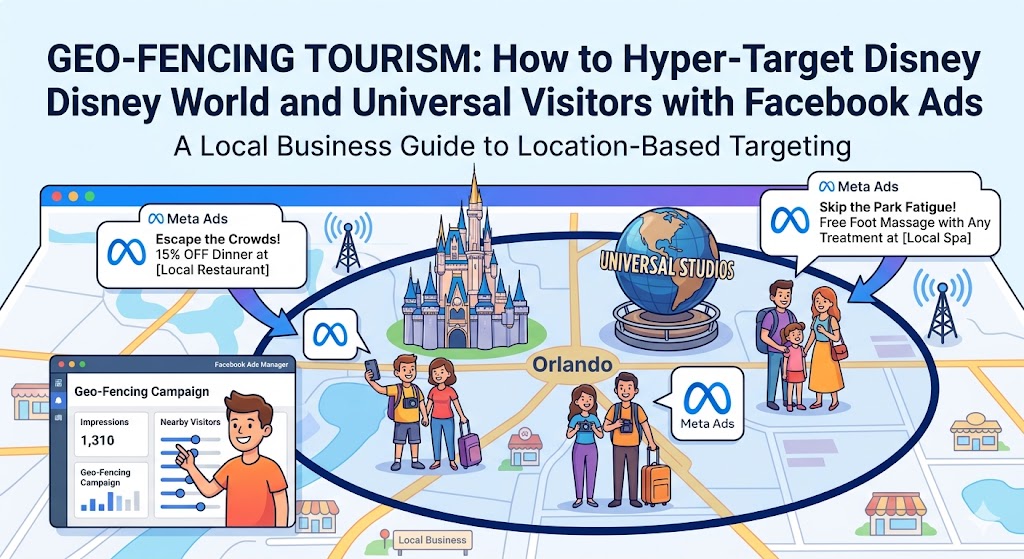
Orlando, Florida, is the undisputed theme park capital of the world. Every year, tens of millions of tourists flock to the city to experience the magic of Walt Disney World and the thrill of Universal Studios. For local businesses—restaurants, boutique shops, alternative attractions, and wellness centers—this massive influx of visitors represents a goldmine. However, tapping into this lucrative market requires more than just setting up shop on International Drive. While establishing a robust foundation through comprehensive search engine optimization is critical for long-term local discovery, tapping into the immediate tourist market requires hyper-targeted, short-term strategies
Tourists are distracted, overwhelmed with choices, and often stuck inside the “theme park bubble.” How do you break through the noise and pull them to your business? The answer lies in geo-fencing tourism.
By utilizing the advanced location-based targeting capabilities of Facebook (Meta) Ads, you can hyper-target these vacationers at the exact moment they are walking down Main Street U.S.A. or exploring the Wizarding World of Harry Potter. Geo-fencing allows you to draw a digital perimeter around these parks and deliver highly relevant, timely advertisements directly to the smartphones of potential customers.
In this comprehensive guide, we will explore how to successfully implement geo-fencing strategies to hyper-target Disney World and Universal visitors. You will learn how to navigate Meta’s ad platform, craft compelling messages that resonate with tourists, and ultimately drive foot traffic and revenue to your local business.
What is Geo-Fencing in Tourism Marketing?
Before diving into the technical setup, it is vital to understand what geo-fencing actually is and how it applies to the tourism sector.
The Concept of Geo-Fencing
At its core, geo-fencing is a location-based marketing strategy. It involves defining a specific geographic boundary—a “fence”—using GPS, RFID, Wi-Fi, or cellular data. When a mobile device enters or exits this predefined area, it triggers a marketing action. In the context of Facebook Ads, this action is the delivery of a targeted advertisement to the user’s social media feed.
Geo-Fencing vs. Traditional Location Targeting
Traditional location targeting might involve targeting an entire city or zip code (e.g., “Orlando, FL” or “32819”). While useful, this approach casts a wide net. You end up spending your advertising budget on local residents who are sitting at home, people running errands, or individuals who have no interest in vacation-oriented services.
Geo-fencing, or “hyper-targeting,” shrinks this net. It allows you to drop a pin directly onto the Cinderella Castle or the Universal Globe and target people within a precise 1-mile or 2-mile radius. This ensures that your ad dollars are spent exclusively on the people physically present at the attraction—the tourists.
Why It’s a Game-Changer for Tourism
For local businesses operating in the shadow of major attractions, geo-fencing levels the playing field. You do not need a multi-million dollar marketing budget to compete with the theme parks. You simply need to reach the right person, at the right time, with the right offer. When a family is exhausted after eight hours in the sun and your ad pops up offering a relaxing, sit-down meal just five minutes away, you solve a direct pain point using location-based relevance.
Why Target Disney World and Universal Studios Visitors?
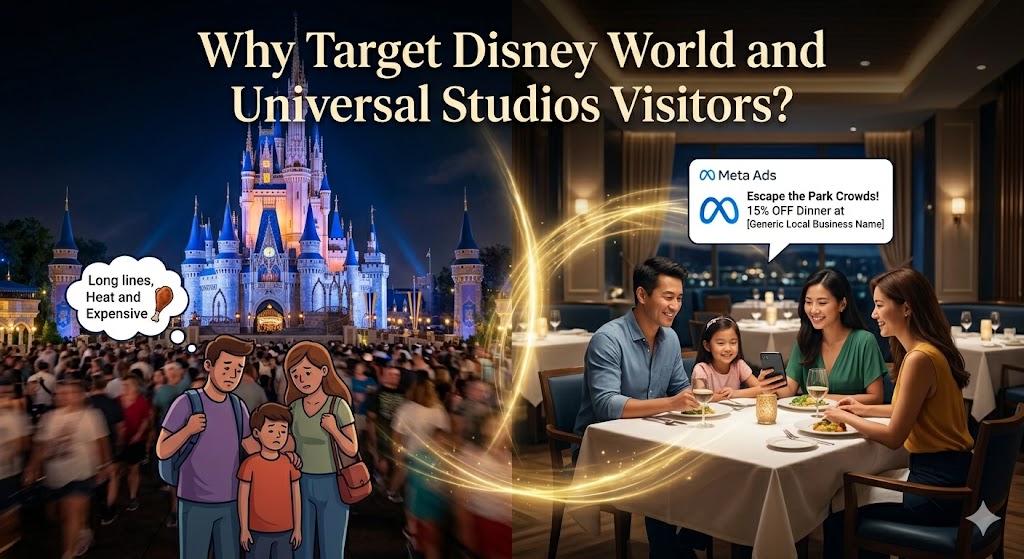
Understanding why these visitors are the perfect audience is essential for crafting the right ad copy and offers. The psychology of a tourist inside a major theme park makes them incredibly receptive to the right local marketing.
The Sheer Volume of Potential Customers
Walt Disney World alone spans over 27,000 acres and attracts roughly 58 million visitors annually. Universal Orlando Resort draws millions more. On any given day, hundreds of thousands of people are concentrated in these specific geographic zones. This creates an incredibly dense pool of potential customers scrolling through Facebook and Instagram while waiting in line for rides.
The Vacation Spending Mindset
Tourists are in a unique psychological state: the “vacation mindset.” When people are on holiday, their spending habits shift drastically. They are more willing to indulge, splurge on conveniences, and try new things. They have already committed to spending money, making them far more likely to convert on an ad for a premium dining experience, an upgraded rental car, or a unique local souvenir than a local resident would be.
The “Spillover” Effect and Pain Points
Theme parks are magical, but they are also exhausting. Visitors frequently experience “park fatigue.” They get tired of waiting in line, they become frustrated with premium park food prices, and they desperately need a change of pace.
This creates the “spillover” effect. Families frequently schedule “off-days” from the parks to explore the surrounding area. They look for places to eat outside the park gates to save money or find better quality. If your business can position itself as the perfect solution to their park-induced pain points, you will capture a highly motivated audience. Similar to optimizing local visibility for seasonal tourism hubs, capturing high-intent travelers requires understanding their immediate, localized needs.
Setting Up Your Facebook Ads for Geo-Fencing
Executing a geo-fencing tourism strategy requires precise configuration within Meta Ads Manager. If set up incorrectly, you risk wasting your budget on locals. Here is the step-by-step process for hyper-targeting Disney and Universal visitors.
Step 1: Choosing the Right Campaign Objective
Before drawing your digital fence, you must tell Facebook what you want to achieve. For local businesses targeting tourists, the most effective objectives are:
- Traffic: Best for sending visitors to a specific landing page (e.g., a restaurant reservation page or an online menu).
- Engagement: Excellent if you want tourists to message your page directly for inquiries or reservations. (Note: Paid engagement works best when your page already appears credible to visitors. If your profile is new, review these proven ways to increase Facebook page followers organically before launching your budget.)
- Sales/Conversions: Ideal if you are selling tickets to an off-site attraction or booking specific services online.
- Awareness (Specifically for Local Reach): Best if your primary goal is maximizing the number of tourists who see your brand, though this is generally less action-oriented.
Step 2: Navigating Location Targeting (The “Drop Pin” Method)
This is where the actual geo-fencing happens. By default, Facebook allows you to type in a city or zip code. Do not do this. Instead, utilize the “Drop Pin” feature.
- Navigate to the Ad Set level of your campaign.
- Scroll down to the Audience section and find Locations.
- Zoom in on the map to Orlando, Florida.
- Locate the specific parks. For example, zoom in on the cluster of Disney Parks (Magic Kingdom, Epcot, Hollywood Studios, Animal Kingdom) or the Universal Studios/Islands of Adventure area.
- Click Drop Pin and place it directly in the center of the park you wish to target.
Step 3: Adjusting the Radius
Once the pin is dropped, Facebook defaults to a 10-mile radius. In the context of geo-fencing, 10 miles is too broad—it will include residential areas of Orlando, Kissimmee, or Windermere.
Click on the radius dropdown and reduce it to 1 mile or 2 miles. You want the blue circle to encompass the park and the immediate resort hotels, but nothing else. You can drop multiple pins with 1-mile radiuses over each individual Disney park to create a custom-shaped geo-fence.
Step 4: The Crucial Setting—”People Recently in This Location”
Note: Meta periodically updates its location settings, but understanding the intent here is vital. In the past, Meta allowed advertisers to distinguish between “People living in this location,” “People recently in this location,” and “People traveling in this location.” Meta has since consolidated location targeting to “People living in or recently in this location.”
To filter out the Orlando locals who happen to be working at the parks or driving by, you must use Exclusions and Demographics.
Step 5: Layering Exclusions and Demographics
Since you cannot simply select “Travelers” anymore via the core location drop-down, you must layer your audience to isolate the tourists:
- Exclude Local Zip Codes: Drop a pin on the residential areas surrounding the parks and set them to “Exclude.”
- Interest Layering: Under “Detailed Targeting,” include interests like “Vacation,” “Tourism,” “Walt Disney World,” “Universal Studios Florida,” or “Theme park.”
- Behavior Layering: Target behaviors such as “Frequent Travelers” or “Currently Traveling.”
By combining a 1-mile radius around Epcot with the behavior “Currently Traveling,” you successfully hyper-target tourists while filtering out the park employees and locals.
Crafting Hyper-Targeted Ad Creatives
Getting your ad in front of a Disney or Universal visitor is only half the battle. If your ad looks generic, they will scroll past it. Your creative (image, video, and copy) must explicitly acknowledge their current context.
Address Their Current Situation
The best geo-fenced ads feel almost clairvoyant. They speak directly to what the user is experiencing at that exact moment.
- Instead of: “Come to Joe’s Steakhouse in Orlando.”
- Use: “Tired of theme park lines? Escape the crowds tonight. Joe’s Steakhouse is just 10 minutes from Universal Studios!”
Acknowledge the heat, the walking, the crowds, or the high prices of the parks. Show empathy for their situation and present your business as the ultimate oasis.
Leverage Urgency and Proximity
Tourists make impulsive decisions based on convenience. If they know you are close by, they are more likely to visit. Always highlight your proximity to the geo-fenced location.
- “Just a 5-minute Uber ride from Disney Springs!”
- “Show your Universal ticket stub today for 15% off your family’s dinner.”
- “Last day in Orlando? Don’t leave without visiting us—located right outside the Disney gates.”
Use words like “Tonight,” “Now,” and “Today” to trigger immediate action.
Using Dynamic Formats (Carousels and Video)
Tourists waiting in a 90-minute line for a roller coaster have time to kill. Engage them with rich media.
- Video Ads: Show a quick, mouth-watering 15-second video of your food being prepared, or a thrilling clip of your off-site attraction. Visuals of air-conditioned, relaxing spaces work wonders.
- Carousel Ads: If you are a restaurant, use a carousel to show your top 5 menu items. If you are a souvenir shop, showcase your best-selling, unique items that cannot be found inside the park.
Mobile Optimization is Non-Negotiable
Since you are targeting people physically inside a theme park, 100% of your audience will be viewing your ad on a mobile device. Ensure your images are vertically oriented (4:5 or 9:16 aspect ratio), your text is large and legible, and any landing page you send them to loads instantly on a 4G/5G connection.
Top Geo-Fencing Strategies for Different Local Businesses
Different businesses require different angles to successfully lure tourists away from the theme park bubble. Here is how various sectors can leverage this strategy.
1. Restaurants and Dining: The “Escape the Park” Angle
Dining inside Disney or Universal is famously expensive, and getting a reservation at a sit-down restaurant can be nearly impossible without months of planning.
The Strategy: Target the parks from 3:00 PM to 6:00 PM (when people are starting to think about dinner). The Message: Focus on value, quality, and immediate availability. Ad Copy Example: “Hungry after a long day at the park? Skip the $25 burgers. Get authentic, award-winning Italian food just 3 miles from the Magic Kingdom. No reservations required tonight! Click here for directions.”
2. Alternative Attractions: The “Off-Day” Strategy
Most families cannot afford (or lack the stamina) to go to a major theme park seven days in a row. They usually schedule one or two “off-days” to relax or do cheaper, local activities (e.g., mini-golf, escape rooms, local water parks, airboat tours).
The Strategy: Target the parks and the on-property resort hotels. The Message: Position your attraction as the perfect, low-stress, high-fun alternative for their rest day. Ad Copy Example: “Planning a day off from the parks tomorrow? Discover authentic Florida! Take a thrilling airboat tour through the Everglades just 20 minutes away. Half the price of a theme park ticket, double the adventure. Book your spot!”
3. Retail and Souvenir Shops: The “Last-Minute Gifts” Angle
Tourists want to bring home gifts, but in-park merchandise is highly priced.
The Strategy: Target the airport, the major resort hotels, and the parks with a focus on the end of the week (when people are packing up). The Message: Highlight unique, affordable, or bulk souvenirs. If you also sell these items online, use these physical store visits to capture customer emails, transitioning one-time tourists into a recurring audience to get sales easily for your Shopify store long after they return home.”
4. Spas, Wellness, and Recovery Services
Walking 10 to 15 miles a day around Epcot or Universal takes a physical toll. Spas, massage therapists, and IV hydration clinics can make a killing with geo-fencing.
The Strategy: Target the resort hotels in the evening and early morning. The Message: Focus on recovery, pain relief, and luxury. Ad Copy Example: “Feet aching from walking around the parks all day? Treat yourself to a luxury foot massage and spa treatment. We are located right outside the resort gates. Walk-ins welcome tonight!”
Budgeting and Bidding Strategies for Location-Based Ads
Running hyper-targeted ads requires a different budgeting approach than broad, national campaigns. Because your audience size is constrained by physical geography, your strategies must adapt.
Start Small and Scale What Works
Because your audience pool (the 1-mile radius) is relatively small compared to a nationwide audience, you do not need a massive daily budget. Starting with $15 to $30 a day per ad set is often enough to reach the people currently inside the geo-fence. Monitor your frequency (how many times the same person sees your ad). If your frequency creeps above 3.0 in a short period, your budget is too high for the audience size, and you risk ad fatigue.
Implementing Dayparting (Ad Scheduling)
Tourists follow predictable schedules. They wake up early to “rope drop” the parks, they eat lunch around noon, they hit an afternoon slump at 3:00 PM, and they leave for dinner around 7:00 PM.
Instead of running your ads 24/7, use Meta’s Ad Scheduling feature (available when using a Lifetime Budget).
- Run restaurant ads heavily between 3:00 PM and 7:00 PM.
- Run “off-day” attraction ads in the evenings when families are back at the hotel planning the next day.
- Run breakfast/coffee ads between 6:00 AM and 9:00 AM targeted at the resort hotels.
This ensures every dollar is spent when the user intent is at its absolute peak.
Overcoming Challenges: Privacy and Meta’s Updates
The digital marketing landscape is constantly shifting, primarily regarding user privacy. Apple’s iOS 14.5 updates and subsequent privacy changes have made tracking users across apps more difficult. How does this affect geo-fencing?
The Impact of Location Services Prompts
For Facebook to know a user is inside your 1-mile radius at Disney World, that user must have Location Services enabled for the Facebook or Instagram app. With privacy updates, more users are opting to share their location “Only While Using the App” rather than “Always.”
Why Geo-Fencing is Still Robust
Fortunately, tourists use social media obsessively while in theme parks. They are posting photos in front of the castle, checking in at restaurants, messaging friends on Messenger, and scrolling Instagram while waiting in a 60-minute line for Peter Pan’s Flight. Every time they open the app, Meta pings their location. Therefore, even with stricter privacy settings, the active usage of social apps in theme parks ensures your geo-fenced pool remains massive and accurate.
To adapt, simply ensure your audience size isn’t too narrow. By targeting the whole park rather than just one specific ride, you capture enough data points to keep the campaign viable.
Measuring Success and Tracking ROI
Running a geo-fencing campaign is pointless if you cannot measure its impact on your bottom line. Because you are bridging the gap between digital ads and physical foot traffic, tracking requires some creativity.
Using Promo Codes and Offer Claims
The easiest way to track ROI from a geo-fenced Facebook ad is to include a specific, unique promo code in the ad copy.
- “Show this ad to your server for a free appetizer.”
- “Use code DISNEYESCAPE at checkout for 10% off.” Train your staff to record every time this specific code is used. This gives you a direct 1:1 attribution of how many sales the Facebook ad generated.
Meta’s Offline Conversions
If you have a CRM or a point-of-sale (POS) system that collects customer data (like email addresses or phone numbers when they book a reservation or buy a ticket), you can upload this data back into Facebook using the Offline Conversions tool. Meta will match the data of people who bought from you with the people who saw your geo-fenced ad, providing a clear picture of your return on ad spend (ROAS).
Monitoring Foot Traffic Baselines
If you run a campaign aggressively for a month, monitor your overall foot traffic and sales compared to the previous month, or the same month in the previous year. While not as exact as a promo code, a noticeable lift in overall business during the campaign period is a strong indicator of success.
Conclusion
The millions of visitors pouring into Disney World and Universal Studios every year do not have to remain captive exclusively to the theme parks. With the right strategy, local businesses can claim their share of this incredible economic engine.
Geo-fencing tourism through Facebook Ads provides a highly effective, cost-efficient way to hyper-target tourists exactly when they are most likely to need your services. By dropping a pin on the parks, applying smart demographic filters, and crafting ad creatives that speak directly to the vacationer’s mindset, you can pull them out of the “theme park bubble” and through your front doors.
Stop competing with the massive marketing budgets of global corporations. Instead, use precision, timing, and relevance to make your local business the highlight of their Orlando vacation. Start small, test your ad copy, monitor your conversions, and watch as your geo-fencing strategy transforms tourists into your best customers.
Related articles :
- Certified Shopify SEO Agency Google Partner
- The Best SEO Agency in Agadir for High Google Rankings
- Best SEO Agency in Tangier Morocco
- Top Free Ways to Increase Facebook Page Followers