
 By
By 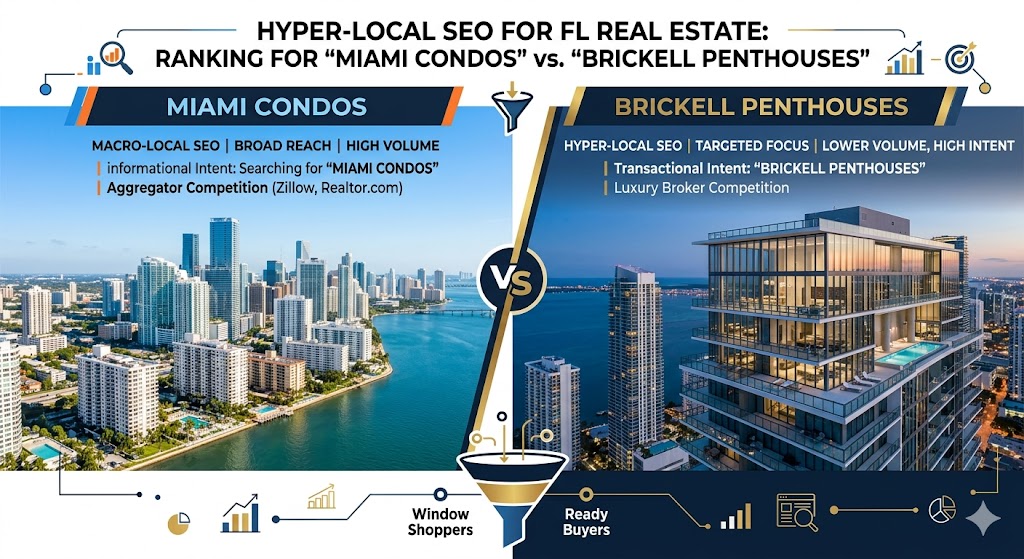
The Florida real estate market is one of the most dynamic, lucrative, and fiercely competitive digital landscapes in the world. As wealth migration continues to drive buyers from high-tax states to the sun-drenched coasts of South Florida, real estate professionals are locked in an aggressive battle for digital visibility. However, many brokerages and solo agents are wasting their marketing budgets fighting the wrong digital wars. They pour endless resources into ranking for massive, broad search terms, ignoring the surgical precision required to capture actual, ready-to-buy clients.
In the realm of Search Engine Optimization (SEO), traffic is a vanity metric; revenue is the only metric that matters. This is where the distinction between macro-local SEO and hyper-local SEO becomes the defining factor of a successful digital strategy. There is a profound psychological and strategic difference between a user searching for “Miami Condos” and a user searching for “Brickell Penthouses.” One is a digital window shopper; the other has their checkbook open.
This comprehensive guide will deconstruct the exact architecture, content strategies, and advanced technical frameworks required to dominate both ends of the search spectrum. By leveraging modern tactics like generative engine optimization, zero-click social strategies, and rigid internal linking structures, you can build an inescapable digital net that captures the highest-intent real estate buyers in Florida.
The Core Difference: Macro vs. Hyper-Local SEO in Real Estate
To build a high-performing real estate website, you must first understand the fundamental differences in keyword intent, competition, and conversion timelines between macro and hyper-local search terms.
The “Miami Condos” Strategy (Macro-Local)
A search term like “Miami Condos” represents a macro-local query. It possesses massive monthly search volume, often reaching into the tens of thousands of queries per month. The allure of this traffic is intoxicating for many real estate agents, but the reality of ranking for it is incredibly harsh. The competition is saturated with massive aggregators like Zillow, Realtor.com, and Redfin, platforms that possess domain authority scores you simply cannot compete with overnight.
Furthermore, the user intent behind “Miami Condos” is highly fragmented and predominantly informational. The searcher might be a college student looking for a cheap rental, a retiree exploring general downsizing options, or someone simply dreaming about a vacation home. The conversion rate for this keyword is notoriously low because the user is at the very beginning of their buyer journey. They do not know what neighborhood they want, what their exact budget is, or what amenities they require. Ranking for this term requires a long-term, high-authority strategy focused on comprehensive, overarching market guides.
The “Brickell Penthouses” Strategy (Hyper-Local)
Conversely, a search term like “Brickell Penthouses” is the epitome of hyper-local SEO. The monthly search volume is significantly lower, perhaps only a few hundred searches per month. However, this is where the actual money is made.
When a user searches for “Brickell Penthouses,” their intent is crystalline. They have already decided on the city (Miami), they have narrowed down the specific neighborhood (Brickell), they know the property type (Condo), and they have defined their luxury tier (Penthouse). This user has moved through the research phase and is squarely in the transactional phase. The competition for these terms is entirely different. You are no longer fighting national aggregators; you are competing against other local luxury brokers. By focusing your SEO efforts on hyper-local terms, you attract highly qualified leads with a fraction of the digital effort required for macro terms.
Decoding Search Intent in the Florida Market
Mastering real estate SEO requires looking beyond the keywords and understanding the psychology of the affluent buyer relocating to or upgrading within Florida. You must map your content directly to their cognitive state at every stage of the funnel.
Top-of-Funnel vs. Bottom-of-Funnel Buyers
Top-of-funnel buyers are driven by curiosity and general planning. They search for terms like “Is Miami a good place to live?” or “Florida property taxes vs New York.” Your macro-local content should capture these users by providing broad, authoritative answers that establish your brand as a trusted advisor.
Bottom-of-funnel buyers are driven by specific desires and immediate needs. They search for “Echo Brickell penthouses for sale” or “Aston Martin Residences floor plans.” Your hyper-local content must serve these exact needs instantly, providing high-resolution imagery, detailed building amenities, and seamless contact options. If your site structure forces a bottom-of-funnel buyer to sift through general Miami information to find Brickell floor plans, they will bounce to a competitor’s site.
The Shift Toward Zero-Click Content
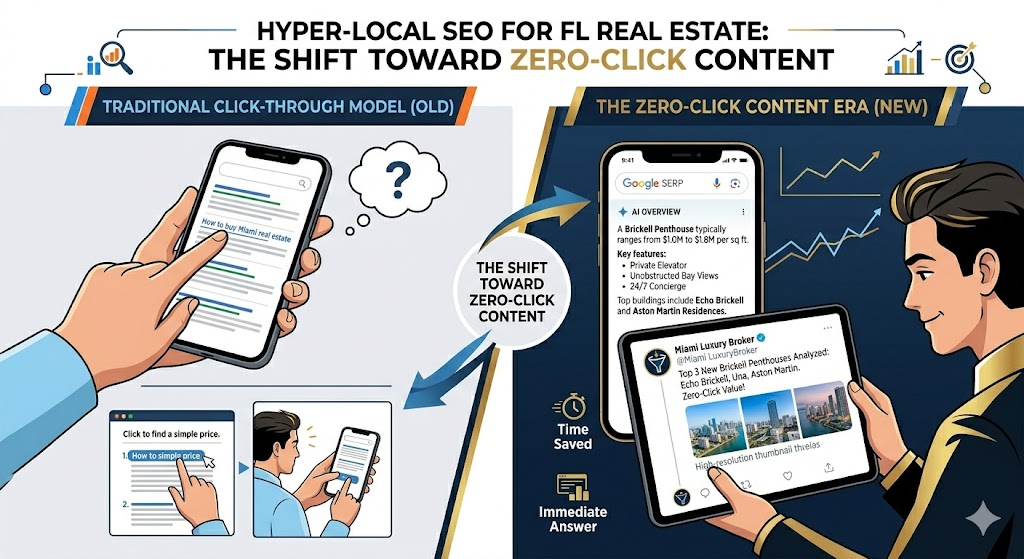
Search behavior is evolving rapidly. Before a high-net-worth individual ever types a query into Google, they are consuming content on platforms like LinkedIn and X. To truly dominate a market, you must implement a “Zero-Click” content strategy on these networks.
Zero-click content involves delivering immense, standalone value natively within the feed, without requiring the user to click a link to your website. For example, publishing a detailed thread on X breaking down the “Top 5 Upcoming Luxury Developments in Brickell” or sharing an in-depth analysis of Miami’s commercial vs. residential tax benefits on LinkedIn. By giving away the expertise for free within the feed, you build massive brand equity. When these users eventually move to a search engine to execute a transaction, they are highly likely to append your brand name to their query or click your result over a competitor because you have already established undeniable authority.
Architecting Your Site for Hyper-Local Dominance
The secret weapon of advanced SEO professionals is site architecture. You cannot simply throw a collection of blog posts and property listings onto a website and expect search engines to understand your expertise. You must explicitly design a structure that funnels authority exactly where you want it.
Building a Silo Internal Link Structure
To rank for highly specific terms like “Brickell Penthouses,” you must employ a rigid silo internal link structure. A silo is a method of grouping related content together to establish profound topical authority. Search engines reward websites that demonstrate deep, organized knowledge about a specific subject.
In the context of Florida real estate, your architecture should look like a pyramid. The top of the pyramid (the parent page) is your broad “Miami Real Estate” page. From there, you link down to your sub-neighborhood pages (the child pages), such as “Brickell Real Estate,” “Edgewater Real Estate,” and “Coconut Grove Real Estate.”
From the “Brickell Real Estate” page, you link further down to hyper-specific niche pages like “Brickell Condos,” “Brickell Penthouses,” and “Brickell Waterfront Properties.” Crucially, you must strictly control the internal links. Child pages should link up to their parent pages and sideways to their sibling pages, but they should not cross-link to unrelated silos. This ensures that the digital “link juice” flows predictably, signaling to search engines that your site is the ultimate, organized authority on Brickell properties.
Creating Neighborhood Content Hubs
Your neighborhood pages cannot be thin pages containing only an MLS feed. Search engines penalize “thin content.” A neighborhood hub must be a comprehensive resource that rivals a Wikipedia page.
A high-ranking Brickell hub should include the history of the neighborhood, demographics, a breakdown of the local lifestyle (restaurants, nightlife, parks), school ratings, and commuting times to major hubs like Miami International Airport or Downtown. By surrounding your property listings with rich, highly relevant contextual data, you prove to the search algorithms that your page is the most useful destination for anyone interested in that specific geographical polygon.
Advanced Content Strategies for Florida Realtors
With the foundation built, the content that populates your architecture must be engineered to satisfy both human buyers and evolving search algorithms.
Generative Engine Optimization (GEO) for Real Estate
The integration of Artificial Intelligence into search engines is fundamentally altering how users find information. Traditional SEO is rapidly making room for Generative Engine Optimization (GEO). When a user asks an AI like Gemini, “What are the best luxury condo buildings in Brickell for families?”, the AI does not just provide a list of blue links; it synthesizes an answer by reading multiple authoritative sources.
To ensure your real estate brand is cited in these AI-generated answers, you must write with absolute clarity, use definitive statements, and back up your claims with hard data (e.g., “The average price per square foot for a Brickell penthouse increased by 14% in 2025”). For a deeper understanding of this shift, explore comprehensive resources on Navigating Google’s New AI Overview for SEO. By structuring your content with clear, descriptive headers and factual density, you increase the likelihood of becoming the primary source for AI search surfaces.
Creating High-Converting Neighborhood Guides
When crafting your hyper-local guides, you must move beyond generic descriptions. Speak directly to the lifestyle and pain points of your target demographic. If you are writing about Brickell penthouses, focus on privacy, concierge services, private elevator access, and unobstructed Biscayne Bay views. Use high-quality, exclusive media. Original photography and video tours of the neighborhoods will keep users on your page longer, sending powerful positive engagement signals to search engines that your content is satisfying user intent.
Implementing FAQ Sections Without Code
A critical element of any hyper-local page is a Frequently Asked Questions (FAQ) section. Buyers always have specific, recurring questions. While many SEO guides recommend complex schema markup and backend coding to achieve rich snippets, it is entirely possible—and often more sustainable for manual content management—to rely strictly on plain text question-and-answer formatting.
Simply use an H3 header for the question and standard paragraph text for the answer.
What is the average HOA fee for a Brickell Penthouse?
HOA fees in Brickell luxury buildings typically range from $1.00 to $1.50 per square foot, covering amenities such as 24/7 security, valet parking, pool maintenance, and fitness center access.
Are Brickell condos pet-friendly?
The majority of high-end buildings in Brickell are incredibly pet-friendly, often featuring dedicated dog runs and pet grooming spas on-site, though some buildings impose weight restrictions.
By presenting these answers clearly, without relying on fragile backend code integrations, you ensure your content remains readable, easy to update, and perfectly accessible for search engine crawlers to index and understand.
Off-Page SEO: Building Hyper-Local Authority
Your on-page content and site architecture represent your digital resume, but your off-page SEO represents your professional references. To outrank established brokerages, you need external validation.
Quality Backlinks from Florida Digital Publications
Backlinks remain one of the most potent ranking factors. However, not all links are created equal. A link from a random, low-quality blog will do nothing for your rankings. You need highly relevant, hyper-local links.
For a Brickell real estate agent, securing a backlink from a Miami-based lifestyle magazine, a South Florida business journal, or a highly trafficked local events blog is incredibly powerful. You can achieve this by offering expert commentary on the Miami housing market to local journalists, sponsoring a major charity event in Brickell, or writing guest columns for regional publications. For a complete methodology on acquiring these vital assets, review strategies on How to Get High Quality Backlinks to increase SEO.
Leveraging Local Tools for Visibility
Local SEO is driven heavily by geographic relevance. Your Google Business Profile must be flawlessly optimized. Ensure your Name, Address, and Phone number (NAP) are consistent across every digital directory on the internet. Post regular updates, new listings, and client testimonials directly to your profile. Furthermore, there are numerous built-in ecosystem utilities you can utilize to monitor your local search health. Familiarizing yourself with 9 Free Google Tools for SEO Experts will give you the diagnostic edge needed to keep your local listings sharp and competitive.
Tracking, Measuring, and Refining Your SEO Engine
SEO is never a “set it and forget it” endeavor. It is a continuous loop of testing, measuring, and refining. You must treat your real estate website as a highly optimized sales engine.
E-commerce Parallels: What Realtors Can Learn
While real estate is a service-based industry dealing in high-ticket physical assets, the digital execution should closely mirror high-performance e-commerce strategies. Every property listing is a product page. Every neighborhood guide is a category page.
You must track user behavior relentlessly. Where do users drop off? What is the conversion rate of your contact forms on the Brickell Penthouse page versus the generic Miami Condos page? By adopting the rigorous conversion rate optimization mindsets used by digital retailers, you can drastically improve your lead generation. The parallels are striking; understanding Why Successful Shopify Stores Live and Breathe SEO can provide a fresh perspective on structuring your property listings for maximum search visibility and user conversion.
Conclusion
Dominating the Florida real estate market requires a shift from broad, ego-driven marketing to targeted, hyper-local precision. Ranking for “Miami Condos” might provide an impressive traffic chart, but ranking for “Brickell Penthouses” is what will actually build a lucrative real estate business.
By understanding the distinct differences in buyer intent, implementing a rigid silo architecture to channel authority, leveraging modern zero-click and generative search strategies, and aggressively pursuing local off-page authority, you can build an insurmountable digital moat. The modern real estate buyer is intelligent, fast-moving, and demanding. Your digital presence must not only meet them at the exact moment of their hyper-local search but must also provide such overwhelming value and clarity that choosing any other agent becomes entirely illogical.
Related Articles
- Is SEO Dead in 2026 with the rise of AI tools?
- Conquer the Web: Mastering Offsite SEO Strategies for 2025
- Internal linking: the backbone of SEO
- Why SEO Is Better Than Paid Ads for Moroccan Websites
- Is SEO Dead? The Truth About GEO and How to Optimize for AI Search in 2026