
 By
By 
The global skincare market is experiencing a massive shift, and the sun-care niche is at the epicenter of this transformation. Consumers are no longer just looking for protection from ultraviolet (UV) rays; they are demanding products that are safe for their skin and harmless to the environment. This shift is most pronounced in coastal regions, particularly Florida, where the preservation of marine ecosystems is both an environmental priority and an economic necessity.
For digital entrepreneurs, e-commerce brand builders, and dropshippers, the reef-safe sunscreen market represents a highly lucrative, scalable opportunity. However, penetrating this market requires more than just slapping a label on a bottle. It requires a deep understanding of cosmetic formulation, regional legislation, targeted e-commerce infrastructure, and high-performance digital marketing.
This comprehensive guide will walk you through the precise steps required to formulate, brand, and successfully sell reef-safe sunscreen specifically tailored to the Florida consumer base. From sourcing non-nano minerals to optimizing your storefront for conversions, we will cover the entire architecture of building a dominant sun-care brand.
Understanding the Florida Sun-Care Market
Before diving into formulation and web design, it is critical to understand the psychological and legal landscape of your target audience. Florida is not just any market; it is a region defined by its relationship with the sun and the ocean.
Legislation and Coral Reef Protection
Florida is home to the Florida Reef Tract, the only living coral barrier reef in the continental United States. Over the past decade, scientific studies have conclusively shown that certain chemical UV filters—most notably oxybenzone and octinoxate—cause coral bleaching, DNA damage to marine life, and the eventual death of reef ecosystems.
In response, local municipalities across Florida (such as Key West) have passed strict ordinances banning the sale of sunscreens containing these harmful chemicals. While state-level legislation often fluctuates, the consumer mandate is clear: Floridians want reef-safe alternatives. If your product does not meet these stringent environmental standards, you will be locked out of the market entirely.
The Consumer Mindset: Eco-Conscious and Sun-Savvy
The Florida shopper is highly educated regarding sun protection. They are looking for broad-spectrum protection (UVA and UVB), water resistance for ocean swimming, and clean ingredient lists. They are equally skeptical of “greenwashing”—the practice of making misleading claims about the environmental benefits of a product.
To succeed, your brand must offer radical transparency. Your marketing copy, internal linking architecture on your website, and social media presence must all work in harmony to educate the consumer while providing a seamless purchasing experience.
Formulating Reef-Safe Sunscreen: What You Need to Know
Creating a physical product in the cosmetic space requires a balance between safety, efficacy, and “cosmetic elegance” (how the product feels and looks on the skin). Whether you are working with a private label manufacturer or formulating in a lab, you must understand the science behind the lotion.
The “Toxic” List: Ingredients to Strictly Avoid
To legitimately market your sunscreen as “reef-safe” to the Florida demographic, your formulation must be 100% free of the following chemical UV filters:
- Oxybenzone: The most notorious coral-damaging chemical.
- Octinoxate: Highly toxic to aquatic environments.
- Octocrylene: Often found to degrade into toxic compounds.
- Homosalate: An endocrine disruptor that accumulates in marine life.
- Avobenzone: While sometimes considered safer than oxybenzone, it is a chemical filter that many eco-purists avoid.
Furthermore, avoid parabens, phthalates, and microplastics, which are equally detrimental to marine biomes.
The Golden Ingredients: Non-Nano Mineral Filters
Reef-safe sunscreens rely on physical (mineral) barriers rather than chemical absorbers. The only two FDA-approved mineral UV filters are:
- Zinc Oxide: Provides excellent broad-spectrum protection against both UVA and UVB rays. It is the gold standard for reef-safe formulations.
- Titanium Dioxide: Highly effective against UVB rays but offers slightly less UVA protection than zinc oxide. It is often combined with zinc for maximum efficacy.
The “Non-Nano” Requirement: For a mineral to be truly reef-safe, it must be “non-nano.” This means the mineral particles are larger than 100 nanometers. If the particles are smaller (nano-sized), they can be ingested by corals and marine life, causing internal damage. Your packaging and product descriptions must proudly highlight the use of non-nano zinc oxide.
Solving Cosmetic Elegance: Avoiding the White Cast
The biggest hurdle in selling mineral sunscreen is the dreaded “white cast”—the chalky residue left on the skin. Florida shoppers want to look good on the beach, not look like ghosts.
To solve this, modern formulations utilize sheer zinc technology, tinting (using iron oxides to blend with various skin tones), and high-quality carrier oils like squalane, jojoba oil, or aloe vera to improve spreadability. Emphasize these skin-nourishing, hydrating ingredients in your long-form content and product metadata.
Building the Brand: Identity, Storytelling, and Domain Strategy
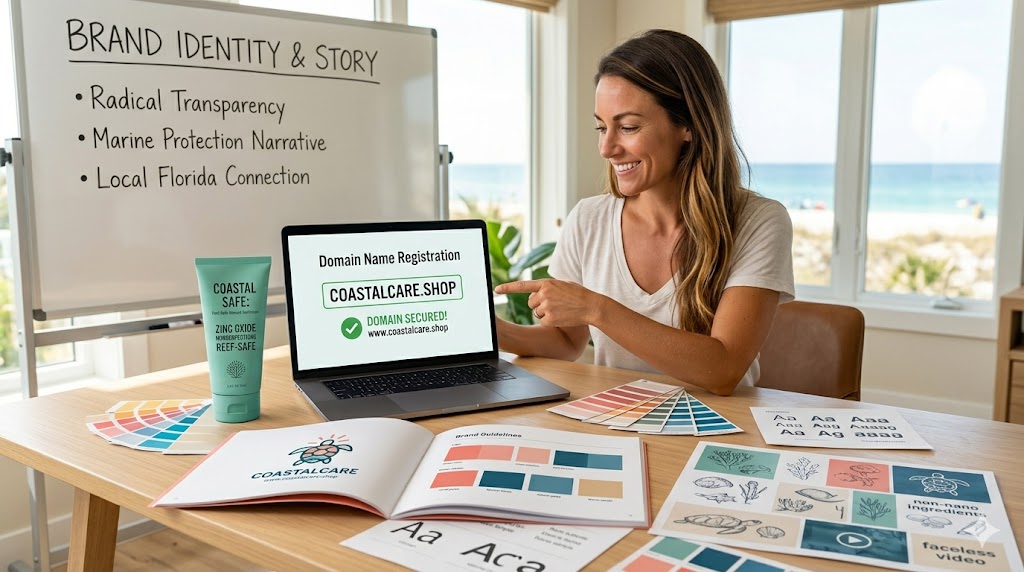
With a stellar formulation in hand, the next phase is packaging that formulation into a compelling digital brand. In the highly competitive e-commerce space, your brand identity is what justifies a premium price tag.
Securing the Right Domain and Brand Name
Your domain name is the foundation of your SEO strategy and brand recall. A confusing or lengthy URL will bleed conversions and hinder your organic search rankings. You need a name that evokes protection, nature, and the coastal lifestyle. Selecting the best domain names for SEO and a successful brand is a critical first step. Aim for a .com extension, keep it memorable, and ensure it aligns with the eco-friendly ethos of your target Florida demographic.
Aesthetics and Packaging
Florida beach culture is vibrant, energetic, and heavily visual. Your packaging should reflect this. Avoid clinical, pharmaceutical-looking designs unless your specific angle is dermatologist-approved medical protection. Instead, lean into modern minimalism, sustainable packaging materials (such as post-consumer recycled plastics or aluminum tubes), and clear, bold typography.
E-commerce Strategy: Setting Up Your Sun-Care Store
Your website is your ultimate digital asset. It is the endpoint of all your marketing efforts. If the user experience (UX) is poor, even the best SEO architecture will fail to generate revenue.
Choosing the Right Infrastructure
To scale a modern brand efficiently, you need a robust backend. Leveraging Shopify as an e-commerce dropshipping platform or for your direct-to-consumer (DTC) private label brand provides the exact scalability required. Shopify offers high-speed servers, seamless payment gateways, and the ability to handle spikes in traffic during peak summer seasons.
Storefront Design and Conversion Optimization
Your storefront must be engineered for conversions. This means lightning-fast load times, intuitive mobile navigation (as most Florida beachgoers will be browsing on their phones), and frictionless checkouts.
If web development is not your core competency, partnering with a professional Shopify design agency can ensure your site is built with technical SEO, dynamic layouts, and optimized backend performance in mind. A custom theme tailored to your brand’s specific aesthetic can dramatically increase click-through rates and decrease bounce rates.
Your product pages should include:
- High-resolution lifestyle imagery.
- Clear badges denoting “Reef-Safe,” “Non-Nano,” “Cruelty-Free,” and “Water Resistant.”
- A transparent, easy-to-read ingredient list.
- User-generated content (UGC) and customer reviews for social proof.
Content Marketing and SEO for Sun-Care Brands
In a niche as specific as “reef-safe sunscreen for Florida,” relying solely on paid ads is a fast track to depleting your budget. You need a sustainable, evergreen traffic source. This is where advanced Search Engine Optimization (SEO) and long-form content generation come into play.
Keyword Strategy and Long-Form Content Architecture
You must build a deep well of content that answers the exact questions your target audience is asking. Do not just target the keyword “reef-safe sunscreen.” Target long-tail, high-intent keyphrases:
- “Best reef-safe sunscreen for Florida Keys”
- “Does non-nano zinc oxide leave a white cast?”
- “Florida sunscreen ban 2026 explained”
For each of these topics, generate comprehensive, 2000+ word articles. Structure these articles with clear H2 and H3 tags, optimized slugs, and targeted meta descriptions.
Internal Linking and Technical SEO
A single blog post floating in the void will not rank. You must establish a strategic internal linking architecture. Create “pillar pages” (e.g., The Ultimate Guide to Marine-Safe Skincare) and build “cluster content” around them. Interlink these pages meticulously to pass link equity throughout your site. This web of internal links signals to search engine crawlers that your site is a massive topical authority on sun-care.
Ensure your metadata is crisp, your schema markup is appropriately tagged for products and articles, and your image alt-text describes the visual content naturally while integrating secondary keywords.
Building a “Faceless” Digital Brand on YouTube and TikTok
Video commerce is dominating the digital landscape. However, you do not necessarily need to be a charismatic influencer to leverage it. The “faceless channel” model is highly effective for product-led growth.
Utilize AI-generated voiceovers, high-quality B-roll footage of Florida beaches, and dynamic text overlays to create engaging, short-form content. Videos explaining “Why chemical sunscreen is killing coral reefs” or “The truth about the white cast” can easily go viral. Hook the viewer in the first three seconds, provide dense educational value, and direct them to the link in your bio. Combine this with AI-assisted video generation tools and automated posting schedules to dominate the feed without ever stepping in front of a camera.
Scaling the Business: High-Performance Execution
Transitioning from a side hustle to a high-revenue one-person operation requires relentless execution and a strict operational framework. You cannot afford to be distracted by vanity metrics or inefficient workflows.
Deep Work and Focus Mastery
Building a complex e-commerce ecosystem—sourcing products, managing a Shopify store, running SEO campaigns, and writing long-form content—requires extended periods of intense concentration. Adopting productivity frameworks like “Monk Mode” or Cal Newport’s “Deep Work” is essential. Block out digital noise, eliminate context-switching, and focus exclusively on high-leverage tasks: optimizing your conversion rate, refining your internal link web, and analyzing your search console data. Master your focus, and the revenue will follow.
Seeking Expert Consultation
When scaling an e-commerce brand, there comes a point where trial and error becomes too expensive. Knowing when to outsource or seek high-level strategic advice is a hallmark of successful entrepreneurship. Engaging an expert eCommerce consultation can provide you with actionable strategies to improve store speed, optimize your theme, and develop advanced marketing funnels that cut through the noise of the competitive sun-care market.
Conclusion
The intersection of e-commerce, environmental conservation, and skincare presents a unique and highly profitable opportunity. Selling reef-safe sunscreen to Florida shoppers is not just about moving inventory; it is about providing a solution to a highly educated, environmentally conscious demographic.
By focusing on clean non-nano mineral formulations, building a high-converting Shopify infrastructure, executing a rigorous long-form SEO strategy, and applying deep work principles to your daily operations, you can build a sustainable, scalable digital asset. The Florida sun-care market is waiting for a brand that combines aesthetic appeal with environmental integrity. With the right strategy, that brand can be yours.
Related Articles
- Shopify: E-commerce Dropshipping Platform
- Shopify Design Agency
- Best Domain Names for SEO and a Successful Brand
- Start a COD Business in Morocco | Step-by-Step 2026 Guide