
 By
By 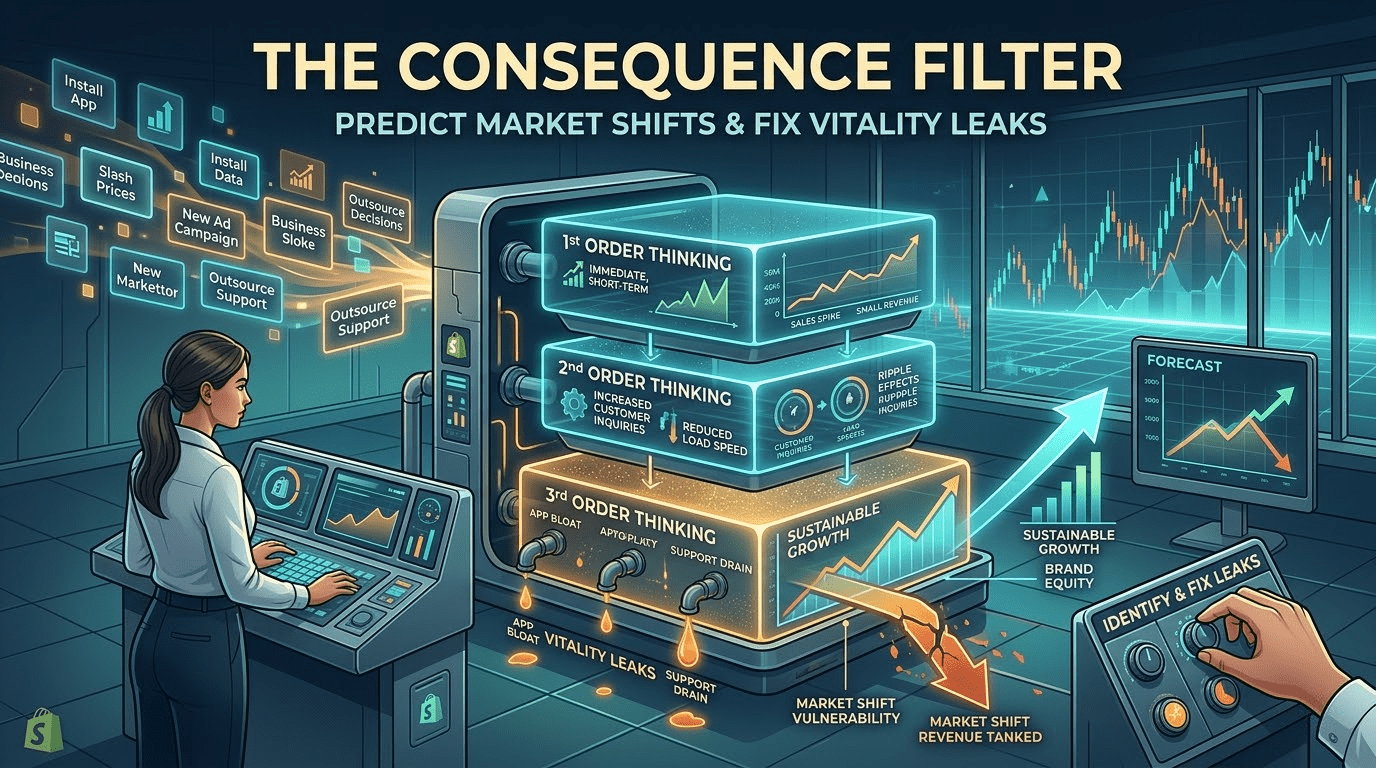
In the hyper-volatile digital economy of 2026, most e-commerce entrepreneurs are playing a game of reactive “Whac-A-Mole.” They react to a drop in Facebook ROAS by increasing spend. They react to a new competitor by slashing prices. They react to a Google algorithm update by panic-buying low-quality backlinks.
These are first-order reactions. They solve a symptom but often poison the well.
To survive and thrive as a solopreneur or high-ticket dropshipper, you must move beyond the immediate. You need The Consequence Filter. This framework utilizes third-order thinking to evaluate every business decision, allowing you to spot “Vitality Leaks”—hidden drains on your time, capital, and brand equity—before they manifest as a revenue crisis.
What is 3rd-Order Thinking in E-commerce?
Most people stop at the immediate result of an action. This is first-order thinking. It’s easy, fast, and usually wrong for long-term growth.
- 1st-Order Thinking: “If I install this app, my store will have a cool countdown timer.”
- 2nd-Order Thinking: “The app adds 2 seconds to my load time, which might lower my mobile conversion rate.”
- 3rd-Order Thinking: “The decreased site speed worsens my Core Web Vitals, leading to a loss in organic search rankings. This forces me to rely 100% on paid ads, making my business fragile to ad platform price hikes.”
By the time you reach the third level, you realize that the “cool countdown timer” is actually a Vitality Leak that could eventually bankrupt you.
When you apply the Consequence Filter, you aren’t just looking at what happens next; you are looking at the ripple effect. If you want to build a resilient empire, you must study The Sigma Architecture, which provides the structural foundation for this level of high-stakes decision-making.
Identifying “Vitality Leaks” in Your Daily Operations
A Vitality Leak is any process, tool, or habit that provides a short-term “hit” of progress while slowly eroding the long-term health of your business. For Shopify store owners, these leaks often hide in plain sight.
1. The App Bloat Leak
Every Shopify app you install adds a script to your header. While a “bundled products” app might increase AOV today, the cumulative drag on your site speed kills your SEO.
The Filter: Is this feature worth the potential 10% drop in organic traffic due to latency? Usually, the answer is no. This is why using a high-performance, all-in-one Shopify theme is critical—it replaces the need for dozens of heavy apps.
2. The High-Maintenance Customer Leak
Many high-ticket dropshippers focus solely on top-line revenue. They run aggressive, discount-heavy ads that attract “vampire customers”—those who demand 20 support emails and eventually file a chargeback.
The Filter: A $1,000 sale that costs $200 in customer support time and carries a 15% chargeback risk is actually a net loss in vitality.
3. The “Manual Labor” Trap
If you are still manually fulfilling orders or responding to basic tracking inquiries, you are leaking strategic energy. Your “vitality” as a founder should be spent on market analysis and offer engineering, not data entry.
The Filter: Every manual task is a failure of your system. You should aim for Zero-Employee Scaling by automating the execution layer entirely.
The Consequence Filter Reference Table
| Feature / Decision | 1st-Order Effect (The Hook) | 2nd-Order Effect (The Reality) | 3rd-Order Effect (The Consequence) |
| Aggressive Discounting | Immediate spike in sales volume. | Lower profit margins and “deal-seeker” audience. | Eroded brand authority; inability to sell at full price. |
| Outsourcing SEO to Cheap Agencies | Low upfront costs; “check the box” feeling. | Thin, AI-generated content that doesn’t convert. | Google penalty or “Generative Engine” exclusion; loss of trust. |
| Investing in a Premium Theme | Initial setup cost and learning curve. | Massive boost in site speed and mobile UX. | Compounding organic growth and higher exit valuation. |
| Switching to High-Ticket Only | Fewer sales notifications on your phone. | Higher barrier to entry for customers. | Higher margins, better suppliers, and more “deep work” time. |
How to Predict Market Shifts Before Your Competitors
Predicting a market shift isn’t about having a crystal ball; it’s about observing the 2nd-order signals that everyone else ignores. Here is how to use the Consequence Filter to stay ahead of the curve.
Analyze the “Ad Fatigue” Threshold
When CPMs (Cost Per Mille) rise across Meta and TikTok simultaneously, most store owners just “wait it out.”
The Filtered Prediction: Rising CPMs mean the “arbitrage” era is ending. The market is shifting toward Brand Equity and SEO. If you don’t start building an organic moat now, your customer acquisition cost (CAC) will eventually exceed your Life-Time Value (LTV).
Monitor the Rise of Generative Engine Optimization (GEO)
Search is changing. Users aren’t just clicking links; they are asking AI for recommendations.
The Filtered Prediction: Standard SEO is no longer enough. You need to ensure your brand is cited in AI models (ChatGPT, Perplexity, Gemini). Failure to adapt to GEO means you will become “invisible” to the next generation of shoppers who use AI assistants to find products.
Watch the “Privacy Debt”
With the death of cookies and increasing privacy regulations, tracking is becoming harder.
The Filtered Prediction: First-party data (email, SMS) is now the only truly “owned” asset. Businesses that rely solely on pixel-tracking will see their ROAS tank as the tech debt of privacy catches up with the industry.

Don’t let distraction hold you back.
[Click Here to Get Your Copy on Amazon Now]
Implementing the “Strategic Pause”
To apply the Consequence Filter effectively, you must implement what I call the Strategic Pause. Before making any significant change to your store—be it a price change, a new marketing channel, or a software integration—ask yourself three questions:
- What does this solve immediately? (1st Order)
- What does this require of me/my system in 3 months? (2nd Order)
- If I do this 1,000 times, where does it lead the brand? (3rd Order)
If the 3rd-order answer involves “lower margins,” “more manual work,” or “dependency on a single platform,” do not do it.
Case Study: The High-Ticket Transition
Imagine a dropshipper selling $30 phone cases.
- 1st Order: High volume, “fun” to see the sales.
- 2nd Order: Constant customer support, low margins, high ad spend.
- 3rd Order: Burnout, zero brand equity, and high risk of account bans.
Now, apply the Filter and shift to $2,000 home saunas.
- 1st Order: Lower sales volume, high anxiety over individual sales.
- 2nd Order: High margins ($500+ profit per sale), professional supplier relationships.
- 3rd Order: A lean, automated business that requires 5 sales a week to generate $10k profit. This provides the “Vitality” needed to reinvest in long-term SEO and GEO dominance.
Frequently Asked Questions
What is the biggest Vitality Leak for Shopify owners?
The biggest leak is usually App Bloat. Store owners install multiple apps for rewards, bundles, and pop-ups, not realizing that each app degrades the user experience and SEO. Switching to a high-performance theme like Scrowp can often replace 10+ apps, instantly plugging this leak.
How do I start practicing 3rd-order thinking?
Start by “mapping the ripple.” For every decision, draw three circles. Label them 1, 2, and 3. Force yourself to write down at least two negative consequences for the third circle, even for “good” decisions. This builds the mental muscle of skepticism.
Is SEO still relevant with the rise of AI?
Absolutely, but it has evolved. You now need SEO + GEO. Traditional search is for “discovery,” while Generative Engine Optimization ensures AI agents recommend your specific products. Organic traffic remains the only way to escape the “Ad Spend Trap.”
Can a solopreneur really predict market shifts?
Yes, because solopreneurs are more agile. By watching the 2nd-order effects of platform changes (like Google’s “Search Generative Experience”), you can pivot your content strategy months before a large corporation can even schedule a meeting to discuss it.
Read Next: Build Your Topical Authority
- The Sigma Architecture: Engineering High-Level Success
- Zero-Employee Scaling: The $1M Tech Stack for Solopreneurs
- Why a Premium Shopify Theme is Your Ultimate Sales Accelerator
- The Power of Internal Linking: The Hidden Engine of High Rankings
- How to Grow Any Business Faster: 10 Proven Scaling Strategies