
 By
By 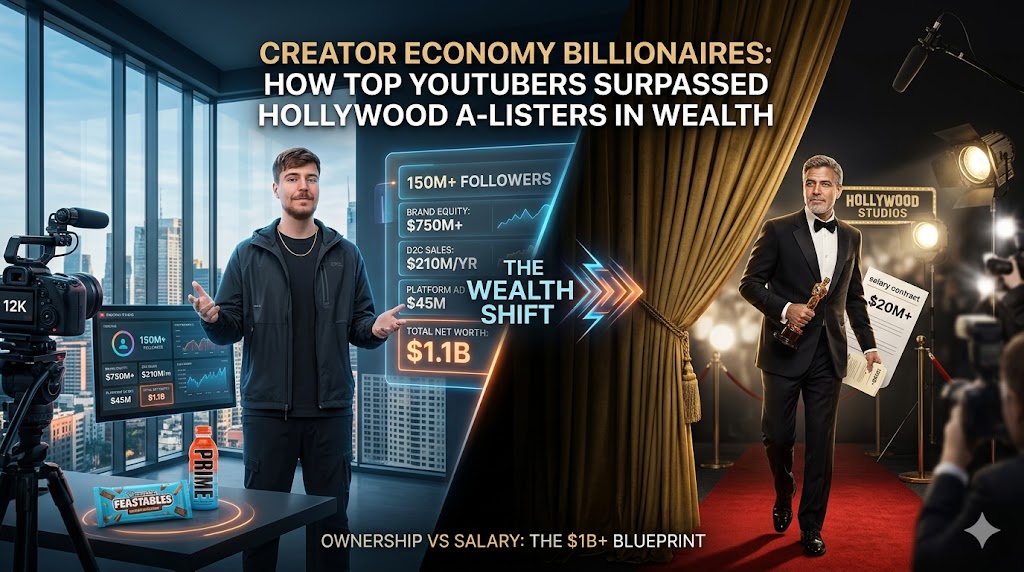
The red carpet is no longer the ultimate symbol of wealth in the entertainment industry. In 2026, the real moguls are wearing hoodies, staring into ring lights, and broadcasting directly to billions of screens worldwide. The era of the “Creator Economy Billionaire” has officially arrived, fundamentally disrupting everything we thought we knew about fame, influence, and net worth.
For decades, the path to astronomical wealth in entertainment was strictly gated. You needed an agent, a casting director, a studio executive, and a massive marketing budget to become a household name. Traditional Hollywood A-listers waited months—sometimes years—for a studio to greenlight a project. Today, top YouTubers and digital creators are leveraging direct audience access, hyper-agile production cycles, and diversified portfolios to build unprecedented financial empires.
They have stopped acting as mere talent and started acting as global media conglomerates. By completely bypassing the traditional Hollywood gatekeepers, digital creators have unlocked revenue streams that outpace the biggest box office stars. This article will break down exactly how the creator economy evolved, the specific business models driving this monumental wealth shift, and the actionable strategies you can use to build your own digital empire.
The Financial Shift: Box Office Points vs. The Creator Economy Ecosystem
To understand how a YouTuber playing video games or performing stunts can out-earn an Oscar-winning actor, you have to look at the underlying math of the entertainment business. The legacy model of Hollywood wealth is highly inefficient and heavily taxed by middlemen.
When a traditional A-lister stars in a blockbuster movie, their highly publicized $20 million salary is rarely what ends up in their bank account. That upfront fee is immediately diluted. Agents take 10%, managers take 10%, lawyers take 5%, and publicists command massive monthly retainers. Furthermore, unless an actor secures “first-dollar gross” on the back end—a rarity reserved only for the absolute top tier of stars—they are subject to the notoriously creative accounting of Hollywood studios, often resulting in zero backend profits.
Conversely, the creator economy operates on a model of high margins, high equity, and direct-to-consumer monetization. A top YouTuber retains total ownership of their intellectual property (IP). When they launch a video, the revenue generated from programmatic ads, direct brand integrations, and affiliate links flows directly into their own holding companies.
Quick Reference: Hollywood vs. Creator Wealth Models
| Revenue Factor | Traditional Hollywood A-Lister | Creator Economy Billionaire |
| Primary Revenue | Upfront Studio Fees & Box Office Points | AdSense, Direct Brand Deals, Owned Products |
| Asset Ownership | Studios own 100% of the IP | Creator owns 100% of the IP and Distribution |
| Product Endorsements | Fixed-Fee Endorsement Contracts | Owned CPG Brands (Equity & Profit Margins) |
| Speed to Market | 2-3 Years (Pre/Post Production) | 24-48 Hours (Ideation to Monetization) |
| Audience Relationship | Mediated through PR and Press Junkets | Direct, Daily, Unfiltered Parasocial Connection |
Why the Studio System is Losing to Independent Creators
The legacy studio system relies on massive overhead. A standard blockbuster requires hundreds of millions in production budgets and equally massive global marketing campaigns just to break even. This forces studios to take fewer risks, relying heavily on established franchises and safe, homogenized content.
Independent creators, however, operate with hyper-agility. They possess a direct, unfiltered connection to their audience and can pivot their content strategy overnight based on real-time data. When you are exploring top money-making YouTube channels, you quickly realize that their true power lies in audience trust and retention, not just temporary viral spikes. A creator can test a concept on Monday, film on Tuesday, publish on Wednesday, and see a positive return on investment by Thursday. Hollywood simply cannot compete with this iterative speed.
The Anatomy of a Creator Billionaire’s Empire: Beyond AdSense
The biggest misconception about creator wealth is that it stems entirely from YouTube AdSense. While ad revenue provides incredible cash flow, no one becomes a billionaire strictly from pre-roll ads. To surpass traditional celebrities in wealth, top YouTubers build massive, multi-channel ecosystems. Their strategy involves turning attention into a proprietary asset.
1. Consumer Packaged Goods (CPG) Dominance
The most significant wealth-building shift in the creator economy happened when YouTubers stopped promoting other people’s products for a flat fee and started building their own. By converting loyal viewers into retail consumers, creators bypass the single largest expense for any new brand: customer acquisition cost (CAC).
Traditional brands spend millions on television and digital ads just to get you to recognize their logo. A top creator simply holds up a chocolate bar, a hydration drink, or a specialized apparel line in a video, instantly driving millions of highly qualified leads to a checkout page. This built-in distribution allows creator-led brands to secure premium retail shelf space in major supermarkets almost instantly.
2. Automated Workflows and AI Scaling
Top creators are essentially cutting-edge tech companies. They do not rely on brute force; they rely on leverage. Today’s digital moguls use generative artificial intelligence for rapid thumbnail generation, algorithmic script outlining, and multi-language dubbing. By dubbing a single video into Spanish, Hindi, and Japanese using AI voice cloning, a creator instantly quadruples their total addressable market without shooting a single frame of new footage. If you want to scale your content output and drastically lower your production costs, you must learn how to use AI videos to make money online while maintaining high-quality storytelling.
3. Venture Capital and Tech Investments
Instead of merely accepting brand deals, top creators are now acting as venture capitalists. When a massive tech startup wants access to a YouTuber’s audience, the creator no longer asks for a $100,000 flat fee. They ask for a $50,000 fee plus advisory shares or equity in the company. By leveraging their influence as an investment vehicle, creators capture the massive upside of a company’s growth, leading to multi-million dollar payouts when those startups eventually go public or are acquired.
Read also :How to Do Shopify SEO & GEO Faster Using AI — Meet My Accio Work AI Agent
The Structural Advantages of Digital Creators Over Traditional Celebrities
Why is a teenager more likely to buy a burger from a YouTuber than a cologne from an Oscar-winning actor? The answer lies in the structural dynamics of digital media.
- Unfiltered Data and Analytics: Hollywood tests movies in limited focus groups. Creators test content in real-time with millions of data points. A YouTuber can A/B test a video’s title and thumbnail in the first hour of uploading. If the click-through rate (CTR) is low, they change it instantly. They analyze audience retention graphs second-by-second to understand exactly when a viewer gets bored. This quantitative approach to entertainment ensures a much higher success rate than Hollywood’s reliance on “gut feeling.”
- Authentic Parasocial Relationships: Traditional celebrities are distant, highly curated, and protected by layers of public relations management. Their mystique is their brand. Creators, conversely, build their brands on accessibility and authenticity. They speak directly to the camera, share their failures, vlog from their messy bedrooms, and respond to comments. This creates a “parasocial relationship”—a psychological bond where the viewer feels a genuine friendship with the creator. When a friend recommends a product, you buy it. When an untouchable celebrity holds a product on a billboard, you ignore it.
- The Power of the Back Catalog: When a movie leaves theaters, its primary earning window is over. For a YouTuber, a video published five years ago can still generate thousands of dollars a month in passive AdSense revenue. This “evergreen” back catalog acts as a digital real estate portfolio, compounding in value as the channel grows and new subscribers binge-watch older content.
The Strategy to Build Your Own Creator Empire in 2026
You do not need millions of subscribers or a Hollywood-sized budget to apply the exact same frameworks used by the digital elite. The mechanics of the creator economy are highly replicable if you approach content creation as a scalable business rather than a hobby. Here is the blueprint for building your own digital empire.
Step 1: Dominate a Micro-Niche and Build an Audience
Do not attempt to be a general entertainer or a lifestyle vlogger; those markets are saturated by legacy creators. Instead, become the absolute authority on one highly specific, high-value topic. Whether it is B2B SaaS marketing, high-ticket real estate SEO, or AI automation for accountants, focus entirely on solving specific problems for a specific demographic. A highly engaged audience of 10,000 industry professionals is infinitely more profitable than a passive audience of 1,000,000 random scrollers.
Step 2: Diversify Off-Platform Quickly
The biggest risk in the creator economy is “platform risk”—the danger of having your entire business wiped out by a sudden algorithm change or account suspension. You must view social media platforms strictly as top-of-funnel lead generators. The moment you capture attention on YouTube, X, or LinkedIn, immediately funnel that audience to assets you own. Build a robust email list, launch a private Discord community, and direct traffic to your own optimized website.
Step 3: Master Cross-Platform SEO
Search behavior has fundamentally changed. Users are no longer just typing queries into Google; they are searching directly on TikTok, YouTube, and native social platforms. To build long-term equity, your content must be discoverable long after the initial algorithmic push fades. If you implement an ultimate SEO guide to rank TikToks and YouTube Shorts, you can drive passive, highly targeted organic traffic to your digital storefronts for years. Optimize your video titles, descriptions, and on-screen text with high-intent keywords to capture search-driven viewers.
Step 4: Productize Your Expertise
Stop trading your time for money. Once you have established an audience and captured their attention, you must build high-margin digital products. This could be a premium cohort-based course, a paid mastermind community, or a specialized micro-SaaS tool. By creating a product once and selling it infinitely, you decouple your income from the hours you work, unlocking true financial scale.
Leveraging Systems Over Hustle
The transition from a burnt-out content creator to a highly profitable media CEO requires a fundamental shift in mindset. You must replace manual labor with automated systems. “Hustle culture” is a recipe for creative burnout; systemization is the blueprint for longevity. Document every step of your production process—from keyword research to final editing—and build standard operating procedures (SOPs). Delegate routine tasks to specialized freelance teams or integrate AI tools to handle repetitive data analysis. Your primary job is to focus on high-level strategy, relationship building, and product development, not meticulously adjusting audio levels on a timeline.
Conclusion: The Future of Entertainment is Independent
The tipping point has officially been reached. Top YouTubers have surpassed traditional Hollywood A-listers in wealth because they recognized early on that attention is the most valuable currency in the modern economy. They stopped acting as expendable talent and started operating as vertically integrated media networks.
The creator economy is no longer a stepping stone to mainstream media; it is the mainstream media. The barriers to entry have been entirely dismantled. Armed with a smartphone, an internet connection, and a deep understanding of audience psychology, anyone can build a digital empire. To succeed in this new landscape, you must focus relentlessly on owning your audience, diversifying your income streams beyond platform payouts, and building long-term equity over fleeting algorithmic fame. The tools are available, the playbook is public, and the next wave of digital billionaires is already building.
Read Next
Expand your knowledge and continue building your digital ecosystem with these highly relevant guides:
- 30 AI Side Hustles You Can Start With $0 in 2026 (Beginner-Friendly Guide)
- Accio Review: Alibaba’s AI Business Agent for E-commerce
- How to Hire Your First AI Agent for Email & Calendar Management
- The Visual Revolution: How to Use AI Videos to Make Money Online