 By
By 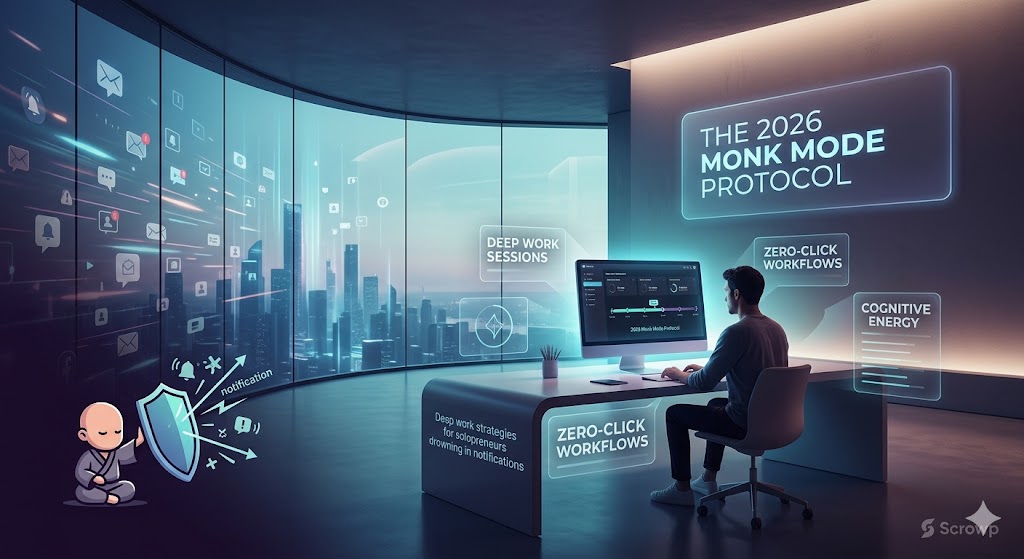
We are living in an era of unprecedented digital leverage. A single individual with an internet connection can now build a highly profitable design agency, run a network of faceless YouTube channels, or manage a flourishing e-commerce ecosystem. However, this immense power comes with a crippling side effect: the constant, deafening roar of notifications. Slack messages, subreddit mentions, client emails, and algorithm alerts are constantly fighting for the most valuable resource you possess—your attention.
For the modern solopreneur, the line between productive work and digital distraction has been entirely blurred. You sit down to outline a comprehensive SEO strategy, but a quick glance at an email derails your morning. You attempt to write an eBook, but a notification pulls you into a trivial debate on social media.
To build a six-figure business without a sprawling team of employees, relying on sheer willpower is no longer enough. You need a system. Enter the 2026 “Monk Mode” Protocol—a ruthless, highly structured approach to deep work designed specifically for the modern digital entrepreneur. It is about actively engineering an environment where absolute focus is not just possible, but inevitable.
What is the 2026 Monk Mode Protocol?
The Evolution of Deep Work
The concept of “Deep Work,” originally popularized by productivity experts like Cal Newport, focuses on the ability to perform in a state of distraction-free concentration that pushes your cognitive capabilities to their limit. By 2026, the digital landscape has evolved, and the demands on a solo operator’s attention have multiplied.
The Monk Mode Protocol is the evolution of deep work. It is a predefined period of time—ranging from a few hours a day to an entire fiscal quarter—where you enter complete digital isolation to achieve a monumental task. It means intentionally disconnecting from the reactive web to engage in the proactive creation of value.
Why Solo-Operated Agencies Need Extreme Focus
When you are running a one-person design or marketing agency, your output is directly tied to your revenue. You cannot afford to lose an hour to scrolling when that hour could be spent securing a high-ticket client or optimizing a digital storefront. Scaling to six figures without the safety net of employees requires you to perform at the highest possible level of cognitive efficiency.
Creating a masterpiece takes time, patience, and uninterrupted thought. Consider the pacing of classic Nepali cinema—whether it’s the raw emotion captured in Chino or the sweeping, deliberate narratives of Prem Geet 3. True impact requires a slow, intentional buildup, not rapid-fire jump cuts. Your business requires the exact same level of cinematic patience and dedicated focus.
The Notification Epidemic: Why We Are Drowning
The High Cost of Context Switching
In the digital economy, context switching is the silent killer of profitability. Context switching occurs when you shift your brain from one complex task to an entirely different one. For instance, transitioning from designing high-converting Shopify graphics to moderating a passionate community like r/shopify_geeks, and then immediately trying to code a backend solution.
Every time you switch contexts, your brain incurs a cognitive penalty. It takes an average of 23 minutes to fully regain deep concentration after a single interruption. If your phone buzzes three times an hour, you are never actually working at full capacity; you are simply treading water in a sea of shallow tasks.
The Myth of Multitasking
Many entrepreneurs pride themselves on multitasking, believing that juggling five tabs makes them productive. Scientifically, the human brain cannot focus on two high-level cognitive tasks simultaneously. It merely rapidly switches back and forth, degrading the quality of both. To build specialized, high-tier products—whether that is a comprehensive SEO package or a niche ecosystem around reef-safe sun-care—multitasking will only lead to burnout and mediocre results.
Core Pillars of the 2026 Monk Mode Protocol
Pillar 1: Total Digital Isolation and Zero-Click Workflows
The first pillar of the protocol requires severing the cord to the reactive internet. When you enter Monk Mode, your phone goes into a different room, your desktop notifications are disabled, and your internet browser is restricted to essential tabs only.
This is also where “zero-click” content strategies shine. Instead of constantly reacting to algorithm changes, focus your deep work blocks on creating high-value, evergreen content that answers user intent directly on the search page. Zero-click workflows allow you to produce comprehensive assets that serve your audience without requiring you to constantly monitor analytics dashboards.
Pillar 2: AI Automation for the Heavy Lifting
True Monk Mode is about focusing only on the tasks that require genuine human creativity and strategic thought. In 2026, solopreneurs must leverage AI to clear the brush.
Use AI tools to handle the mundane and the repetitive. Whether it’s generating featured images, drafting YouTube thumbnails, analyzing legal reviews, or creating the foundational outlines for 2000-word SEO articles, automation acts as your digital employee. By offloading these tasks, you protect your limited cognitive energy for the actual writing, the high-level design, and the strategic direction of your agency.
Pillar 3: Purpose-Built Environmental Engineering
Your physical environment dictates your mental state. If your workspace is cluttered and chaotic, your mind will be too. Environmental engineering means designing a space that triggers immediate focus.
Whether you are working from a high-rise office or a quiet workspace in Chandrapur, Madhesh Province, your environment must signal to your brain that it is time to work. Think of it like crafting a delicate batch of specialty vegan ice cream—it requires the perfect temperature, the right tools, and zero outside contamination to achieve the perfect consistency. Your workspace needs that same level of precise, curated control.
Implementing Monk Mode in Your Daily Routine
Designing the 4-Hour Deep Work Block
The human brain is comparable to modern mobile hardware. If you are tracking the benchmark tests between a Snapdragon and a Bionic chipset on an iPhone 17 or a Samsung S25 Ultra, you know that sustained peak performance requires excellent thermal management. Run them too hot for too long, and they throttle.
Your brain operates the same way. You cannot sustain Monk Mode for 12 hours a day. The most successful solopreneurs implement a strict 4-hour deep work block, usually first thing in the morning.
- Preparation: Brew your coffee, close all irrelevant tabs, and open only the software required for the task.
- Isolation: Put your phone in a drawer. Use website blockers to restrict access to Reddit, social media, and news sites.
- Execution: Work in 90-minute sprints with 15-minute breaks. During breaks, do not look at a screen. Stretch, walk, or look out a window.
Managing Client Expectations Across Platforms
A common fear among solo-operated agencies is that going offline for four hours will alienate clients. The solution is asynchronous communication and expectation management.
Clearly state your communication hours in your onboarding documents and email signatures. Let your clients know that you prioritize deep, focused execution over instant replies because that is what delivers results. Batch your community management—such as answering questions or fostering engagement—into a dedicated 30-minute block in the late afternoon.
Monk Mode for Specific E-commerce and Content Niches
Scaling a High-Ticket Content Ecosystem
Building an authoritative presence in high-ticket niches requires incredibly deep research. Suppose you are building a content cluster around the $10B smart sleep technology market. You cannot write authoritative, medically accurate, and persuasive copy while simultaneously checking text messages.
Monk mode allows you to dive deeply into consumer pain points, technical specifications, and market gaps. This level of focus is what separates a low-effort affiliate blog from a six-figure media asset.
Building an Unshakable SEO Foundation
For e-commerce agencies, SEO is not a quick hack; it is a long-term architectural project. It requires auditing technical structures, mapping out internal links, and executing on-page optimization. By investing in professional search engine optimization techniques, you realize that driving organic revenue requires hours of uninterrupted data analysis. Applying Monk Mode to your SEO audits ensures that no broken link or missing meta tag slips through the cracks.
The Psychology of Sustained Focus
Treating Attention Like a Strategic Game
Maintaining focus in a world designed to distract you requires a gamified mindset. It requires the same strategic foresight and resource management as surviving the endless, unpredictable aisles of Roblox’s SCP-3008, or mastering the hyper-competitive meta hero builds in Season 40 of Mobile Legends: Bang Bang.
You must view your attention as a health bar. Every notification is a hit that drains your energy. Every hour of Monk Mode is a strategic level-up. By treating your focus as a finite, heavily guarded resource, you become highly protective of who and what gets access to it.
Embracing Boredom to Fuel Creativity
We have lost the ability to be bored. The moment we feel a lull in stimulation, we reach for our phones. However, boredom is the crucible of creativity. When you restrict your dopamine inputs during Monk Mode, your brain is forced to generate its own stimulation. This is where breakthrough ideas for marketing campaigns, innovative graphic designs, and unique business models are born. Stop running from the quiet; learn to weaponize it.
Tools and Technical Frameworks to Protect Your Time
Infrastructure That Doesn’t Break
One of the fastest ways to get pulled out of Monk Mode is dealing with broken website code, server crashes, or plugin conflicts. To maintain focus, you must build your digital assets on reliable infrastructure that requires minimal maintenance.
If you are running an online store, utilizing SEO-friendly Shopify themes ensures that your technical foundation is solid right out of the box. You do not want to spend your valuable deep work hours troubleshooting layout shifts or poor mobile responsiveness. As industry data consistently shows, successful Shopify stores live and breathe SEO because their founders spend their time optimizing strategy, not fixing broken code.
Asynchronous Communication Tools
Move your clients away from instant messaging platforms like WhatsApp or Slack and push them toward asynchronous tools like email, Trello, or specialized client portals. Train your clients to expect comprehensive, batched updates rather than a constant drip of fragmented communication. This protects your time and provides a more professional, documented experience for the client.
Conclusion: Embracing the Quiet
The 2026 digital landscape is noisy, chaotic, and relentlessly demanding. As a solopreneur, your ultimate competitive advantage is not your software stack, your geographic location, or your ad budget—it is your ability to focus deeply on a single, meaningful task until it is complete.
The Monk Mode Protocol is not about punishing yourself; it is about respecting your craft. By embracing digital isolation, leveraging automation, and fiercely protecting your cognitive energy, you can escape the shallow waters of notification overload. Step away from the noise, lock in your focus, and start building the six-figure business you are capable of creating.
Related Articles
- The Secret to Online Success Starts With the Perfect Domain Name
- Shopify Store Design for SEO & Conversions: The Complete Guide to Ranking Higher and Selling More
- How to Rank Your TikToks and YouTube Shorts on Google’s Front Page: A Complete SEO Guide
- How Myntra Increased Its Revenue By 187% Via SEO